
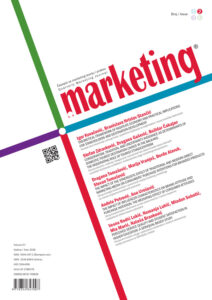
Issue 2, Volume 57, Year 2026 of the scientific journal Marketing contains, in addition to the Editorial, four original research papers and one review paper.
The contributions address a diverse range of contemporary marketing topics, including the impact of the nightlife economy on destination image, consumer ethnocentrism in the context of tourist destination choice, the synergistic effects of traditional and digital direct marketing media, as well as the effects of influencer characteristics on attitudes and intentions regarding brand choice. The final paper examines the application of the SERVQUAL model in higher education.
Igor Kovačević and Branislava Hristov Stančić in their paper highlight the indispensable role of nightlife experiences in destination development. The authors argue that nightlife, as an important driver of social and personal development, significantly contributes to the growth of creative industries within local communities and generates substantial economic effects for tourist destinations. Accordingly, destination development strategies should carefully incorporate all relevant dimensions of nightlife. This insightful study provides a valuable theoretical foundation for future empirical research on destination success factors viewed through the lens of nightlife economy. The study conducted by Stefan Zdravković, Dragana Gašević, and Božidar Čakajac builds upon the previously described paper, as it addresses the influence of conservatism, tradition, and uncertainty avoidance on the choice of domestic tourist destinations. Drawing on a sample of respondents from Serbia, Croatia, and Bosnia and Herzegovina, the authors employ structural equation modeling to propose and test a novel model of domestic destination choice, with particular emphasis on the moderating role of tourism ethnocentrism.
U studiji koju su sproveli Dragana Tomašević, Marija Vranješ, Đorđe Alavuk, and Stefan Tomašević investigate the synergistic effects of traditional and digital direct marketing media on consumers’ purchase intentions for branded products. Their research encompasses four digital media channels (websites, email marketing, mobile marketing, and social media) and three traditional channels (television, radio, and print media). The proposed research framework includes twelve models designed to test both main and interaction effects. A different perspective on social media marketing is offered by Anđela Petrović and Ana Urošević. , whose study explores the effects of influencer characteristics on brand attitudes and purchase intentions. Particular attention is devoted to the mediating role of attitudes in the relationship between influencer attractiveness and followers’ purchase intentions.
The concluding paper in this issue focuses on service quality measurement through the application of the SERVQUAL model in higher education. Vesna Rodić Lukić, Nemanja Lukić, Mladen Subotić, Mia Marić, and Nataša Branković examine the influence of five service quality dimensions on student satisfaction. Using three multiple regression analyses, the authors analyze the relationships between expectations, perceived performance, gap scores, and student satisfaction. Their findings reaffirm the enduring relevance of the SERVQUAL framework in evaluating higher education service quality.
Veljko Marinković
Editor-in-Chief