
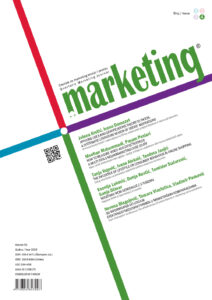
Issue 4 Volume 56 Year 2025 The scientific journal Marketing contains, in addition to the Editorial, five original scientific papers and a thank you to the reviewers. I believe that the diverse topics of the scientific papers published in this issue will attract significant attention from readers.
The papers cover very interesting areas of contemporary marketing, from marketing communications and social media marketing, through research into consumer lifestyles and their willingness to share their dissatisfaction with the quality of tourist services, right up to the application of new machine learning methods in market research.
In their academic study, Jelena Krstić and Ivana Domazet provide a systematic review of the literature based on the Uses and Gratifications Theory (UGT).. The purpose of the paper is to identify the key motives for using the TikTok platform. The PRISMA methodological framework was used in the paper, and the initial set of 50 scientific papers selected from the Web of Science database was thus narrowed down to the 25 most relevant papers that address the application of the Theory of Use and Satisfaction in explaining the key motives for using the TikTok platform. The findings of the conducted study indicate ten dominant clusters of user satisfactions when it comes to the use of the TikTok Platform.
Modern market research is characterised by a trend of digitalisation, which contributes to the increasing use of online surveys and focus groups for both quantitative and qualitative consumer research. Also, the use of scanners to track changes in the stock levels of various product groups in retail outlets is also noticeable. Additionally, neuromarketing and eye-tracking are among the most cutting-edge techniques used in market research. In this context, the authors Moohan Mohammadi and Payam Paslari apply contemporary machine learning techniques in their study to measure the effectiveness of video advertisements. The following neurophysiological methods were used to collect primary data: electroencephalography, eye tracking and NIR spectroscopy. The data were then analysed using machine learning algorithms. Specifically, the k-nearest neighbour algorithm, the support vector machine method, decision trees and neural networks were used in the study. Based on the results of the analysis, the authors compare the effectiveness of the aforementioned techniques in tracking video advertisements.
The application of psychographic analysis in marketing has long attracted the attention of authors and experts. Consumer segmentation based on lifestyle has proven to be an important prerequisite for positioning products in target market segments. Linking lifestyle with consumers' purchasing habits and preferences provides businesses with useful guidance in their efforts to develop long-term relationships with consumers. Tanja Vujović, Ivana Aleksić and Teodora Janjić conducted an interesting study in which they tested the relationship between different lifestyles and different types of decision-making.
In addition to the above, the paper examines how different lifestyles and decision-making types influence the frequency of online purchases. The findings of the research provide useful practical implications for creating a marketing strategy for products marketed through online sales channels.
Word-of-mouth (WOM) communication is considered a highly credible source of information, and consumers typically have a high degree of trust in the recommendations and negative comments about brands that are passed on by other consumers. With the development of the internet and digital communication channels, electronic WOM communication has taken on a particular role. In a study conducted by Ksenija Leković, Dunja Kostić, Tomislav Sudarević and Sanja Džever, the importance of negative electronic word-of-mouth (WOM) communication for consumer decision-making regarding the use of tourist services was highlighted. The authors focused their research on Generation Z and specifically determined the significance and strength of the correlation between the consumer's right of redress in the event of dissatisfaction with a tourist service and their willingness to share their negative experience on forums, as well as with family members and their friends. The main finding of the study indicates that, in the event of dissatisfaction with tourist services, members of Generation Z are more willing to share negative comments with family and friends than on forums and websites.
The authors Nevena Blagojević, Tamara Vlastelica and Vladimir Pavković conducted a very interesting study on the effectiveness of different media formats in marketing communications. The authors identify eight media formats and, based on the results of a survey, measure their visibility, the trust consumers have in them, the usefulness of the information they offer, and their influence on consumer decision-making. The study's findings indicate that marketing communications experts should pay special attention to the influencer format, which was rated as a modern and effective channel for communicating with consumers. It is also noteworthy that consumers perceive advertorial as an ethically questionable communication format.
Finally, issue 4 of the journal Marketing also includes a thank you to the reviewers of manuscripts that were in the evaluation process in 2025. The editorial board owes a great debt of gratitude to the reviewers for their academic effort in improving the quality of the initial versions of the manuscripts under review. Of course, special thanks are also due to the authors of the submitted manuscripts, because without their work, the journal Marketing would not exist. It is hoped that the years ahead will bring the journal Marketing better quality of published papers, greater regularity in publication, and solid internationalisation.
Veljko Marinković
Editor-in-Chief