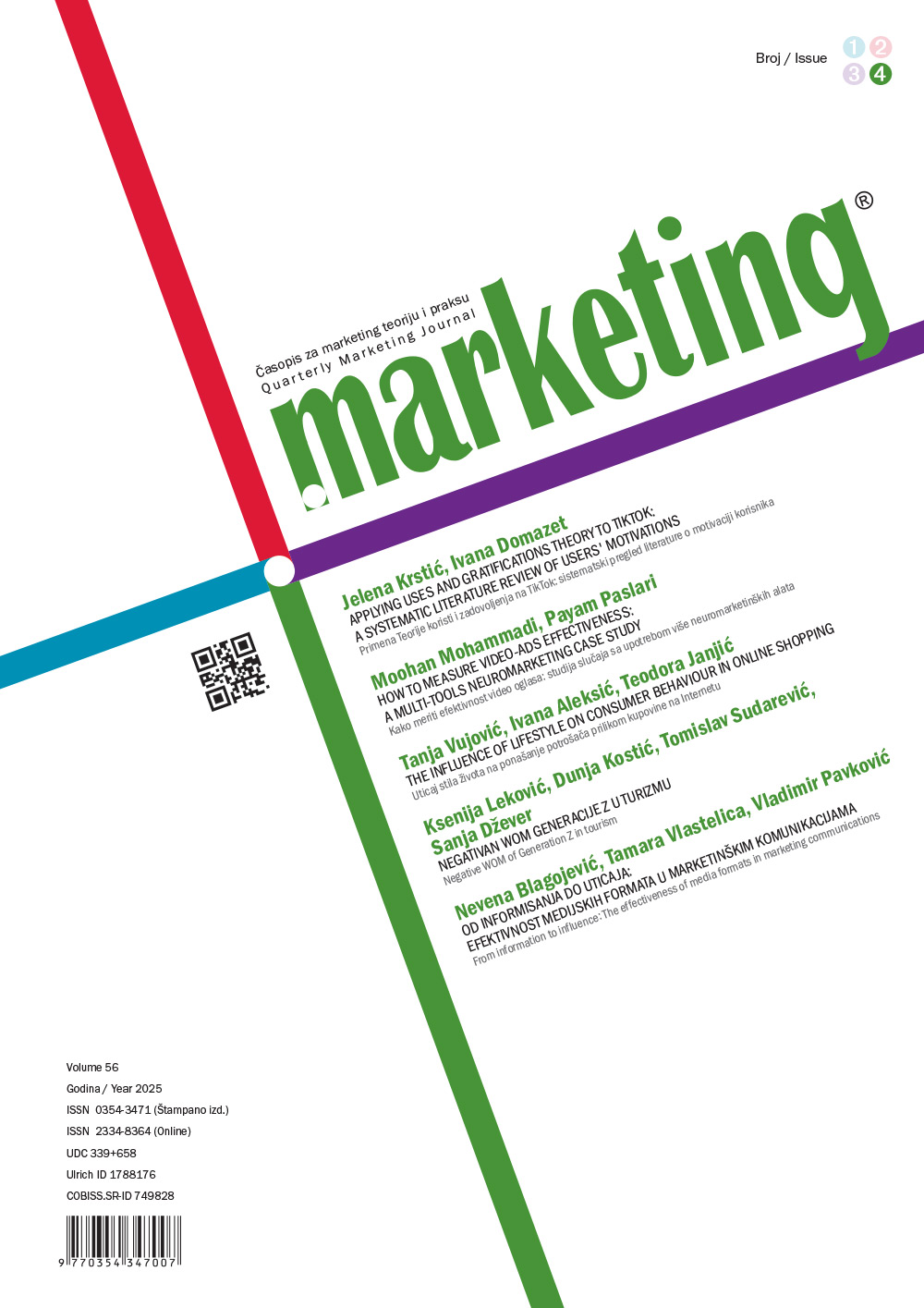
Word-of-mouth of Generation Z in tourism
Negativan WOM generacije Z u turizmu
Abstract
Users can have different experiences when using tourism services. The biggest problem for companies and other potential tourists is a negative experience that arises from an unmet need. It can be shared publicly via social media, privately in the form of negative word-of-mouth to family or friends, or by taking no action. Due to the increasing use of the Internet, users today feel much less discomfort when expressing their negative experiences. It can be observed that negative experiences are significantly caused by negative emotions that arise from unmet needs. In expressing their dissatisfaction, the greatest importance is attributed to Generation Z as the leading generation in the development of tourism. Their main advantage is reflected in the fact that they are young people who spend their daily lives in an online environment where they actively search for information. As they are characterized by high levels of family travel planning and a constant need for entertainment, the company‘s primary goal should be to eliminate dissat isfaction by providing high-quality services in line with user expectations. To understand how Generation Z users express their complaint behavior and whether they decide to share negative WOM, a study was conducted in the Republic of Serbia using the Pearson correlation test. The results obtained indicated that dissatisfied users express their complaint behavior by sharing negative recommendations both through websites and forums or directly to people in their close environment. The results of the conducted study may be a significant foundation for future research on the complaint behavior of Generation Z in tourism, especially if the sample is expanded to a larger number of respondents and research is conducted beyond the borders of the Republic of Serbia.
Apstrakt
Prilikom korišćenja turističkih usluga korisnici mogu imati različita iskustva. Najveći problem za kompanije, ali i druge potencijalne turiste, predstavlja negativno iskustvo koje se javlja kao rezultat nezadovoljene potrebe. Ono može biti podeljeno javno putem društvenih mreža, privatno u obliku negativne preporuke (eng. negative word-of-mouth – WOM) upućene porodici ili prijateljima, ili da se turista odluči na ponašanje bez akcije. Usled sve veće upotrebe interneta, korisnici danas osećaju mnogo manju neprijatnost prilikom iznošenja svojih negativnih iskustava. Ono što je moguće uočiti kada je reč o negativnom WOM-u jeste da je negativno iskustvo značajno prouzrokovano negativnim emocijama koje proističu iz nezadovoljene potrebe. U iskazivanju svog nezadovoljstva najveći značaj se pripisuje generaciji Z kao vodećoj generaciji u razvoju turizma. Njihova osnovna prednost se ogleda u tome što je reč o mladim ljudima koji svakodnevnicu provode u onlajn okruženju u u kom aktivno tragaju za informacijama. Kako ih karakteriše visok stepen angažovanosti u planiranju porodičnih putovanja i konstantna potreba za zabavom, osnovni cilj kompanija treba da bude otklanjanje nezadovoljstva pružajući usluge visokog kvaliteta u skladu sa očekivanjima korisnika. Za potrebe razumevanja na koji način korisnici generacije Z ispoljavaju svoje žalbeno ponašanje i da li se odlučuju na deljenje negativnog WOM-a, sprovedeno je istraživanje na teritoriji Republike Srbije primenom Pirsonovog testa korelacije. Dobijeni rezultati su ukazali da nezadovoljni korisnici svoje žalbeno ponašanje ispoljavaju deljenjem negativnih preporuka i putem sajtova i foruma, ali i direktno ljudima u svom bliskom okruženju. Rezultati sprovedenog istraživanja mogu biti značajna osnova za buduća istraživanja žalbenog ponašanja generacije Z u turizmu, posebno ukoliko se uzorak proširi na veći broj ispitanika i istraživanje sprovede van granica Republike Srbije.
References
- Al-Bourini, F. A., Aljawarneh, N. M., Almaaitah, M. F., Altahat, S., Alomari, Z. S. and Sokiyna, M. Y. (2021). The role of E-Word of mouth in the relationship between online destination image, E-satisfaction, E-Trust & E-Service quality for international tourists perception. Journal of Information Technology Management, 13(Special Issue: Big Data Analytics and Management in Internet of Things), 92-110. https://doi.org/10.22059/jitm.2021.80756
- Alfansi, L. and Atmaja, F. T. (2009). Service failure and complaint behaviour in the public hospital industry: the Indonesian experience. Journal of Nonprofit & Public Sector Marketing, 21(3), 309-325. https://doi.org/10.1080/10495140802644554
- Baltescu, C. A. (2019). Elements of tourism consumer behaviour of Generation Z. Bulletin of the Transilvania University of Brasov, 12(61)(1), 63-68. https://doi.org/10.31926/but.es.2019.12.61.1.9
- Berry, R., Tanford, S., Montgomery, R. and Green, A. J. (2018). How we complain: the effect of personality on consumer complaint channels. Journal of Hospitality & Tourism Research, 42(1), 74-101. https://doi.org/10.1177/1096348014550921
- Bosangit, C., Hibbert, S. and McCabe, S. (2015). “If I was going to die I should at least be having fun”: Travel blogs, meaning and tourist experience. Annals of Tourism Research, 55, 1-14.
https://doi.org/10.1016/j.annals.2015.08.001 - Ergün, G. S. and Kitapci, O. (2018). The impact of cultural dimensions on customer complaint behaviours: an exploratory study in Antalya/Manavgat tourism region. International Journal of Culture, Tourism and Hospitality Research, 12(1), 59-79. https://doi.org/10.1108/IJCTHR-01-2017-0010
- Irawan, Y., Saptarini, T. and Hestiyana, H. (2023). Customers’ Complaint Behavior (CCB) and Tourists’ Linguistic Complaint Strategy Against Tourist Attractions in the Case of West Java. In W. Striełkowski et al. (eds.), Proceedings of the International Conference on Academia-Based Tourism Revival 2022 (ABTR 2022) (pp. 92-100). Dordrecht, Netherlands: Atlantis Press.
- Jayathilake, H. D. and Annuar, N. (2020). Exploring HRM practices to retain Generation-Z in information technology Sector: a systematic literature review. International Journal of Business and Technopreneurship, 10(1), 79-100.
- Jeuring, J. H. G. and Haartsen, T. (2017). Destination branding by residents: The role of perceived responsibility in positive and negative word-of-mouth. Tourism Planning & Development, 14(2), 240-259. https://doi.org/10.1080/21568316.2016.1214171
- Kitapci, O., Yetkin Özbük, R. M., Sakarya, A. and Sarıyıldız, A. (2019). Consumer Complaint Behavior: A Literature Review and Research Agenda. Journal of Applied Economics & Business Research, 9(3), 141-165.
- Kurnaz, A. and Duman, O. (2021). The effect of electronic word-of-mouth communication (e-WOM) on conspicuous and materialist consumption: Research on Generation Z. International Journal of Business and Management, 16(5), 103-114. https://doi.org/10.5539/ijbm.v16n5p103
- Kusumawati, N., Suhandi, A. T. and Purwanegara, M. S. (2024). Why do customers decide to complain on social media? And how to produce customer forgiveness. Review of Integrative Business and Economics Research, 13(3), 235-254.
- Li, W. and Liu, Z. (2022). A comparative study of the impact of negative word of mouth on travel intentions of Chinese and Korean consumers in tourism destinations. Sustainability, 14(4).
https://doi.org/10.3390/su14042062 - Luna-Nevarez, C. and Hyman, M. R. (2012). Common practices in destination website design. Journal of destination marketing & management, 1(1-2), 94-106.
https://doi.org/10.1016/j. jdmm.2012.08.002 - Naeem, M. K. H., Nadezhda, B. and Wang, Y. (2024). Service failure is bound to happen: Unraveling the impact of dissatisfaction, complaint behaviour and re-travel intention in travel and tourism industry. Acta Psychologica, 248. https://doi.org/10.1016/j.actpsy.2024.104343
- Nyer, P. U. and Gopinath, M. (2005). Effects of complaining versus negative word of mouth on subsequent changes in satisfaction: The role of public commitment. Psychology & Marketing, 22(12), 937-953. https://psycnet.apa.org/doi/10.1002/mar.20092
- Panda, S. (2014). Post Purchase Consumer Complaint Behaviour: A Review of Literature. Business Management Dynamics, 4(5), 1-7.
- Pricope Vancia, A. P., Băltescu, C. A., Brătucu, G., Tecău, A. S., Chițu, I. B. and Duguleană, L. (2023). Examining the disruptive potential of generation Z tourists on the travel industry in the digital age. Sustainability, 15(11). https://doi.org/10.3390/su15118756
- Robinson, V. M. and Schänzel, H. A. (2019). A tourism inflex: Generation Z travel experiences. Journal of tourism futures, 5(2), 127-141. https://doi.org/10.1108/JTF-01-2019-0014
- Sánchez-García, I. and Currás-Pérez, R. (2011). Effects of dissatisfaction in tourist services: The role of anger and regret. Tourism Management, 32(6), 1397-1406. https://doi.org/10.1016/j.tourman.2011.01.016
- Șchiopu, A. F., Nica, A. M., Pădurean, A. M. and Ţală, M. L. (2023). Generation Z vs. Generation Y: different from or similar? A comparison of centennials and millennials regarding the use of social media for travel purposes. Cactus – The Tourism Journal for Research, Education, Culture and Soul, 5(1), 20-35.
- Selvanathan, M., Jayabalan, N., Saini, G. K., Supramaniam, M. and Hussin, N. (2020). Employee productivity in Malaysian private higher educational institutions. PalArch's Journal of Archaeology of Egypt/Egyptology, 17(3), 66-79.
- Slivar, I., Alerić, D. and Dolenec, S. (2019). Leisure travel behaviour of generation Y & Z at the destination and post-purchase. E-Journal of Tourism, 6(2), 147-159.
- Sudarević, T., Kostić, D. and Jevtić, J. (2024). The Application of Social Media in Generation Z's Travel Planning. Marketing, 55(3), 175-185. https://doi.org/10.5937/mkng2403175S
- Tosun, P., Sezgin, S. and Uray, N. (2022). Consumer complaining behaviour in hospitality management. Journal of Hospitality Marketing & Management, 31(2), 247-264.
https://doi.org/10.1080/19368623.2021.1941474 - Tronvoll, B. (2011). Negative emotions and their effect on customer complaint behaviour. Journal of Service Management, 22(1), 111-134. https://doi.org/10.1108/09564231111106947
- Wang, D., Xiang, Z. and Fesenmaier, D. R. (2014). Adapting to the mobile world: A model of smartphone use. Annals of Tourism Research, 48, 11-26. https://doi.org/10.1016/j.annals.2014.04.008
- Yen, C. L. A. and Tang, C. H. H. (2015). Hotel attribute performance, eWOM motivations, and media choice. International Journal of Hospitality Management, 46, 79-88.
https://doi.org/10.1016/j. ijhm.2015.01.003 - Yussof, F. M., Harun, A., Norizan, N. S., Durani, N., Jamil, I. and Salleh, S. M. (2018). The influence of social media consumption on Gen Z consumers’ attitude. Journal of Fundamental and Applied Sciences, 10, 1288-1299.