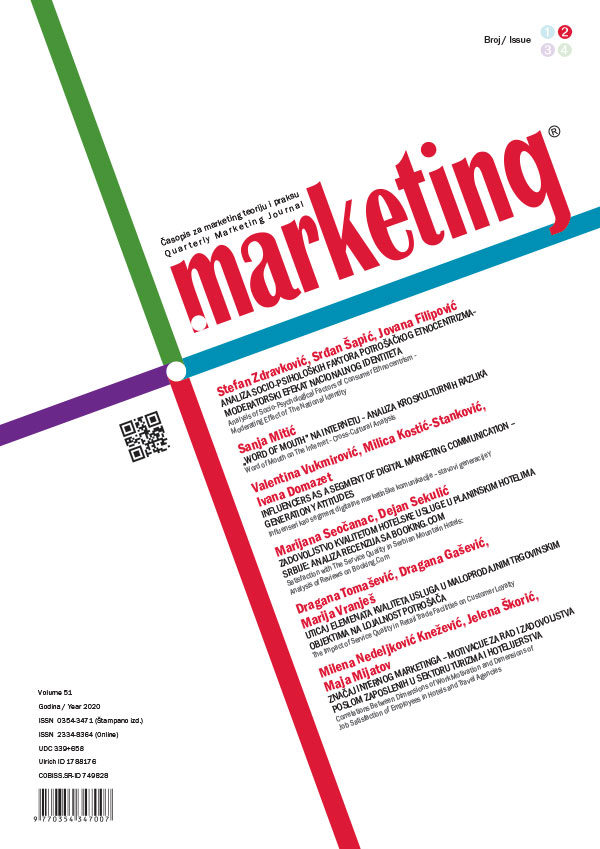
Correlations Between Dimensions of Work Motivation and Dimensions of Job Satisfaction of Employees in Hotels and Travel Agencies
Značaj internog marketinga – motivacije za rad i zadovoljstva poslom zaposlenih u sektoru turizma i hotelijerstva
Abstract
Rapid development of service sector at global level prompted many researchers to examine specifics of work in this sector. One of specifics is so-called service meeting. During the service meeting there is an emotional exchange between provider and customers, so the work motivation and satisfaction of employees is important for perception of the high quality of delivered service by consumers. Subject of this paper is related to development of internal marketing in order to determine correlations between dimensions of job satisfaction and dimensions of motivational potential of the job, as important aspects of gaining the customers’ satisfaction, according to the Hekman-Oldham model in selected hotels and travel agencies in Belgrade and Novi Sad. According to this model, five basic characteristics of the job (diversity of work, identity of the task, importance of the task, autonomy and feedback) are antecedents of work motivation and job satisfaction. Using the Hakman-Oldham theory, one needs to find out the extent to which the job in hotel and travel agency contains aforementioned basic characteristics, or whether the jobs in these two sectors have motivational potential. The aim of the paper is to provide recommendations for development of internal marketing on the basis of increasing the employees’ work motivation and their job satisfaction in different organizations that are operating in service sector (tourism and hospitality), in order to provide services of high quality and to gain the customers’ satisfaction.
Apstrakt
Brz razvoj sevisnog sektora na globalnom nivou podstakao je brojne istraživače da ispituju specifičnosti rada u ovom sektoru. Jedna od specifičnosti je takozvani uslužni susret tokom kojeg se isporučuje usluga u neposrednom kontaktu provajdera i korisnika usluge. Tokom uslužnog susreta dolazi i do emocionalne razmene između davaoca i korisnika usluga, i stoga su motivacija za rad i zadovoljstvo poslom zaposlenih od velike važnosti za percepciju visokog kvaliteta isporučene usluge od strane njenog konzumenta. Predmet ovog rada je razvoj internog marketinga kroz istraživanje motivacije za rad i zadovoljstvo poslom zaposlenih, koji su važna karika u postizanju satisfakcije potrošača. Osnovna istraživačka pitanju su utvrđivanje korelacija između dimenzija zadovoljstva poslom i dimenzija motivacionog potencijala posla prema modelu Hekman-Oldham-a u odabranim hotelima i turističkim agencijama u Beogradu i Novom Sadu. Prema ovom modelu pet bazičnih karakteristika posla (raznolikost posla, identitet zadatka, važnost zadatka, autonomnost i povratna informacija) su antecedenti motivacije za rad i zadovoljstva poslom. Cilj rada je da se daju preporuke menadžmentu ljudskih resursa u različitim organizacijama u servisnom (turističkom i hotelijerskom) sektoru kako da razviju interni marketing kroz povećanu motivisanost zaposlenih za rad i njihovo zadovoljstvo poslom kako bi se ispororučila usluga visokog kvaliteta i postiglo zadovoljstvo korisnika usluge.
References
- Akhtar, R., Boustani, L., Tsivrikos, D. and Chamorro-Premuzic, T. (2015). The engageable personality: Personality and trait EI as predictors of work engagement. Personality and Individual Differences, 73, 44-49.
- Alegre, I., Mas-Machuca, M. and Berbegal-Mirabent, J. (2016). Antecedents of employee job satisfaction: Do they matter? Journal of Business Research, 69(4), 1390-1395.
- Hadžić, O., Nedeljković, M. (2008): Motivacija i zadovoljstvo poslom zaposlenih u organizaciji. Prirodno-matematički fakultet, Departman za geografiju, turizam i hotelijerstvo, Novi Sad.
- Babalola, S. S. (2016). The effect of leadership style, job satisfaction and employee-supervisor relationship on job performance and organizational commitment. Journal of Applied Business Research (JABR), 32(3), 935-946.
- Bakotić, D. (2016). Relationship between job satisfaction and organisational performance. Economic research – Ekonomska istraživanja, 29(1), 118-130.
- Baron, R. A. (1996). Psychology. New Delhi: Prentice-Hall of India.
- Berhardt, K., Donthu, N. and Kennett, P. A. (2000). A longitudinal analysis of satisfaction and profitability. Journal of Business Research, 47(2), 161-171.
- Bin, A. S. (2015). The relationship between job satisfaction, job performance and employee engagement: An explorative study. Issues in Business Management and Economics, 4(1), 1-8.
- Bogićević-Milikić, B. and Ognjanov, G. (2019). Improving organizational commitment through internal marketing. Marketing, 50(2), 94-110.
- Čábelková, I., Abrhám, J. and Strielkowski, W. (2015). Factors influencing job satisfaction in post-transition economies: The case of the Czech Republic. International Journal of Occupational Safety and Ergonomics, 21(4), 448-456.
- Chand, M. and Ranga, A. (2018). Performance appraisal practices in Indian hotel industry: An investigation of employee’s perceptions. International Journal of Hospitality & Tourism Systems, 11(2), 47-55.
- Darwish, T. K. (2013). Strategic HRM and performance: Theory and practice. Retrieved from: http://unitec.eblib.com.au/patron/FullRecord.aspx?p=1220971
- Ertas, N. (2015). Turnover intentions and work motivations of millennial employees in federal service. Public Personnel Management, 44(3), 401-423.
- Grobelna, A., Sidorkiewicz, M. and Tokarz-Kocik, A. (2016). Job satisfaction among hotel employees: Analyzing selected antecedents and job outcomes, A case study from Poland. Argumenta Oeconomica, 37(2), 281-310.
- Hackman, J. R. and Oldham, G. R. (1976). Motivation through the design of work: Test of a theory. Organizational Behaviour and Human Performance, 16(2), 250-279.
- Hackman, J. R. and Oldham G. R. (1975). Development of the job Diagnostic Survey. Journal of Applied Psychology, 60(2), 159-170.
- Holbeche, L. (2012). Aligning human resources and business strategy. Oxford, UK: Taylor & Francis.
- Homberg, F., McCarthy, D. and Tabvuma, V. (2015). A meta-analysis of the relationship between public service motivation and job satisfaction. Public Administration Review, 75(5), 711-722.
- Horng, J. S., Tsai, C. Y., Yang, T. C. and Liu, C. H. (2016). Exploring the relationship between proactive personality, work environment and employee creativity among tourism and hospitality employees. International Journal of Hospitality Management, 54, 25-34.
- Howard, J., Gagné, M., Morin, A. J. and Van den Broeck, A. (2016). Motivation profiles at work: A self-determination theory approach. Journal of Vocational Behavior, 95, 74-89.
- Judge, T. A., Weiss, H. M., Kammeyer-Mueller, J. D. and Hulin, C. L. (2017). Job attitudes, job satisfaction, and job affect: A century of continuity and of change. Journal of Applied Psychology, 102(3), 356-374.
- Karanges, E., Johnston, K., Beatson, A. and Lings, I. (2015). The influence of internal communication on employee engagement: A pilot study. Public Relations Review, 41(1), 129-131. DOI: 10.1016/j. pubrev.2014.12.003.
- Karumuri, V. (2016). Employee engagement: Hotel industry. SCMS Journal of Indian Management, 13(3), 120-128.
- Kingir, S. and Mesci, M. (2010). Factors that affect hotel employees motivation, The case of Bodrum. Serbian Journal of Management, 5(1), 59-76.
- Kong, H., Jiang, X., Chan, W. and Zhou, X. (2018). Job satisfaction research in the field of hospitality and tourism. International Journal of Contemporary Hospitality Management, 30(5), 2178-2194.
- Lăzăroiu, G. (2015). Work motivation and organizational behavior. Contemporary Readings in Law and Social Justice, 7(2), 66-75.
- Locke, E. A. (1976). The nature and causes of job satisfaction. Handbook of Industrial and Organizational Psychology, 1, 1297-1343.
- Nickson, D. (2013). Human resource management for hospitality and tourism industries (2nd ed.). New York, NY: Taylor & Francis.
- Pomirleanu, N., Mariadoss, B. J. and Chennamaneni, P. R. (2016). Managing service quality in high customer contact B2B services across domestic and international markets. Industrial Marketing Management, 55, 131-143.
- Rao, G. V., Vijayalakshmi, D. and Goswami, R. (2018). A study on factors of workplace happiness. Asian Journal of Management, 9(1), 251-260.
- Raziq, A. and Maulabakhsh, R. (2015). Impact of working environment on job satisfaction. Procedia Economics and Finance, 23, 717-725.
- Singh, S. P. and Sharma, H. K. (2016). Impact of work motivation on the job satisfaction of teachers in professional education. The International Journal of Research Publication’s. Research Journal of social science and management, 6(5), 90-96.
- Slijepčević, M., Bovan, A. and Radojević, I. (2018). Internal communications as a factor of company‘s efficiency. Marketing, 49(2), 124-143.
- Stanton, J., Sinar, E. F., Balzer, W. K., Julian, A. L., Thoresen, P., Aziz, Sh., Fisher, G. G. and Smith, P.
- (2001). Development of a compact measure of job satisfaction: The abridged job descriptive index, Educational and Psychological Measurement, 62(1), 173-191.
- Tarcan, M., Hikmet, N., Schooley, B., Top, M. and Tarcan, G. Y. (2017). An analysis of the relationship between burnout, socio-demographic and workplace factors and job satisfaction among emergency department health professionals. Applied nursing research, 34, 40-47.
- Trépanier, S. G., Forest, J., Fernet, C. and Austin, S. (2015). On the psychological and motivational processes linking job characteristics to employee functioning: Insights from self-determination theory. Work and Stress, 29(3), 286-305.
- Vilares, M. and Coelho, P. (2003), The employee-customer satisfaction chain in the ECSI model. European Journal of Marketing, 37, 1703-1722.
- Vroom, V. (1964). Work and motivation. New York: Wiley Publication.
- Wood, D., Lowman, G. H., Harms, P. D. and Roberts, B. W. (2019). Exploring the relative importance of normative and distinctive organizational preferences as predictors of work attitudes. Journal of Applied Psychology, 104(2), 270-292.