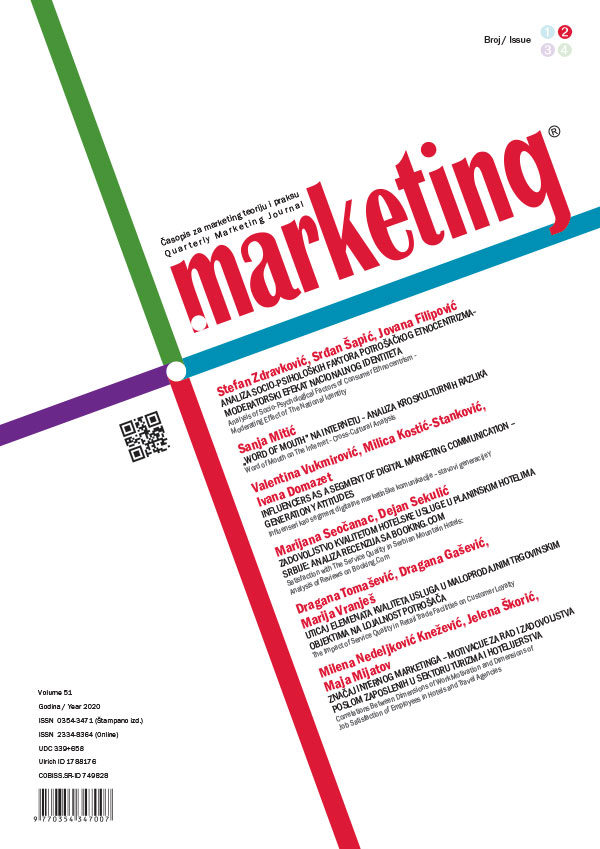
Word of Mouth on The Internet - Cross-Cultural Analysis
„Word of mouth” na internetu – analiza kroskulturnih razlika
Abstract
Development of the Internet and the technology of user generated content, allowed informal online communication between consumers (word of mouth). As the intensity of word of mouth on the Internet is growing, in terms of customers‘ comments, reviews on the products and services, and its potential influence on customer behaviour, this has become a contemporary topic in the literature. The topic of this paper is cross-cultural differences in generating word of mouth on the Internet. This paper aims to reveal main national cultural dimensions, in regard to Hofstede’s and Globe project’s methodology, that influence generating electronic word of mouth, on the sample of 15 European countries. The Western Balkans’ and the East Europe’s countries are included in the research, which was hard to find in different cross-cultural studies. The results show that members of individualistic cultures, where there is high uncertainty avoidance, as well as the members of cultures with high institutional collectivism, more often generate eWOM, in comparison to the members of collectivistic cultures, especially those with high in-group collectivism.
Apstrakt
Sa razvojem interneta i tehnologije generisanja sadržaja od strane korisnika neformalna komunikacija („word of mouth“) se pojavila i u onlajn okruženju. Zbog sve većeg intenziteta „word of mouth-a“ na internetu u vidu komentar, recenzija i ocena koji potrošači objavljuju o proizvodima i uslugama, kao i potencijalnog uticaja koji ova komunikacija ima na ponašanje potrošača, ova tema je postala aktuelna u akademskoj literaturi. Tema ovog rada su kroskulturne razlike u generisanju word of mouth-a na internetu. Cilj rada je pokazati na koji način dimenzije nacionalnih kultura, prema metodologiji Hofstede-a i projekta Globe, utiču na generisanje elektronskog word of mouth-a, na primeru 15 zemalja Evrope. Među analiziranim zemljama se nalaze i zemlje Zapadnog Balkana i istočne Evrope, koje nisu bile obuhvaćene kroskulturnim studijama. Rezultati pokuzuju da pripadnici individualističkih kultura, sa visokim stepenom izbegavanja neizvesnosti, kao i visokog institucionalnog kolektivizma u većem stepenu generišu eWOM, u odnosu na pripadnike kolektivističkih kultura, a posebno u slučaju visokog kolektivizma unutar grupe.
References
- Batra, R. & Keller, K.L. (2016). Integrating Marketing Communications: New Findings, New Lessons, and New Ideas. Journal of Marketing, 80, 122–145.
- Cantallops, S. A. &Salvi, F. (2014). New consumer behaviour: a research on ewom and hotels. International Journal of Hospitality Management, 36, 41-51.
- Chatterjee, P. (2001). Online Reviews: Do Consumers Use Them? Advances in Consumer Research, 28, 129-133.
- Chen, Y.-L., Tang, K., Wu, C.-C., & Jheng, R.-Y. (2014). Predicting the influence of users’ posted information for eWOM advertising in social networks. Electronic Commerce Research and Applications, 13(6), 431–439.
- Cheung, C. M. K., & Thadani, D. R. (2012). The impact of electronic word-of-mouth communication: A literature analysis and integrative model. Decision Support Systems, 54(1), 461–470.
- Cheung, M.Y., Luo, C., Sia, C.L., Chen, H. (2009). Credibility of electronic word-of-mouth: informational and normative determinants of on-line consumer recommendations. International Journal of Electronic Commerce, 13(4), 9–38.
- Chhokar S.J., Brodbeck C.F. & House J.R. (Eds.) (2007). Culture and Leadership Across the World: The GLOBE Book of In-Depth Studies of 25 Societies, New York: Lawrence Erlbaum Associates, Taylor & Francis Group.
- Chih, W. H., Wang, K. Y., Hsu, L. C., Huang, S. C. (2013). Investigating electronic word-of-mouth effects on online discussion forums: the role of perceived positive electronic word-of-mouth review credibility. Cyberpsychology, Behavior, and Social Networking, 16(9), 658–668.
- Christodoulides, G., Michaelidou, N., & Argyriou, E. (2012). Cross-national differences in e-WOM influence. European Journal of Marketing, 46(11/12), 1689–1707.
- Chu, S.C. & Choi, S.M. (2011). Electronic Word-of-Mouth in Social Networking Sites: A Cross-Cultural Study of the United States and China. Journal of Global Marketing, 24 (3), 263–281.
- Dogruel, L. & Xiaoming H. (2016). Movie Selection and E-WOM Preference: A Cross-Cultural Perspective. International Journal of Communication, 10, 2934–2954
- Globe, 2020, https://globeproject.com/results/clusters
- Hennig-Thurau, T., Gwinner, K. P., Walsh, G. & Gremler, D. D. (2004). Electronic word-of-mouth via consumer-opinion platforms: what motivates consumers to articulate themselves on the Internet?Journal of interactive marketing, 18(1), 38-52.
- Hofsted insight, 2020, Preuzeto 05.05.2020 sa www. hofstede-insights.com
- House, J.R., Hanges, J.P., Javidan, M., Dorfman, W.P. & Gupta, V., (eds.) (2004). Culture, leadership, and organizations: The GLOBE study of 62 societies. Thousand Oaks: Sage Publications.
- Ismagilova, E., Dwivedi, K.Y., Slade, E. & Williams, D. M. (2017). Electronic Word of Mouth (eWOM) in the Marketing Context: A State of the Art Analysis and Future Directions. Cham: Springer.
- Ismagilova, E., Slade, E. L., Rana, N. P., & Dwivedi, Y. K. (2019). The Effect of Electronic Word of Mouth Communications on Intention to Buy: A Meta-Analysis. Information Systems Frontiers. doi:10.1007/s10796-019-09924-y
- Kim, J. M., Jun, M. & Kim, C. K. (2018). The effects of culture on consumers’ consumption and generation of online reviews. Journal of Interactive Marketing, 43, 134–150.
- Koo, D.M. (2016). Impact of tie strength and experience on the effectiveness of online service recommendations. Electronic Commerce Research and Applications, 15 (1), 38–51.
- Ladhari, R., Michaud, M. (2015). eWOM effects on hotel booking intentions, attitudes, trust, and website perceptions. International Journal of Hospitality Management, 46 (3), 36–45.
- Lee, J. & Hong B. I. (2019). Consumer’s Electronic Word-of-Mouth Adoption: The Trust Transfer Perspective, International Journal of Electronic Commerce, 23(4), 595-627.
- Lee, M., & Youn, S. (2009). Electronic word of mouth (eWOM): How eWOM platforms influence consumer product judgement. International Journal of Advertising, 28(3), 473–499.
- Luo, C., Wu, J., Shi, Y., & Xu, Y. (2014). The effects of individualism–collectivism cultural orientation on eWOM information. International Journal of Information Management, 34 (4), 446–456.
- Luo, Q., & Zhong, D. (2015). Using social network analysis to explain communication characteristics of travel-related electronic word-of-mouth on social networking sites. Tourism Management, 46, 274–282.
- Luo, X., Gu, B. & Zhang, J. (2017). Expert blogs and consumer perceptions of competing brands, MIS Quarterly, 41(2), 371-395.
- Mansour, O. & Farmanesh, P. (2020). Does gender matter? Acceptance and forwarding of electronic word of mouth: A moderated mediation analysis. Management Science Letters, 10 (7), 1481-1486.
- Messner, W. (2020). Cultural and Individual Differences in Online Reviews. Journal of International Consumer Marketing, 1–27. doi:10.1080/ 08961530.2020.1722980
- Nisar, T. M., Prabhakar, G., Ilavarasan, P. V. & Baabdullah, A. M. (2020). Up the ante: Electronic word of mouth and its effects on firm reputation and performance. Journal of Retailing and Consumer Services. 53, 101726. doi:10.1016/j. jretconser.2018.12.010
- Park, C. & Lee, T.M. (2009). Information direction, web site reputation and e-WOM effect: a moderating role of product type. Journal of Business Research, 62(1), 61-7.
- Pentina, I., Basmanova, O., Zhang, L. & Ukis, Y. (2015). Exploring the Role of Culture in eWOM Adoption. MIS Review, 20 (2), 1-26.
- Qiu, L., Pang, J., & Lim, K. H. (2012). Effects of conflicting aggregated rating on eWOM review credibility and diagnosticity: The moderating role of review valence. Decision Support Systems, 54, 631–643.
- Rieh, S. Y. (2002). Judgment of information quality and cognitive authority in the web. Journal of the American Society for Information Science and Technology, 53(2), 145-161.
- Schmäh, M., Wilke, T. & Rossmann, A. (eds.) (2017). Electronic Word-of-Mouth: A Systematic Literature Analysis, 147-158 in Rossmann, A. & Zimmermann, A. (2017). Digital Enterprise Computing, Lecture Notes in Informatics (LNI), Gesellschaft für Informatik, Bonn.
- Senecal, S., & Nantel, J. (2004). The influence of online product recommendations on consumers’ online choices. Journal of Retailing, 80 (2), 159–169.
- Stamolampros, P., Dousios, D., & Korfiatis, N. (2020). Evaluating domestic bias on airline passengers’ ratings: The moderating effect of cultural value orientation. International Journal of Hospitality Management, 87, doi:10.1016/j.ijhm.2020.102466
- Statista, 2015, Consumer trust in advertising worldwide from 2007 to 2015, by ad format, Preuzeto 25.04.2020. sa www.statista.com/statistics/222698/consumer-trust-in-different-types-of-advertising/
- Sundaram, DS., Mitra, K. & Webster, C. (1998). Word-of-Mouth Communications: A Motivational Analysis. Advances in Consumer Research, 25, 527–531.
- Sun-Jae, D. & Hwang, J.S. (2009). How Consumers Evaluate eWOM (Electronic Word-of-Mouth) Messages. Cyberpsychology & Behavior, 12(2), 193–197.
- Tang, L. (2017). Mine Your Customers or Mine Your Business: The Moderating Role of Culture in Online Word-of-Mouth Reviews. Journal of International Marketing, 25(2), 88–110
- Tang, L. (2017). Mine Your Customers or Mine Your Business: The Moderating Role of Culture in Online Word-of-Mouth Reviews. Journal of International Marketing, 25(2), 88–110
- Wang, S., Cunningham, R. N. & Eastin, S. M. (2015). The Impact ofeWOM Message Characteristics on the Perceived Effectiveness of Online Consumer Reviews, Journal of Interactive Advertising, 15(2), 151-159.
- Xie, K., Kam Fung So, K., Wang, W. (2017). Joint effects of management responses and online reviews on hotel financial performance: a data-analytics approach. International Journal of Hospitality Management, 62, 101-110.
- Zhang, J., & Lee, W.N. (2012). Exploring the Influence of Cultural Value Orientations on Motivations of Electronic Word-of-Mouth Communication. Journal of Internet Commerce, 11 (2), 117–138.