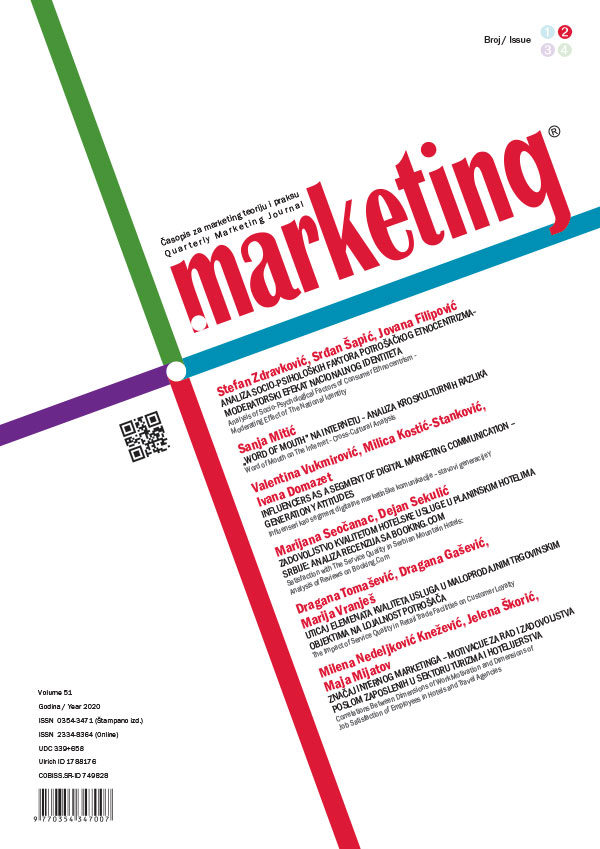
Influencers as a Segment of Digital Marketing Communication – Generation Y Attitudes
Influenseri kao segment digitalne marketinške komunikacije – stavovi generacije Y
Abstract
The aim of the research presented in this paper is to provide insights into marketing communication changes induced by digital transformation and social media use. Contemporary marketing communication strategies are observed in the context of dominant information sources shift, as well as demographic trends that have placed Generation Y in marketing theorists‘ and practitioners‘ focus of interest. This paper examines the role and significance of prominent social media users – influencers in creating contemporary marketing communication. Considering the fact that modern customers are characterized by a high degree of digital sophistication, the research in this paper focused on the prominence of social media as main sources of information sharing. This paper presents the results of an empirical research which aim was to examine the attitudes of Generation Y members in Serbia regarding influencer marketing. The contribution of this paper is reflected in the critical analysis of obtained results, thus increasing the corpus of relevant knowledge.
Apstrakt
Cilj istraživanja u ovom radu podrazumeva sticanje uvida u način na koji se marketinška komunikacija izmenila pod uticajem digitalne transformacije i upotrebe društvenih medija. Savremene strategije marketinške komunikacije posmatrane su u kontekstu pojave tehnološih inovacija kao i demografskih trendova koji su postavili generaciju Y u centar interesa marketinških teoretičara i praktičara. U tom smislu, ovaj rad istražuje ulogu i značaj dominantnih korisnika društvenih medija, influensera, u kreiranju savremene marketinške komunikacije. Uzimajući u obzir činjenicu da današnje potrošače karakteriše visok stepen digitalne sofisticiranosti, istraživanje u ovom radu usmereno je ka rastu značaja društvenih medija kao glavnih izvora sticanja i deljenja informacija. U ovom radu prezentovani su rezultati empirijskog istraživanja koje je za cilj imalo sticanje uvida u stavove generacije Y u Srbiji u pogledu influenser marketinga. Doprinos ovog rada ogleda se u kritičkoj analizi prikupljenih podataka, čime se povećava korpus znanja iz ove oblasti.
References
- Abidin, C. (2016). Visibility labour: Engaging with Influencers’ fashion brands and #OOTD advertorial campaigns on Instagram. Media International Australia, 161(1), 86–100. doi:10.1177/1329878X16665177
- Barbagallo, P. (2003), “Teens”, Target Marketing. 26(4), 65-68. in Dawn B. Valentine Thomas L. Powers,(2013),“Generation Y values and lifestyle segments“, Journal of Consumer Marketing, 30(7), 597 – 606. doi:10.1108/JCM-07-2013-0650.
- Chae, J. (2018). Explaining Females’ Envy Toward Social Media Influencers. Media Psychology, 21(2), 246–262. doi: 10.1080/15213269.2017.1328312
- Cooley, D. & Parks-Yancy, R. (2019). The Effect of Social Media on Perceived Information Credibility and Decision Making. Journal of Internet Commerce, 18(3), 249–269. doi:10.1080/15332861.2019.1595362
- D‘alessandro, C. (2018). Recruitment Tools for Reaching Millennials: The Digital Difference. International Journal of Quantitative Methods. 17. 1-17. doi:10.1177/1609406918774446.
- De Veirman, M., Cauberghe, V. & Hudders, L. (2017). Marketing through instagram influencers: The impact of number of followers and product divergence on brand attitude. International Journal of Advertising, 36(5), 798–828. doi:10.1080/02650487.2017.1348035
- Domazet, I. (2018). Digital Transformation of Business Portfolio Through DCRM. In: Digital transformation: new challenges and business opportunities. London: Silver and Smith Publishers.
- Domazet, I. & Cvetkov Čikošev, T. (2019). Uloga digitalnog marketinga u razvoju i pozicioniranju brenda Nisotec. In: Nacionalna konferencija sa međunarodnim učešćem „Izazovi savremenog marketinga“. Srpsko udruženje za marketing – SeMa, Beograd, 101-111.
- Domazet, I., Neogradi, S. & Simović, V. (2019). Značaj društvenih mreža kao digitalnih kanala komunikacije u srpskim bankama. Marketing – Časopis za ekonomsku teoriju i praksu. 50(4), 289-297.
- Enginkaya, E. & Yılmaz, H. (2014). What Drives Consumers to Interact with Brands through Social Media? A Motivation Scale Development Study. Procedia – Social and Behavioral Sciences, 148, 219–226. doi:10.1016/j.sbspro.2014.07.037
- Gardašević, J., Ćirić, M. & Carić, M. (2018). Razumevanje motiva korišćenja društvenih mreža u funkciji unapređenja komunikacije sa potrošačima. Marketing – Časopis za ekonomsku teoriju i praksu. 49(4), 311-320.
- Gerzema, J. & D’Antonio, M. (2011). Spend Shift: How the Post-crisis Values Revolution Is Changing the Way We Buy, Sell, and Live. Jossey-Bass, San Francisco, CA.
- Gibson, L. A. & Sodeman, W. A. (2014). Millennials and technology: Addressing the communication gap in education and practice. Education and Development Journal, 32, 63–75. In D‘alessandro,
- (2018). Recruitment Tools for Reaching Millennials: The Digital Difference. International Journal of Quantitative Methods. 17. 1-17. doi:10.1177/1609406918774446.
- Goodey, C. & East, R. (2008). Testing the market maven concept. Journal of Marketing Management. 24:3-4. 265-282. DOI: 10.1362/026725708X306095.
- Hershatter, A. & Epstein, M. (2010). Millenials and the world of work: an organization and management perspective. Journal of Business Psychology, 25(2), 211-223. doi:10.1007/s10869-010-9160-y.
- Hughes, C., Swaminathan, V. & Brooks, G. (2019). Driving Brand Engagement Through Online Social Influencers: An Empirical Investigation of Sponsored Blogging Campaigns. Journal of Marketing. 83(5), 78–96. doi:10.1177/0022242919854374
- Jin, S. V. & Muqaddam, A. (2019). Product placement 2.0: “Do Brands Need Influencers, or Do Influencers Need Brands?” Journal of Brand Management. doi:10.1057/s41262-019-00151-z
- Khamis, S., Ang, L. & R. Welling. 2016. Self-branding, ‘micro-celebrity’ and the rise of social media influencers. Celebrity Studies 8(2): 191–208. Retrieved from: https://www.tandfonline.com/doi/abs/10.1080/19392397.2016.1218292 (Accessed: 23.01.2020.)
- Ki, C. & Kim, Y. (2019). The mechanism by which social media influencers persuade consumers: The role of consumers’ desire to mimic. Psychology & Marketing, 36(10), 905–922. doi:10.1002/mar.21244
- Kolo, C., Widenhorn, S., Borgstedt, A.-L. & Eicher, D.(2018). A Cross-Cultural Perspective on Motives and Patterns of Brand Recommendation in Social Media. International Journal of Online Marketing, 8(2), 27–44. doi:10.4018/IJOM.2018040102
- Krovna organizacija mladih Srbije. (2019). Mladi u medijskom ogledalu 2019. Beograd. ISBN-978- 86-80578-07-1. Retrieved from: https://koms.rs/wp-content/uploads/2020/01/Mladi-u-medijskom-ogledalu-FINAL-1.pdf (accessed: 27.01.2019.).
- Luck, E. & Mathews, S. (2010). What Advertisers Need to Know about the iYGeneration: An Australian Perspective. Journal of Promotion Management. 16. 134–147. doi:10.1080/10496490903574559.
- Mangold, G.W. & Taken Smith, K. (2011). Selling to Millennials with Online Reviews. Business Horizons. 55(2). 141-153. doi: 10.1016/j.bushor.2011.11.001.
- Morgan Stanley. (2019). Millenials, Gen Z and the Coming „Youth Boom“ Economy. Retrieved from: https://www.morganstanley.com/ideas/millennial-gen-z-economy. (accessed:18.02.2020.)
- Ministry of Youth and Sports, Republic of Serbia. (2016). The research on youth information and activism. Retrieved from: https://www.mos.gov.rs/public/ck/uploads/files/Dokumenta/Omladina/istrazivanja/istrazivanje%202016/Aktivizam-i-informisanost-mladih-terensko-istra%C5%BEivanje-decembar-2016-finalni.pdf (accessed:18.02.2020.)
- Myers, K. K. & Sadaghiani, K. (2010). Millennials in the Workplace: A Communication Perspective on Millennials’ Organizational Relationships and Performance. Journal of Business and Psychology, 25(2), 225–238. doi:10.1007/s10869-010-9172-7
- Parment, A., 2013. Generation Y vs. Baby Boomers: shopping behavior, buyer in- volvement and implications for retailing. Journal of Retailing and Consumer Services. 20(2), 189–199.
- Peković, J., Zdravković, S. & Pavlović, G. (2019). Influenseri sa društvenih mreža kao prediktor namera potrošača. Marketing – Časopis za ekonomsku teoriju i praksu. 50(3), 207-216.
- Pempek, T.A., Yermolayeva, Y.A. & Calvert, S.L. (2009), “College students’ social networking experiences on Facebook”, Journal of Applied Developmental Psychology. 30(3). 227-238. doi: 10.1016/j.appdev.2008.12.010.
- Pentina, I., Zhang, L. & Basmanova, O. (2013). Antecedents and consequences of trust in a social media brand: A cross-cultural study of Twitter. Computers in Human Behavior. 29(4), 1546–1555. doi:10.1016/j.chb.2013.01.045
- Pilgrim, K. & Bohnet-Joschko, S. (2019). Selling health and happiness how influencers communicate on Instagram about dieting and exercise: mixed methods research. BMC Public Health, 19(1), 1054. doi:10.1186/s12889-019-7387-8
- Rakuten Marketing. (2019). Influencer Marketing Global Survey. Retrieved from:
https://www.iab.com/wp-content/uploads/2019/03/Rakuten-2019- Influencer-Marketing-Report-Rakuten-Marketing.pdf (accessed: 19.02.2020.) - Schouten, A. P., Janssen, L. & Verspaget, M. (2019). Celebrity vs. Influencer endorsements in advertising: the role of identification, credibility, and Product-Endorser fit. International Journal of Advertising. 1–24. doi:10.1080/02650487.2019.1634898
- Shen, C. W., Kuo, C. J. & Ly, P. T. M. (2017). Analysis of social media influencers and trends on online and mobile learning. International Review of Research in Open and Distance Learning. 18(1), 1–224. doi:10.19173/irrodl.v18i1.2640
- Stojanović, B. (2019). Alternativni izveštaj o položaju i potrebama mladih u Republici Srbiji. Krovna organizacija mladih Srbije. Retrieved from: http://koms.rs/istrazivanja/alternativni-izvestaj-o-polozaju-potrebama-mladih-u-republici-srbiji-2019/ (Accessed: 25.02.2020.)
- Süli, D. & Martyin-Csamangó, Z. (2020). The Impact of Social Media in Travel Decision-making Process among the Y and Z Generations of Music Festivals in Serbia and Hungary. Turizam. 24(2), 79-90. 37. Tanyel, F., Stuart, E.W. & Griffin, J. (2013) Have “Millennials” Embraced Digital Advertising as They Have Embraced Digital Media?, Journal of Promotion Management, 19(5), 652-673. doi: 10.1080/10496491.2013.829161.
- Tkalac Verčič, A. & Verčič, D. (2013). Digital natives and social media. Public Relations Review, 39(5), 600–602. doi:10.1016/j.pubrev.2013.08.008
- Thompson Foundation. (2018). Serbia: Digital Economy & Media Development, Assesment Report. Retrieved from: http://www.thomsonfoundation.org/media/113958/tfserbia_report_digitaleconomy-small.pdf (accessed: 18.02.2020.)
- Wang, X., Yu, C. & Wei, Y. (2012). Social Media Peer Communication and Impacts on Purchase Intentions: A Consumer Socialization Framework. Journal of Interactive Marketing, 26(4), 198–208. doi:10.1016/j. intmar.2011.11.004
- Wan-Hsiu, S. T. & Linjuan, R. M. (2014): Consumer engagement withbrands on social network sites: A cross-cultural comparison of China and the USA, Journal of Marketing Communications. 23(1), 2-21. doi: 10.1080/13527266.2014.942678
- Wohn, D. Y. & Bowe, B. J. (2016). Micro Agenda Setters: The Effect of Social Media on Young Adults’ Exposure to and Attitude Toward News. Social Media and Society, 2(1). doi:10.1177/2056305115626750