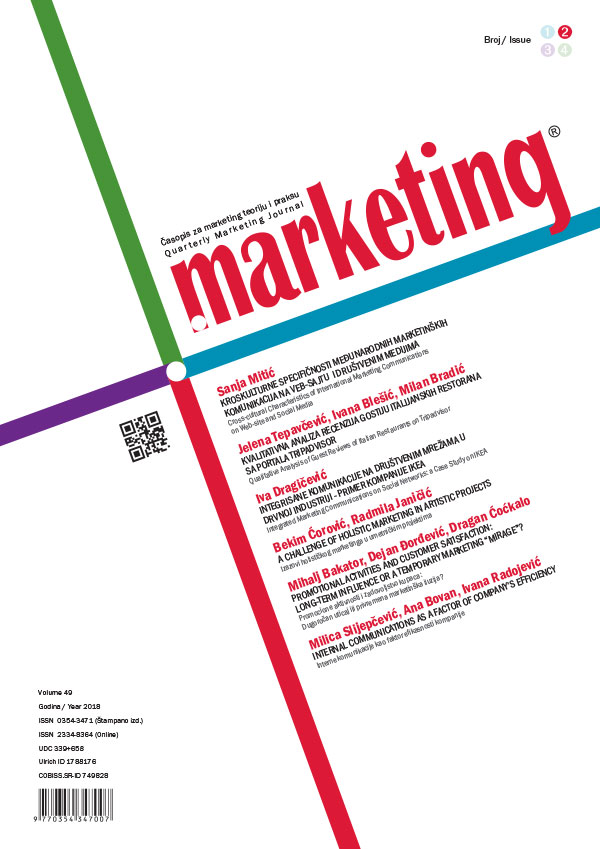
Qualitative Analysis of Guest Reviews of Italian Restaurants on Tripadvisor
Kvalitativna analiza recenzija gostiju italijanskih restorana sa portala Tripadvisor
Abstract
Developing measures for improving the quality of hospitality services is a basic precondition for successful business and positioning of restaurants on the market. The importance of measuring the satisfaction of quests is reflected in the objectivisation and quantification of subjective perceptions in order to improve the service quality. Sometimes a very important tool for obtaining feedback – quest books are replaced with social networks, forums and specialized sites, thus distributing information about the perception of service quality gets a new dimension. Thanks to the large number of online reviews available in electronic form, the sentiment analysis is increasingly prevalent in scientific and professional works which deals with the research of the quality of services in the restaurant industry. The aim of the paper is to research reviews of users (domestic and foreign guests) that visited Italian cuisine restaurants in Belgrade. Qualitative analysis of reviews was done, different readability indices were calculated, the feelings in the reviews were analysed, T-test according to gender was done, and the chi square test for variables subjectivity and irony were applied.
Apstrakt
Razvijanje mera za unapređenje kvaliteta ugostiteljskih usluga je osnovni preduslov za uspešno poslovanje i pozicioniranje restorana na tržištu. Značaj merenja zadovoljstva gostiju ogleda se u objektiviziranju i kvantifikovanju subjektivnih percepcija sa ciljem poboljšanja kvaliteta usluga. Nekada veoma bitno sredstvo za dobijanje povratne informacije – knjige gostiju, zamenjene su društvenim mrežama, forumima i specijalizovanim sajtovima čime distribucija informacija o percepciji kvaliteta usluge dobija novu dimenziju. Zahvaljujući velikom broju onlajn recenzija koje su dostupne u elektronskoj formi, analiza sentimenta je sve zastupljenija u naučnim i stručnim radovima koji se bave istraživanjem kvaliteta usluge u restoraterstvu. Cilj rada je istraživanje recenzija korisnika (domaćih i stranih gostiju) koji su posetili restorane italijanske kuhinje u Beogradu. Urađena je kvalitativna analiza recenzija, izračunati su različiti indeksi čitljivosti, analizirana su osećanja u recenzijama, T-test prema polu kao i chi kvadrat test za varijable subjektivnost i ironičnost.
References
- Amblee, N., & Bui, T. (2011). Harnessing the influence of social proof in online shopping: The effect of electronic word of mouth on sales of digital microproducts. International Journal of Electronic Commerce, 16(2), 91-114. https://doi.org/10.2753/JEC1086-4415160205.
- Anand, P., Holbrook, M.B., Stephens, D. (1988). The formation of affective judgments: the cognitive-affective model versus the independence hypothesis. Journal of Consumer Research, 15(3), 386–391.
- Anderson, C.K. (2012). The impact of social media on lodging performance. Cornell Hospitality Report, 12(15), 4–12.,
- Bronner, F., De Hoog, R. (2010). Consumer-generated versus marketer-generated websites in consumer decision making. International Journal of Market Research, 52(2), 231-248.
- Cantallops, A.S., Salvi, F. (2014). New consumer behaviour: A review of research on eWOM and hotels. International Journal of Hospitality Management, 36, 41-51.
- Cheung, C., Lee, M. (2012). What drives consumers to spread electronic word of mouth in online consumer-opinion platforms. Decision Support Systems 53(1), 218-225. doi: 10.1016/j.dss.2012.01.015
- Chevalier, J. A., & Mayzlin, D. (2006). The effect of word of mouth on sales: online book reviews. Journal of Marketing Research, 43(3), 345–354.
- Čačić, K., & Mašić, S. (2013). The impact of the TripAdvisor portal on the business of hotels in Serbia. Marketing, 44(3), 211-220.
- Daugherty, T., Eastin, M., Bright, L. (2008). Exploring consumer motivations for creating user-generated content. Journal of Interactive Advertising, 8(2), 16-25.
- Dai, H., Luo, X.R., Liao, Q., Cao, M. (2015). Explaining consumer satisfaction of services: the role of innovativeness and emotion in an electronic mediated environment. Decision Support Systems, 70, 97 – 106.
- Dellarocas, C., Zhang, X.M., Awad, N.F. (2007). Exploring the value of online product reviews in forecasting sales: the case of motion pictures. Journal of Interactive Marketing, 21 (4), 23–45.
- Duan, W., Gu, B., Whinston, A.B. (2008). Do online reviews matter?—An empirical investigation of panel data. Decision Support System, 45 (4), 1007–1016.
- Farr, J. N., Jenkins, J. J., & Paterson, D. G. (1951). Simplification of the Flesch reading ease formula. Journal of Applied Psychology, 35(5), 333–337.
- Ganzaroli A., De Noni I., van Baalen P. (2017). Vicious advice: Analyzing the impact of TripAdvisor on the quality of restaurants as part of the cultural heritage of Venice. Tourism Management, 61, 501-510.
- Gavilan, D., Avello M., Martinez- Navarro G. (2018). The influence of online ratings and reviews on hotel booking consideration. Tourism Management, 66, 53-61.
- Geetha, M., Singha, P., Sinha, S. (2017). Relationship between bustomer sentiment and online customer ratings for hotels – An empirical analysis. Tourism Management, 61, 43-54.
- Ghose, A., & Ipeirotis, P. G. (2011). Estimating the helpfulness and economic impact of product reviews: mining text and reviewer characteristics. IEEE Transactions on Knowledge and Data Engineering, 23(10), 1498–1512
- Goldsmith, R. Horowitz, D. (2006). Measuring motivations for online opinion seeking. Journal of Interactive Advertising, 6(2), 1-16.
- Gretzel, U., & Yoo, K. H. (2008). Use and impact of online travel reviews. In P. O'Connor, W. Höpken, & U. Gretzel (Eds.), Information and communication technologies in tourism 2008 (35–46). New York: Springer.
- Gunning, R. (1969). The fog index after twenty years. Journal of Business Communication, 6(2), 3–13.
- Harrison-Walker, L.J. (2001). The measurement of word-of-mouth communication and an investigation of service quality and customer commitment as potential antecedents. Journal of Service Research, 4(1), 60-75.
- Hennig-Thurau, T., Walsh, G. (2003). Electronic Word-of-Mouth: Motives for and Consequences of Reading Customer Articulations on the Internet. International Journal of Electronic Commerce, 8(2), 51-74.
- Hu, N., Bose, I., Koh, N.S., Liu, L. (2012). Manipulation of online reviews: an analysis of ratings, readability and sentiments. Decision Supports Systems, 52(3), 674-684.
- Hu, Y-H., Chen, K. (2016). Predicting hotel review helpfulness: The impact of review visibility, and interaction between hotel stars and review ratings. International Journal of Information Management, 36, 929-944.
- Kim, W.G., Lim, H. & Brymer, R.A. (2015). The effectiveness of managing social media on hotel performance. International Journal of Hospitality Management, 44, 165-171.
- Kincaid, J. P. (1981). Computer readability editing system. IEEE Transactions on Professional Communications, 24(1), 38–42.
- Litvin, S., Goldsmith, R., Pan, B. (2008) „Electronic word-of-mouth in hospitality and tourism management." Tourism Management, 29(3), 458–468.
- Leung, H.D., Lee, A., Law, R. (2012). Examining Hotel Managers Acceptance of Web 2.0 in Website Development: A case Study of Hotels in Hong Kong. Social Media in Travel, Tourism and Hospitality (eds. Sigala, M., Christou, E., Gretzel, U.) Ashgate Publishing Limited, Farnham, 54-69.
- Martin, L., Pu, P. (2014). Prediction of helpful reviews using emoting extraction. Twenty-Eighth AAAI conference on artificial intelligence.
- McLaughlin, G. H. (1969). SMOG grading: a new readability formula. Journal of Reading, 12(8), 639–646.
- Miguens, J., Baggio, R., Costa, C. (2008). Social media and Tourism Destinations: TripAdvisor Case Study. Advances in Tourism Research 2008, Aveiro, Portugal.
- Middleton V., Fyall A., Morgan M., Ranchhod A. (2009). Marketing in travel and tourism. Elsevier, Oxford.
- Park, S.Y., Allen, J.P. (2013). Responding to online reviews: problem solving and engagement in hotels. Cornell Hospitality Quarterly, 54 (1), 64–73.
- Purnawirawan, N., De Pelsmacker, P., Dens, N. (2012). Balance and Sequence in Online Reviews: How Perceived Usefulness Affects Attitudes and Intentions. Journal of Interactive Marketing, 26(4), 244-255.
- Rose, S., Hair, N., Clark, M. (2011). Online customer experience: a review of the business-to-consumer online purchase context. International Journal of Management Reviews, 13(1), 24-39.
- Schoefer, K., Ennew, C. (2005). The impact of perceived justice on consumers’ emotional responses to service complaint experiences. Journal of Services Marketing. 19(5), 261-270.
- Smith, E. A., & Kincaid, J. P. (1970). Derivation and validation of the automated readability index for use with technical materials. Human Factors: The Journal of the Human Factors and Ergonomics Society, 12(5), 457–564.
- Sparks, B.A., Browning, V. (2011). The impact of online reviews on hotel booking intentions and perception of trust. Tourism Management, 32 (6), 1310–1323.
- Sharkey, G. (2009). True or false? You decide. Caterer & Hotelkeeper, 199 (4591), 30-32
- Westbrook, R.A., Oliver, R.L., (1991). The dimensionality of consumption emotion patterns and consumer satisfaction. Journal of Consumer Research 18(1), 84-91
- Xiang, Z., Gretzel, U. (2010). Role of social media in online travel information search. Tourism management, 31(2), 179-188.
- Xu, X., Li, Y., (2016). The antecedents of customer satisfaction and dissatisfaction toward various types of hotels: a text mining approach. International Journal of Hospitality Management, 55, 57-69.
- Yates, F. (1934). Contingency table involving small numbers and the χ2 test. Supplement to the Journal of the Royal Statistical Society, 1(2), 217–235.
- Ye, Q., Law, R., Gu, B. (2009). The impact of online user reviews on hotel room sales. International Journal of Hospitality Management. 28 (1), 180–182.
- Yim, E.S., Lee, S., Kim, W.G. (2014). Determinants of a restaurant average meal price: an application of the hedonic pricing model. International Journal of Hospitality Management, 39, 11–20.
- Yoon, Y., Uysal, M. (2005). An examination of the effects of motivation and satisfaction on destination loyality: a structural model. Tourism Management, 26(1), 45-56.
- Zhang L., Hanks L. (2018). Online reviews: The effect of cospolitanism, incidental similarity, and dispersion on consumer attitudes toward ethnic restaurants. International Journal of Hospitality Management, 68, 115-123.
- Zhu, F., Zhang, X. (2010). Impact of Online Consumer Reviews on Sales: The Moderating Role of Product and Consumer Characteristics. Journal of Marketing. 74(2), 133-148.