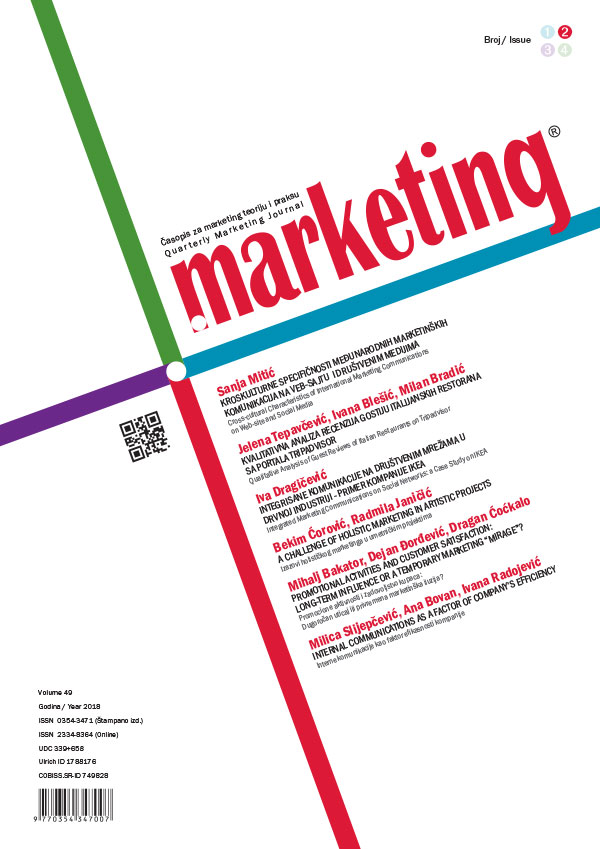
Cross-cultural Characteristics of International Marketing Communications on Web-site and Social Media
Kroskulturne specifičnosti međunarodnih marketinških komunikacija na veb-sajtu i društvenim medijima
Abstract
The topic of this paper are cross-cultural specifics of marketing communications on Website and social media. Website is starting point for all activities of a company on Internet. Its global reach is especially important to companies with international orientation. Standardization/adaption dilemma in the context of international marketing communications on website will be evaluated in this paper, from the perspective of cultural influences, especially influences of language and cultural values. Hofstede‘s cultural dimensions and Hall‘s classifications of cultures will be used as a theoretical framework for this analysis. On the other hand, social media are becoming highly popular not jus among individuals as users, but among companies, also. Their role in international marketing communications is not widely examined. Cross-cultural differences in social media usage will be part of the analysis in this paper. The aim of this paper is to systemize result of some researches in this area in order to examine necessity of adaption of international marketing communications on website and social media.
Apstrakt
Predmet rada su kroskulturne specifičnosti marketinških komunikacija putem veb sajta preduzeća i društvenih medija. Veb-sajt predstavlja osnovu za sve aktivnosti kompanije na internetu, a od posebnog značaja za međunarodno orijentisana preduzeća je njegov globalni domet. U radu će biti odvrednovana dilema standardizacije i prilagođavanja međunarodnih marketinških komunikacija putem veb sajta. Kao najznačajniji faktor koji utiče na ovu poslovnu odluku izdvojen je uticaj kulture, kroz jezik i različite kulturne vrednosti. Kao koncepcijski okvir korišćene su Hofstedove kulturne dimenzije i Holova klasifikacija kultura. S druge strane, društveni mediji su poslednjih godina dobili na popularnosti, ne samo među pojedincima već i preduzećima. Njihova uloga u međunarodnim marketinškim komunikacijama još uvek nije široko istraživana. U radu će biti sistematizovane kroskulturne razlike u korišćenju društvenih medija. Cilj rada je da prikaže najznačajnije rezultate istraživanja u ovoj oblasti i ukaže na neophodna prilagođavanja marketinških komunikacija putem veb-sajta i društvenih medija u cilju targetiranja inostranih tržišta.
References
- Alden, L.D., Steenkamp, J.B. & Batra, R. (1999). Brand Positioning Through Advertising in Asia, North America, and Europe: The Role of Global Consumer Culture. Journal of Marketing, 63, 75-87
- Batra R. & Keller K.L. (2016). Integrating Marketing Communications: New Findings, New Lessons, and New Ideas. Journal of Marketing, 80, 122–145
- Chapman, C.N. & Lahav, M. (2008). International ethnographic observation of social networking sites. CHI 2008, 5-10 April, pp. 3123-3128, Florence: ACM, Retrieved 12.07.2018, from: http://onemvweb.com/sources/sources/international_ethnographic_social.pdf
- Czinkota R.M. & Ronkainen A. (2010). Principles of International Marketing. South-Western: Cengage Learning
- Hall, E.T. (1977). Beyond Culture. New York: Anchor Books
- Hofstede Insights (2018), Retrieved 12.06.2018, from:
https://www.hofstede-insights.com/product/compare-countries/, - Hutt R. (2017). The world's most popular social networks, mapped. World Economic Forum. Retrieved 18.08.2017. from: www.weforum.org/agenda/2017/03/most-popular-social-networks-mapped/
- Internet World Stats (2017). World Internet usage and population statistics. Retrieved 12.06.2018, from: https://www.internetworldstats.com/stats.htm
- Kaplan, A.M. & Haenlein, M. (2010). Users of the world, unite! The challenges and opportunities of social media. Business Horizons, 53, 1, 59-68.
- Kim, Y., Sohn, D. & Choi, S.M. (2011). Cultural difference in motivations for using social network sites: a comparative study of American and Korean college students. Computers in Human Behavior, 27, 1, 365-372.
- Lafrance, A. (2015). How Many Websites Are There? Retrieved 13.06.2018, from: www.theatlantic.com/technology/archive/2015/09/how-many-websites-are-there/408151/
- Luna D, Peracchio A.L. & de Juan D.M. (2002). Cross-cultural and cognitive aspects of Web site navigation. Journal of the Academy of Marketing Science, 30, 4, 397-410
- Okazaki S. & Taylor C.R. (2013). Social media and international advertising: theoretical challenges and future directions. International Marketing Review, 30, 1, 56-71
- Okazaki S., Mueller B. & Taylor C.R. (2010). Global Consumer Culture Positioning: Testing Perceptions of Soft-Sell and Hard-Sell Advertising Appeals between U.S. and Japanese Consumers. Journal of International Marketing, 18, 2, 20–34
- Park C., Jun J. & Lee T. (2015). Consumer characteristics and the use of social networking sites: A comparison between Korea and the US. International Marketing Review, 32, 3/4, 414-437
- Poushter, J. (2017). Not everyone in advanced economies is using social media. Retrieved 12.06.2018, from: www.pewresearch.org/fact-tank/2017/04/20/not-everyone-in-advanced-economies-is-using-social-media/
- Rakita B. & Mitić S. (2017). International Marketing: From Local to Global Perspective, Belgrade: Faculty of Economics, University of Belgrade
- Shukairy, A. (2018). Social Media Ad Spending –Statistics and Trends. Retrieved 15.08.2017, from:
www.invespcro.com - Singh N., Zhao H. & Hu X. (2005). Analysing the cultural content of websites: A cross-national comparison of China, India, Japan, and the US. International Marketing Review, 22, 2, 129-146
- Statista (2015). Average number of hours per day spent by social media users on all social media channels as of the fourth quarter of 2015, by country. Retrieved 18 August 2017, from: www.statista.com/statistics/270229/usage-duration-of-social-networks-by-country/
- Statista (2018a). Most famous social network sites worldwide as of April 2018, ranked by number of active users, Retrieved 12.06.2018, from:
www.statista.com/statistics/272014/global-social-networks-ranked-by-number-of-users/ - Statista (2018b). Global social network penetration rate as of January 2018, by region, Retrieved 12.06.2018, from: www.statista.com/statistics/269615/social-network-penetration-by-region/
- Statista (2018c). Active social network penetration in selected countries as of January 2018. Retrieved 12 June 2018, from: www.statista.com/statistics/282846/regular-social-networking-usage-penetration-worldwide-by-country/
- Steenkamp, J.B. & Geyskens, I. (2006). How Country Characteristics Affect the Perceived Value of Web Sites. Journal of Marketing, 70, 136-150
- Tang L. (2017). Mine Your Customers or Mine Your Business: The Moderating Role of Culture in Online Word-of-Mouth Reviews. Journal of International Marketing, 25, 2, 88–110
- www.unilever.com, Retrieved 18 August 2017.