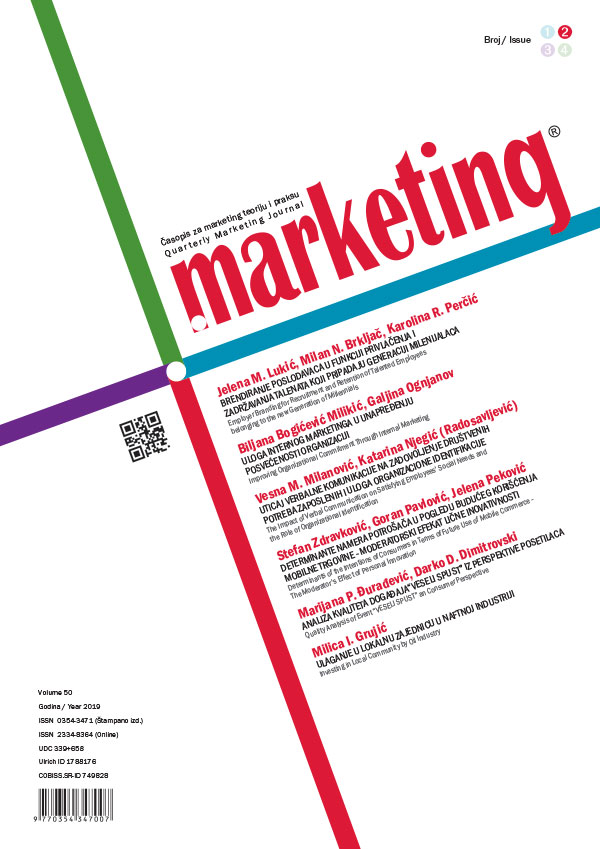
Improving Organisational Commitment Through Internal Marketing
Uloga internog marketinga u unapređenju posvećenosti organizaciji
Abstract
In this paper we made an attempt to highlight the relationship between organizational commitment and internal marketing, building our analysis on reviewing related organizational behaviour, internal marketing and human resource management literature. The analysis has shown that internal marketing has an important role in developing employee commitment through: informing the employees about organizational values, developing organization brend both internally and externally, facilitating two-way communication within organization, improving organizational climate, selection of new employees whose values and attitudes support organizational ones, motivation of employees through job design, creation of equity-based reward system and systematic planning and management of employees` careers. The analyss has also indicated that organizational commitment mediates the relationship between internal marketing and organizational performances.
Apstrakt
U ovom radu pokušali smo da dublje istražimo odnos između posvećenosti organizaciji i internog marketinga na bazi pregleda relevantne literature iz oblasti organizacionog ponašanja, internog marketinga i menadžmenta ljudskih resursa (MLJR-a). Analiza je pokazala da interni marketing ima važnu ulogu u razvoju posvećenosti kod zaposlenih preko: informisanja zaposlenih o organizacionim vrednostima, kreiranja brenda organizacije interno i eksterno, podsticanja dvosmerne komunikacije unutar organizacije, unapređenja organizacione klime, selekcije novih zaposlenih koji dele vrednosti i stavove koji podržavaju vrednosti organizacije, motivisanja zaposlenih kroz adekvatno dizajniranje poslova, kreiranje pravednog sistema nagrađivanja i sistematsko planiranje i upravljanje karijerom zaposlenih. Analiza je sugerisala i da posvećenost organizaciji predstavlja medijatorsku varijablu odnosa između internog marketinga i organizacionih performansi.
References
- Abelson, R.P., & Rosenberg, M.J. (1958). Symbolic psycho-logic: A model of attitudinal cognition. Behavioral Science, 3(1), 1-13. doi:10.1002/bs.3830030102
- Abzari, M., Ghorbani, H., & Alsadat, M.F. (2011). The effect of internal marketing on organizational commitment from market-orientation viewpoint in hotel industry in Iran. International Journal of Marketing Studies, 3(1), doi:10.5539/ijms.v3n1p147
- Ahmed, P.K., & Rafiq, M. (2003). Internal marketing issues and challenges. European Journal of Marketing,37(9), 1177-1186. doi:10.1108/03090560310498813
- Ahmed, P.K., Rafiq, M., & Saad, N.M. (2003). Internal marketing and the mediating role of organisational competencies. European Journal of Marketing, 37(9), 1221-1241. doi:10.1108/03090560310486960
- Allen, N.J., & Meyer, J.P. (1990). The measurement and antecedents of affective, continuance and normative commitment to the organization. Journal of Occupational Psychology, 63, 1–18.
- Allen, N.J., & Meyer, J.P. (1996). Affective, Continuance, and Normative Commitment to the Organization: An Examination of Construct Validity. Journal of Vocational Behavior,49(3), 252-276. doi:10.1006/jvbe.1996.0043
- Alves, H., Paço, D.A., & Roberto, C. (2015). Influence of internal marketing on organizational commitment. Tržište, 27(2); 237-250.
- Alvesson, M. (2001). Knowledge Work: Ambiguity, Image and Identity. Human Relations, 54(7), 863-886. doi:10.1177/0018726701547004
- Bakker, A.B., & Leiter, M.P. (2010). Work engagement: A handbook of essential theory and research. Hove: Psychology Press. doi:10.4324/9780203853047
- Bansal, H.S., Mendelson, M.B., & Sharma, B. (2001). The impact of internal marketing activities on external marketing outcomes. Journal of Quality Management, 6(1), 61-76. doi:10.1016/s1084-8568(01)00029-3
- Becker, H.S. (1960). Notes on the Concept of Commitment. American Journal of Sociology, 66(1), 32-40. doi:10.1086/222820
- Bergman, M.E. (2006). The relationship between affective and normative commitment: review and research agenda. Journal of Organizational Behavior, 27(5), 645-663. doi:10.1002/job.372
- Bergmann, T.J., Lester, S.W., DeMeuse, K.P., & Grahn, J.L. (2000). Integrating The three domains of employee commitment: an exploratory study. Journal of Business and Industrial Marketing, 16(4), 15-26.
- Berry, L.L., Hensel, J., & Burke, M. (1976). Improving retailer capability for effective consumerism response. Journal of Retailing, 52(3); 25-80.
- Boshoff, C., & Tait, M. (1996). Quality perceptions in the financial services sector: The potential impact of internal marketing. International Journal of Service Industry Management, 7(5), 5-31. doi:10.1108/09564239610149939
- Brehm, J.W. (1972). Responses to loss of freedom: A theory of psychological reactance. New York: General Learning Press.
- Brooks, G. (2002). Knowledge‐based structures and organisational commitment. Management Decision, 40(6), 566-573. doi:10.1108/00251740210433954
- Brown, S.P., & Peterson, R.A. (1993). Antecedents and Consequences of Salesperson Job Satisfaction: Meta-Analysis and Assessment of Causal Effects. Journal of Marketing Research, 30(1), 63-77. doi:10.1177/002224379303000106
- Buchanan, B. (1974). Building Organizational Commitment: The Socialization of Managers in Work Organizations. Administrative Science Quarterly, 19(4), 533. doi:10.2307/2391809
- Caruana, A., & Calleya, P. (1998). The effect of internal marketing on organisational commitment among retail bank managers. International Journal of Bank Marketing, 16(3), 108-116. doi:10.1108/02652329810213510
- Chughtai, A.A., & Zafar, S. (2006). Antecedents and consequences of organizational commitment among Pakistani university teachers. Applied H. R. M. Research, 11(1); 39-64.
- Cohen, A. (2003). Multiple commitments in the workplace, an integrative approach. Mahvah: Lawrence Erlbaum Associates, Publishers.
- Cohen, A. (2007). Commitment before and after: An evaluation and reconceptualization of organizational commitment. Human Resource Management Review, 17(3), 336-354. doi:10.1016/j.hrmr.2007.05.001
- Cook, J., & Wall, T. (1980). New work attitude measures of trust, organizational commitment and personal need non-fulfilment. Journal of Occupational Psychology, 53(1), 39-52. doi:10.1111/j.2044-8325.1980.tb00005.x
- Cooper-Hakim, A., & Viswesvaran, C. (2005). The Construct of Work Commitment: Testing an Integrative Framework. Psychological Bulletin,131(2), 241-259. doi:10.1037/0033-2909.131.2.241
- Eagly, A., & Chaiken, S. (1993). The psychology of attitudes. Fort Worth, TX: Harcourt Brace.
- Eby, L.T., Freeman, D.M., Rush, M.C., & Lance, C. E. (1999). Motivational bases of affective organizational commitment: A partial test of an integrative theoretical model. Journal of Occupational and Organizational Psychology, 72(4), 463-483. doi:10.1348/096317999166798
- Eisenberger, R., Fasolo, P., & Davis-LaMastro, V. (1990). Perceived organizational support and employee diligence, commitment, and innovation. Journal of Applied Psychology,75(1), 51-59. doi:10.1037/0021-9010.75.1.51
- Farzad, A., Nahavandi, N., & Caruana, A. (2008). The effect of internal marketing on organizational commitment in Iranian banks. American Journal of Applied Sciences, 5(11), 1480-1486. doi:10.3844/ajassp.2008.1480.1486
- Fernandez-Lores, S., Gavilan, D., Avello, M., & Blasco, F. (2016). Affective commitment to the employer brand: Development and validation of a scale. BRQ Business Research Quarterly,19(1), 40-54. doi:10.1016/j.brq.2015.06.001
- Festinger, L. (1957). A theory of cognitive dissonance. Evanstone, IL: Row, Peterson.
- Fishbein, M., & Ajzen, I.I. (1975). Belief, attitude, intention and literatur: An introduction to theory and research. Reading, MA: Addison-Wesley Publishing.
- Foreman, S.K., & Money, A.H. (1995). Internal marketing: Concepts, measurement and application. Journal of Marketing Management, 11(8), 755-768. doi :10.1080/0267257x.1995.9964388
- Gronroos, C. (1981). Internal marketing – an integral part of marketing theory. U J.H. Donnely & W.R. George (Ur.), Marketing of Services. Chicago: American Marketing Association. pp. 236-238.
- Erkmen, E. (2018). Managing Your Brand for Employees: Understanding the Role of Organizational Processes in Cultivating Employee Brand Equity. Administrative Sciences, 8(3), 52. doi:10.3390/admsci8030052
- Hallberg, U.E., & Schaufeli, W.B. (2006). “Same Same” But Different? Can work engagement be discriminated from job involvement and organizational commitment? European Psychologist, 11(2), 119-127. doi:10.1027/1016-9040.11.2.119
- Halbesleben, J.R.B., & Wheeler, A.R. (2008). The relative roles of engagement and embeddedness in predicting job performance and intention to leave. Work and Stress, 22(3), 242-256. doi:10.1080/02678370802383962
- Heery, E., & Noon, M. (2017). A Dictionary of Human Resource Management. Oxford University Press (OUP). doi:10.1093/acref/9780191827822.001.0001
- Heider, F. (1958). The psychology of interpersonal relations. New York: Wiley. doi:10.1037/10628-000
- Heller, J.F., Pallak, M.S., & Picek, J.M. (1973). The interactive effects of intent and threat on boomerang attitude change. Journal of Personality and Social Psychology, 26(2), 273-279. doi:10.1037/h0034461
- Hovland, C., Janis, I.L., & Kelley, H. (1953). Communication and persuasion. New Haven, CT: Yale University Press.
- Hunt, S.D., & Morgan, R.M. (1994). Organizational Commitment: One Of Many Commitments Or Key Mediating Construct. Academy of Management Journal, 37(6), 1568-1587. doi:10.2307/256799
- Ismail, W., & Sheriff, N.M. (2017). The Effect Of Internal Marketing On Organizational Commitment: An Empirical Study In Banking Sector In Yemen. Polish Journal of Management Studies, 15(1), 88-98. doi:10.17512/pjms.2017.15.1.09
- Janis, I.L., & Feshbach, S. (1953). Effects of fear-arousing communications. The Journal of Abnormal and Social Psychology, 48(1), 78-92. doi:10.1037/h0060732
- Jassawalla, A.R., & Sashittal, H.C. (2003). Building collaborative new product processes: why instituting teams are not enough. Advanced Management Journal, 68(1); 27-30.
- Jaworski, B.J., & Kohli, A.K. (1993). Market Orientation: Antecedents and Consequences. Journal of Marketing, 57(3), 53-70. doi:10.1177/002224299305700304
- Jou, J.Y.H., Chou, C.K., & Fu, F.L. (2008). Development of an instrument to measure internal marketing concept. Journal of Applied Management and Entrepreneurship, 13(3): 66-76.
- Katz, D. (1960). The functional approach to the study of attitudes. Public Opinion Quarterly, 24(2, Special Issue: Attitude Change), 163. doi:10.1086/266945
- Kohli, A.K., & Jaworski, B.J. (1990). Market orientation: the construct, research propositions, and managerial implications. Journal of Marketing, 54(2), 1. doi:10.2307/1251866
- Kooij, D.T.A.M., Jansen, P.G.W., Dikkers, J.S.E., & De, L.A.H. (2010). The influence of age on the associations between HR practices and both affective commitment and job satisfaction: A meta-analysis. Journal of Organizational Behavior, 31(8), 1111-1136. doi:10.1002/job.666
- Kotler, P., & Keller, K.L. (2017). Marketing menadžment. Beograd: Data Status / Univerzitet u Beogradu – Ekonomski fakultet.
- Kreitner, R., & Kinicki, A. (2002). Organizational Behaviour. London: Mcgraw Hill. 2nd Edition.
- Kurav, R.P.S., Chowdhary, N., Prakash, M., & Briggs, A. D. (2016). Internal marketing: Review for next generation businesses. Journal of Services Research, 16(1); 81-95.
- Luthans, F. (2006). Organizational behavior. Andi Publisher.
- Malhotra, N., & Mukherjee, A. (2003). Analysing the Commitment – Service Quality Relationship: A Comparative Study of Retail Banking Call Centres and Branches. Journal of Marketing Management, 19(9-10), 941-971. doi:10.1080/026725 7x.2003.9728246
- Markovits, Y., Davis, A.J., & Van Dick, R. (2007). Organizational Commitment Profiles and Job Satisfaction among Greek Private and Public Sector Employees. International Journal of Cross Cultural Management, 7(1), 77-99. doi:10.1177/1470595807075180
- Mathieu, J.E., & Zajac, D.M. (1990). A review and meta-analysis of the antecedents, correlates, and consequences of organizational commitment. Psychological Bulletin, 108(2), 171-194. doi:10.1037//0033-2909.108.2.171
- McElroy, J.C. (2001). Managing workplace commitment by putting people first. Human Resource Management Review, 11(3), 327-335. doi:10.1016/s1053-4822(00)00054-1
- Mcginnies, E. (1970). Social behavior: A functional analysis. Boston, MA: Houghton Mifflin Company.
- McGuire, W.J. (1964). Inducing resistance to persuasion. U I. Berkowitz (Ur.), Advances in experimental social psychology. San Diego, CA: Academic Press. Vol. 1, pp. 191–229.
- Meyer, J.P., Becker, T.E., & van Dick, R. (2006). Social identities and commitments at work: toward an integrative model. Journal of Organizational Behavior, 27(5), 665-683. doi:10.1002/job.383
- Meyer, J.P., & Herscovitch, L. (2001). Commitment in the workplace: toward a general model. Human Resource Management Review, 11(3), 299-326. doi:10.1016/s1053-4822(00)00053-x
- Meyer, J.P., Stanley, D.J., Herscovitch, L., & Topolnytsky, L. (2002). Affective, continuance, and normative commitment to the organization: a meta-analysis of antecedents, correlates, and consequences. Journal of Vocational Behavior, 61(1), 20-52. doi:10.1006/jvbe.2001.1842
- Morrow, P.C. (1983). Concept Redundancy in Organizational Research: The Case of Work Commitment. Academy of Management Review, 8(3), 486-500. doi:10.5465/amr.1983.4284606
- Mowday, R.T., Steers, R.M., & Porter, L.W. (1979). The measurement of organizational commitment. Journal of Vocational Behavior, 14(2), 224-247. doi:10.1016/0001-8791(79)90072-1
- Mowday, R., Porter, L., & Steers, R. (1982). Employee-organization linkages: The psychology of commitment, absenteeism, and turnover. New York, NY: Academic Press.
- Naudé, P., Desai, J., & Murphy, J. (2003). Identifying the determinants of internal marketing orientation. European Journal of Marketing, 37(9), 1205-1220. doi:10.1108/0390560310486951
- Newcomb, T.M. (1961). The acquaintance process. New York: American Psychological Association (APA). doi:10.1037/13156-000
- O’Driscoll, M.P., Pierce, J.L., & Coghlan, A. (2006). The psychology of ownership: work environment structure, organizational structure, and organizational citizenship behaviors. Group and Organization Management, 31(3), 388-416. doi:10.1177/1059601104273066
- O‘Keefe D., (1990). Persuasion. Newbury Park, CA: Sage.
- O‘Reilly, C.A., & Chatman, J. (1986). Organizational commitment and psychological attachment: The effects of compliance, identification, and internalization on prosocial behavior. Journal of Applied Psychology, 71(3), 492-499. doi:10.1037//0021-9010.71.3.492
- Porter, L.W., Steers, R.M., Mowday, R.T., & Boulian, P.V. (1974). Organizational commitment, job satisfaction, and turnover among psychiatric technicians. Journal of Applied Psychology, 59(5), 603-
- doi:10.1037/h0037335
- Reichers, A.E. (1985). A review and reconceptualization of organizational commitment. Academy of Management Review, 10(3), 465-476. doi:10.5465/amr.1985.4278960
- Rafiq, M., & Ahmed, P.K. (2000). Advances in the internal marketing concept: definition, synthesis and extension. Journal of Services Marketing, 14(6), 449-462. doi:10.1108/08876040010347589
- Riketta, M. (2002). Attitudinal organizational commitment and job performance: a meta-analysis. Journal of Organizational Behavior,23(3), 257-266. doi:10.1002/job.141
- Riketta, M., & Dick, R.V. (2005). Foci of attachment in organizations: A meta-analytic comparison of the strength and correlates of workgroup versus organizational identification and commitment. Journal of Vocational Behavior, 67(3), 490-510. doi:10.1016/j.jvb.2004.06.001
- Rollinson, D., & Broadfield, A. (2002).Organisational behaviour and analysis: An integrated approach. FT Prentice Hall. 2nd. ed.
- Rosenberg, M.J. (1956). Cognitive structure and attitudinal affect. The Journal of Abnormal and Social Psychology,53(3), 367-372. doi:10.1037/h0044579
- Salancik, G.R. (1977). Commitment and the control of organizational literatur and belief. U B. Staw & G.R. Salancik (Ur.), New directions in organizational behavior. Chicago: St Clair Press. pp. 1-59.
- Schaufeli, W.B., & Bakker, A.B. (2010). Defining and measuring work engagement: bringing clarity to the concept. U A.B. Bakker & M.P. Leiter (Ur.), Work engagement: A handbook of essential theory and research. Hove: Psychology Press. pp. 10-24.
- Schaufeli, W.B., & Salanova, M. (2007). Work engagement: an emerging psychological concept and its implications for organizations. U S.W. Gilliland, D. D. Steiner, & D.P. Skarlicki (Ur.), Managing social and ethical issues in organizations. Charlotte, NC: Information Age Publishing. pp. 135-177.
- Scott, K.D., & Taylor, G.S. (1985). An examination of conflicting findings on the relationship between job satisfaction and absenteeism: A meta-analysis. Academy of Management Journal, 28(3), 599-612. doi:10.2307/256116
- Sherif, M., & Hovland, C. (1961). Social judgment, assimilation and contrast effects in communication and attitude change. New Haven, CT: Yale University Press.
- Sherif, C., Sherif, M., & Nebergall, R. (1965). Attitude and attitude change. Philadelphia, PA: Saunders.
- Shetty, B., & Gujarathi, R. (2014). The impact of employer branding practices on organizational commitment of customer relationship officers in banking sector. Amity Global HRM Review,4, 45-51.
- Slijepčević, M., Bovan, A., & Radojević, I. (2018). Interne komunikacije kao faktor efikasnosti kompanije. Marketing, 49(2), 124-143. doi:10.5937/markt802124s
- Smidts, A., Pruyn, A.T.H., & Van, R.C.B.M. (2001). The impact of employee communication and perceived external prestige on organizational identification. Academy of Management Journal, 44(5), 1051-1062. doi:10.5465/3069448
- Steers, R.M. (1977). Antecedents and outcomes of organizational commitment. Administrative Science Quarterly, 22(1), 46. doi:10.2307/2391745
- Vaijayanthi, P., Roy, R., Shreenivasan, K.A., & Srivathsan, J. (2011). Employer branding as an antecedent to organisation commitment – an empirical Study. International Journal of Global Business, 4(2), 91–106.
- van Knippenberg, D., & Sleebos, E. (2006). Organizational identification versus organizational commitment: self-definition, social exchange, and job attitudes. Journal of Organizational Behavior,27(5), 571-584. doi:10.1002/job.359
- Wiener, Y. (1982). Commitment in organizations: A normative view. Academy of Management Review, 7(3), 418-428. doi:10.5465/amr.1982.4285349
- Winter, J.P. (1985). Getting your house in order with internal marketing: a marketing prerequisite. Health Marketing Quarterly, 3(1), 69-77. doi:10.1300/j026v03n01_09