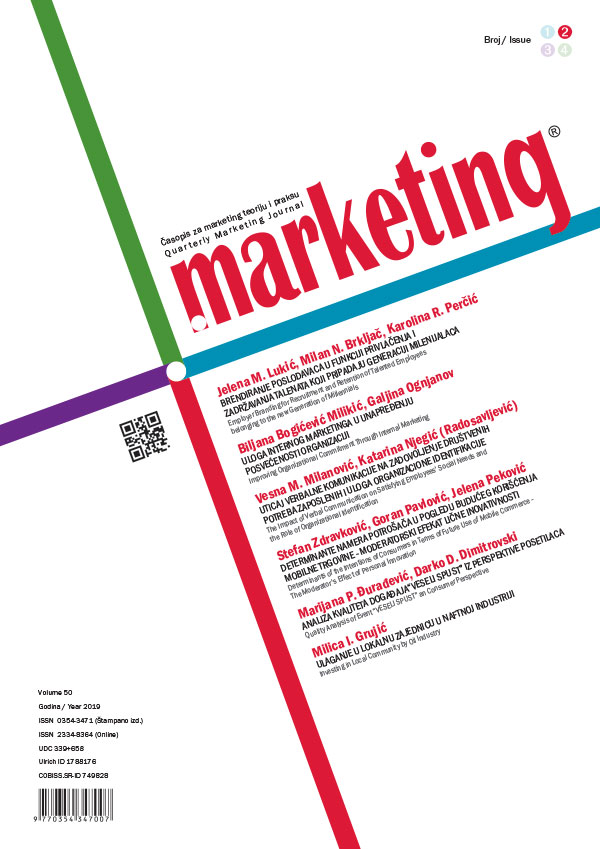
Employer Branding for the Recruitment and Retention of Talented Employees belonging to the new Generation of Millennials
Brendiranje poslodavaca u funkciji privlačenja i zadržavanja talenata koji pripadaju generaciji milenijalaca
Abstract
Employers are increasingly faced with the need to identify, attract, hire and retain the best talent from the labor market in order to survive in the condition of fierce competition. As talents are in a position to choose an employer, successful companies seek to position themselves as ideal and desirable employers through the establishment of a strong employer brand. In the process of brand establishing, by applying the knowledge from the field of marketing and human resources, employers tend to position themselves to labor market candidates as unique and desirable with ideal working conditions, while at the same time trying to increase the level of satisfaction and dedication of existing employees. A modern approach to the process of branding an employer implies taking into account the needs and desires of different generation of employees. A generation that takes an important position in society and labor market – millennium generation (also known as the generation Y) has specific needs, demands and desires when it comes to selecting an employer. In this paper are point out the key specifics of establishing employer brand in order to position it as an ideal place for talents that belong to the generation of millennials.
Apstrakt
Poslodavci se sve više trude da identifikuju, privuku, zaposle i zadrže najbolje talente u svojoj kompaniji kako bi opstali na tržištu u uslovima oštre konkurencije. Kako su talenti u poziciji da biraju poslodavca, uspešne kompanije nastoje da se pozicioniraju kao idealni i poželjni poslodavci kroz izgradnju brenda dobrog poslodavca. U procesu izgradnje brenda, primenom znanja iz oblasti marketinga i ljudskih resursa, poslodavci nastoje da se kandidatima sa tržišta rada predstave kao poslodavci sa idealnim uslovima za rad, dok kod postojećih zaposlenih nastoje da povećaju stepen zadovoljstva, posvećenosti, motivisanosti i lojalnosti. Savremeni pristup brendiranja poslodavaca podrazumeva da se uzmu u obzir potrebe i želje koje imaju različite generacije zaposlenih. Generacija koja počinje da zauzima sve značajnije pozicije u društvu i privredi – milenijumska genera-cija (poznata i pod nazivom generacija Y) ima specifične preferencije, zahteve i želje kada je reč o odabiru poslodavca. U ovom radu je ukazano na ključne specifičnosti izgradnje brenda poslodavca kako bi se poslodavac pozicionirao kao idealno mesto za rad talenata koji pripadaju generaciji milenijalaca.
References
- Aldousari, A.A., Robertson, A., Yajid, M.S.A., & Ahmed, Z.U. (2017). Impact of employer branding on organization’s performance. Journal of Transnational Management, 22(3), 153-170. doi:10.1080/15475778.2 017.1335125
- Alnıaçık, E., & Alnıaçık, Ü. (2012). Identifying Dimensions of Attractiveness in Employer Branding: Effects of Age, Gender, and Current Employment Status. Procedia – Social and Behavioral Sciences, 58, 1336-1343. doi:10.1016/j.sbspro.2012.09.1117
- Ambler, T., & Barrow, S. (1996). The employer brand. Journal of Brand Management, 4(3), 185-206. doi:10.1057/bm.1996.42
- Aslam, S., Mason, C., Zakria, A., & Farid, M. (2015). Gender perceptions: Employer branding through attractiveness, job characteristics and organizational attributes. American Journal of Trade and Policy, 2(3), 161–166.
- Backhaus, K.B. (2004). An Exploration of Corporate Recruitment Descriptions on Monster.com. Journal of Business Communication, 41(2), 115-136. doi:10.1177/0021943603259585
- Backhaus, K., & Tikoo, S. (2004). Conceptualizing and researching employer branding. Career Development International, 9(5), 501-517. doi:10.1108/13620430410550754
- Backhaus, K. (2016). Employer Branding Revisited. Organization Management Journal, 13(4), 193-201. do i:10.1080/15416518.2016.1245128
- Beardwell, J., & Claydon, T. (2010). Human Resource Management. A Contemporary Approach, Sixth Edition. Pearson Education Limited.
- Bersin, J. (2013). Predictions for 2014: Building a Strong Talent Pipeline for the Global Economic Recovery. San Francisco, CA: Deloitte Development LLC.
- Berthon, P., Ewing, M., & Hah, L. L. (2005). Captivating company: dimensions of attractiveness in employer branding. International Journal of Advertising, 24(2), 151-172. doi:10.1080/02650487.20 05.11072912
- Biswas, M.K., & Suar, D. (2016). Antecedents and Consequences of Employer Branding. Journal of Business Ethics, 136(1), 57-72. doi:10.1007/s10551-014-2502-3
- Brkljač, M., Lukić, J., & Dejanović, A. (2018). Innovations, New Technologies And Millennial Generation – Simultaneous Development. U Integrated Politics of Research and Innovations. (str. 411-418). Association of Economists and Managers of the Balkans – Udekom Balkan. doi:10.31410/limen.2018.411
- Chapman, D.S., Uggerslev, K.L., Carroll, S.A., Piasentin, K.A., & Jones, D.A. (2005). Applicant Attraction to Organizations and Job Choice: A Meta-Analytic Review of the Correlates of Recruiting Outcomes. Journal of Applied Psychology, 90(5), 928-944. doi:10.1037/0021-9010.90.5.928
- Coca-Cola HBC Srbija i Crna Gora, (2019). Da li ste znali?. Preuzeto 22.08.2019. sa:
https://rs.coca-colahellenic.com/rs/karijera/da-li-ste-znali/. - Conference Board. (2001). Engaging employees through your brand. New York, NY.
- Davidson, M.C.G., Timo, N., & Wang, Y. (2010). How much does labour turnover cost?: A case study of Australian four- and five-star hotels. International Journal of Contemporary Hospitality Management, 22(4), 451-466. doi:10.1108/95961190980000614
- Davies, G. (2008). Employer branding and its influence on managers. European Journal of Marketing, 42(5/6), 667-681. doi:10.1108/03090560810862570
- Dejanović, A., Ljubojević, Č., & Lukić, J. (2018). Definisanje ličnosti brenda grada: kako književnost može da pomogne. Marketing, časopis za marketing teoriju i praksu, 49(3); 161-171.
- DelCampo, R.G., Haggerty, L.A., Haney, M.J., & Knippel, L.A. (2011). Managing the multi-generational workforce: From the GI generation to the millennials. Gower Publishing, Ltd.
- Gaddam, S. (2008). Modelling Employer Branding Communication: The Softver Aspect of HR Marketing Management. ICFAI Journal of Soft Skills, 2(1); 45-55.
- Gilani, H., & Cunningham, L. (2017). Employer branding and its influence on employee retention: A literature review. The Marketing Review, 17(2), 239-256. doi:10.1362/146934717×149097339662
- Grace, D., & Lo, I.J. (2015). Value creation: an internal customers’ perspective. Journal of Services Marketing, 29(6/7), 560-570. doi:10.1108/jsm-09-2014-0311
- Gupta, P., Patti, R., & Marwah, S. (2014). Employer Branding: A Descriptive Study. International Journal of Economic and Management Strategy, 4(1); 1-10.
- Holbeche, L., & Matthews, G. (2012). Engaged: Unleashing your organization‘s potential through employee engagement, 1st ed. San Francisco, CA: Jossey-Bass.
- Kapoor, V. (2010). Employer Branding: A Study of Its Relevance in India. IUP Journal of Brand Management, 7, 51-75.
- Kazak, L. (2018). How to Build a Winning Employer Brand: The Case of Siemens. Preuzeto 18.06.2019. sa https://www.clappro.ch/2018/11/06/employer-branding-the-case-of-siemens-ag/.
- King, C., & Grace, D. (2008). Internal branding: Exploring the employee‘s perspective. Journal of Brand Management, 15(5), 358-372. doi:10.1057/palgrave.bm.2007.48
- Kucherov, D., & Zavyalova, E. (2012). HRD practices and talent management in the companies with the employer brand. European Journal of Training and Development, 36(1), 86-104. doi:10.1108/03090591211192647
- Kuron, L.K.J., Lyons, S.T., Schweitzer, L., & Ng, E.S.W.(2015). Millennials’ work values: differences across the school to work transition. Personnel Review, 44(6), 991-1009. doi:10.1108/pr-01-2014-0024
- Lazarević, S., & Lukić, J. (2018). Team Learning Processes and Activities in Organization: A Case Study. Economic Themes, 56(3); 301-319.
- Lee, S. (2018). Employer Branding 101: How to Attract Millennials. Preuzeto 18.06.2019. sa:
https://employers.glints.com/sg/blog/2018/06/29/employer-branding-101-how-to-attract-millennials/ - Leekha, C.N., & Sharma, S. (2014). Employer branding: strategy for improving employer attractiveness. International Journal of Organizational Analysis, 22(1), 48-60.
doi:10.1108/ijoa-09-2011-0513 - Lloyd, S. (2002). Branding from the inside out. Business Review Weekly, 24(10); 64-66.
- Love, L.F., & Singh, P. (2011). Workplace Branding: Leveraging Human Resources Management Practices for Competitive Advantage Through “Best Employer” Surveys. Journal of Business and Psychology, 26(2), 175-181. doi:10.1007/s10869-011-9226-5
- Mäkelä, K., Björkman, I., & Ehrnrooth, M. (2010). How do MNCs establish their talent pools? Influences on individuals’ likelihood of being labeled as talent. Journal of World Business, 45(2), 134-142. doi:10.1016/j.jwb.2009.09.020
- Mamula, T., Perić, N., & Vujić, N. (2019). The contribution of innovative leadership style as an answer to global and business changes. Quality -Access to Success, 20(170), 9-14. Preuzeto 26.06.2019. sa: https://www.srac.ro/calitatea/en/arhiva/2019/QAS_Vol.20_No.170_June.2019.pdf
- Martin, G., Beaumont, P., Doig, R., & Pate, J. (2005). Branding: A New Performance Discourse for HR?. European Management Journal, 23(1), 76-88. doi:10.1016/j.emj.2004.12.011
- Martin, G., Gollan, P.J., & Grigg, K. (2011). Is there a bigger and better future for employer branding?Facing up to innovation, corporate reputations and wicked problems in SHRM. The International Journal of Human Resource Management, 22(17), 3618-3637. doi:10.1080/09585192.2011.560880
- Martin, G., & Hetrick, S. (2012). Corporate reputations, branding and people management: A strategy approach to HR. New York: Taylor and Francis.
- MASMI – agencija za istraživanje tržišta (2016a). Od škole do uspeha: Milenijalsi i Generacija X. Preuzeto 25.06.2019. sa: https://masmi.rs/wp-content/uploads/2016/05/Od-skole-do-uspeha-Milenijalsi-i-Generacija-_MASMI.pdf.
- MASMI – agencija za istraživanje tržišta (2016b). Y generacija u Srbiji: Ko su (stvarno) srpski milenijalsi?Vrednosti, životni stil i potrošačko ponašanje. Preuzeto 25.06.2019. sa:
https://masmi.rs/wp-content/uploads/2016/08/Milenijalsi-u-Srbiji_Preview_MASMI.pdf. - Mastrolia, S.A., & Willits, S.D. (2013) Millennials: What Do We Really Know About Them? U Advances in Accounting Education: Teaching and Curriculum Innovations. Emerald Group Publishing Limited. 45-72. doi:10.1108/S1085-4622(2013)0000014009
- Maxwell, R., & Knox, S. (2009). Motivating employees to „live the brand“: a comparative case study of employer brand attractiveness within the firm. Journal of Marketing Management, 25(9-10), 893-907. doi:10.1362/026725709×479282
- Michaels, E., Handfiled-Jones, H., & Axelrod, B. (2001). The war for talent. Boston: Harvard Business School Publishing.
- Mihalcea, A.D. (2017). Employer Branding and Talent Management in the Digital Age. Management Dynamics in the Knowledge Economy, 5(2), 289-306. doi:10.25019/mdke/5.2.07
- Minchington, B., & Thorne, K. (2007). Measuring the effectiveness of your employer brand. Human Resources Magazine, 12(4); 14-16.
- Mirković, V., Lukić, J., Lazarević, S., & Vojinović, Ž. (2019). Key Characteristics of Organizational Structure that Supports Digital Transformation. Conference: Strategic Management and Decision Support Systems in Strategic Management – SM 2019, Faculty of Economics, Subotica, 255-261.
- Ognjanović, J., & Slavković, M. (2019). Impact of Employer Brand on Employees Satisfaction in Serbian Hotel Enterprises. Tourism in function of development of the Republic of Serbia – TICS 2019 Thematic proceedings I, 254-271.
- Özçelik, G. (2015). Engagement and Retention of the Millennial Generation in the Workplace through Internal Branding. International Journal of Business and Management, 10(3), 99-107. doi:10.5539/ijbm. v10n3p99
- Poslovi.Infostud (2018). Opšti izveštaj – Najpoželjniji poslodavac 2018. Preuzeto 22.08.2019. sa: https://poslovi.infostud.com/poslodavci/najpozeljniji-poslodavac.
- Pyöriä, P., Ojala, S., Saari, T., & Järvinen, K. M. (2017). The millennial generation: a new breed of labour?. SAGE Open, 7(1), 1-14. doi:10.1177/2158244017697158
- Rampl, L.V. (2014). How to become an employer of choice: transforming employer brand associations into employer first-choice brands. Journal of Marketing Management, 30(13–14), 1486–1504. doi:1 0.1080/0267257x.2014.934903
- Rana, R., & Kapoor, S. (2016). Exploring the Contribution of Employer Branding in Corporate Image Building. International Journal of Business and General Management, 21-32.
- Shih, W., & Allen, M. (2007). Working with Generation-D: adopting and adapting to cultural learning and change. Library Management, 28(1/2), 89-100. doi:10.1108/01435120710723572
- Slavković, M., Pavlović, G., & Simić, M. (2018). Povezanost regrutovanja i satisfakcije zaposlenih: verifikacija medijatorske uloge brenda poslodavca. Ekonomski horizonti, 20(2), 127-139. doi:10.5937/ekonhor1802127S
- Sujansky, J., & Ferri-Reed, J. (2009). Keeping the Millennials: Why companies are losing billions in turnover to this generation-and what to do about it. John Wiley and Sons.
- Theurer, C.P., Tumasjan, A., Welpe, I.M., & Lievens, F. (2016). Employer Branding: A Brand Equity-based Literature Review and Research Agenda. International Journal of Management Reviews, 20(1), 155-179. doi:10.1111/ijmr.12121
- Thorne, K. (2004). One-stop guide: Employer branding. Personnel Today, 30, 66–75.