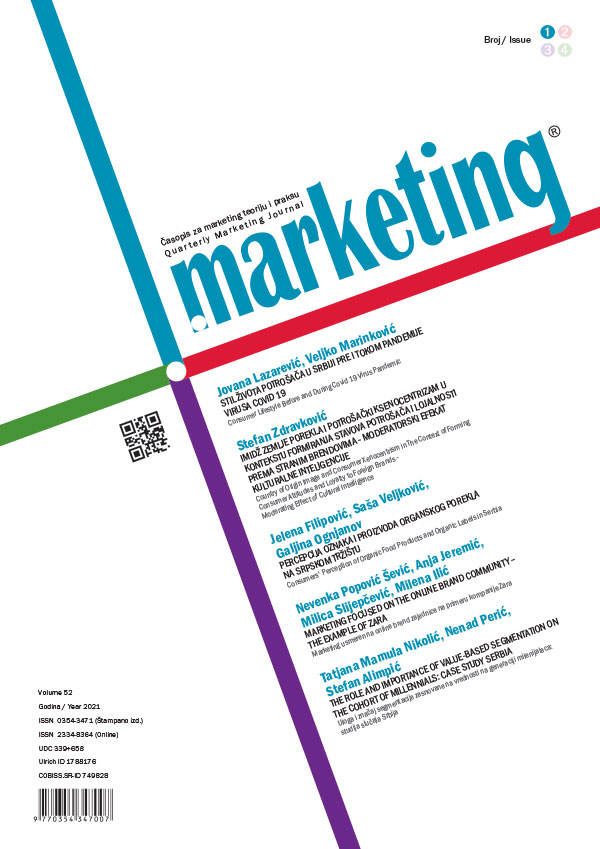
Consumer Lifestyle Before and During Covid 19 Virus Pandemic
Stil života potrošača u Srbiji pre i tokom pandemije virusa Covid 19
Abstract
The proclamation of the COVID 19 virus pandemic has changed the way people live in almost all parts of the world. Due to the pandemic, consumers are adapting to the new circumstances not only by respecting epidemiological measures but also by changing their habits in everyday life. The aim of this paper is to identify changes in consumer lifestyle as a consequence of the current COVID 19 pandemic. The research was conducted on a sample of 153 respondents by observing their eaiting habits, travel, use of electronic shopping and payment channels and healthy lifestyle. Based on the analysis of the collected primary data in the SPSS program, the results indicate thatlifestyle related to travel, use of electronic shopping and payment channels and healthy lifestyle significantly differs, while eating habits also changed but in lower degree. The conducted research contributes to the generation of useful knowledge in order to better understand the COVID 19 virus, which is still unknown to the scientific community and various market actors, as well as its effects on everyday life of people.
Apstrakt
Proglašenje pandemije virusa COVID 19 promenilo je način života ljudi u gotovo svim delovima sveta. Potrošači se usled pandemije prilagođavaju novonastalim okolnostima ne samo pridržavanjem epidemioloških mera već i promenom svojih navika u svakodnevnom životu. Cilj rada je da se identifikuju promene u stilu života potrošača kao posledice aktuelne pandemije virusa COVID 19. Istraživanje je sprovedeno na uzorku od 153 ispitanika uz posmatranje njihovog načina ishrane, putovanja, korišćenja elektronskih kanala kupovine i plaćanja i zdravog načina života. Na osnovu analize prikupljenih primarnih podataka u programu SPSS došlo se do rezultata da se stil života potrošača u pogledu putovanja, upotrebe elektronskih kanala kupovine i plaćanja i vođenja zdravog načina života značajno razlikuje u periodu pre i tokom pandemije, dok je način ishrane takođe doživeo promene ali u manjem stepenu. Sprovedeno istraživanje doprinosi generisanju korisnih znanja u cilju boljeg sagledavanja virusa COVID 19 koji je još uvek nepoznanica za naučnu zajednicu i različite tržišne aktere, kao i efekata istog na svakodnevni život ljudi.
References
- Al-Dmour, R., Hammdan, F., Al-Dmour, H. and Khwaldeh, S. M. (2017). The effect of lifestyle on online purchasing decision for electronic services: the Jordanian flying e-tickets case. Asian Social Science, 13(11), 157-169. DOI: 10.5539/ass. v13n11p157
- Ashby, N. J. (2020). Impact of the COVID-19 pandemic on unhealthy eating in populations with obesity. Obesity, 28(10), 1802-1805. DOI: https://doi.org/10.1002/oby.22940
- Batlle-Bayer, L., Aldaco, R., Bala, A., Puig, R., Laso, J., Margallo, M., Vasquez-Rowe, I., Anto, M.J. and Fullana-i-Palmer, P. (2020). Environmental and nutritional impacts of dietary changes in Spain during the COVID-19 lockdown. Science of The Total Environment, 748, 141410. DOI: https://doi.org/10.1016/j.scitotenv.2020.141410
- Beck, M. J. and Hensher, D. A. (2020). Insights into the impact of COVID-19 on household travel and activities in Australia–The early days of easing restrictions. Transport policy, 99, 95-119. DOI: https://doi.org/10.1016/j.tranpol.2020.08.004
- Bonaccorsi, G., Pierri, F., Cinelli, M., Flori, A., Galeazzi, A., Porcelli, F., Schmidt, A.L., Valensise, C. M., Scala, A., Quattrociocchi, W. and Pammolli, F.(2020). Economic and social consequences of human mobility restrictions under COVID-19. Proceedings of the National Academy of Sciences, 117(27), 15530-15535. DOI: https://doi.org/10.1073/pnas.2007658117
- Bradbury-Jones, C. and Isham, L. (2020). The pandemic paradox: The consequences of COVID-19 on domestic violence. Journal of clinical nursing, 29(13-14), 2047-2049. DOI: 10.1111/jocn.15296
- Brunsø, K., Scholderer, J. and Grunert, K. G. (2004). Testing relationships between values and food-related lifestyle: results from two European countries. Appetite, 43(2), 195-205. DOI: https://doi.org/10.1016/j.appet.2004.05.001
- Chang, H. H. and Meyerhoefer, C. D. (2020). COVID-19 and the Demand for Online Food Shopping Services: Empirical Evidence from Taiwan. American Journal of Agricultural Economics. Preuzeto sa: https://onlinelibrary.wiley.com/ doi/10.1111/ajae.12170 (datum preuzimanja: 12.11.2020.)
- Cheval, B., Sivaramakrishnan, H., Maltagliati, S., Fessler, L., Forestier, C., Sarrazin, P., Orsholits, D., Chalabaev, A., Sander, D., Ntoumanis, N. and Boisgontier, M. P. (2020). Relationships between changes in self-reported physical activity, sedentary behaviour and health during the coronavirus (COVID-19) pandemic in France and Switzerland. Journal of sports sciences. Preuzeto sa: https://www.tandfonline.com/doi/full/10.1080/02640 414.2020.1841396 (datum preuzimanja: 10.11.2020.)
- Chopra, S., Ranjan, P., Singh, V., Kumar, S., Arora, M., Hasan, M. S., Kasiraj, R., Suryansh., Kaur, D., Vikram, K. N., Malhotra, A., Kumari, A., Klanidhi, B. K. and Baitha, U. (2020). Impact of COVID-19 on lifestyle-related behaviours-a cross-sectional audit of responses from nine hundred and ninety-five participants from India. Diabetes & Metabolic Syndrome: Clinical Research & Reviews, 14(6), 2021-2030. DOI: 10.1016/j. dsx.2020.09.034
- Damijanić Težak, A. (2019). Wellness and healthy lifestyle in tourism settings. Tourism Review, 74(4), 78-989. DOI: https://doi.org/10.1108/TR-02-2019-0046
- Di Renzo, L., Gualtieri, P., Pivari, F., Soldati, L., Attinà, A., Cinelli, G., Leggeri, C., Caparello, G., Barrea, L., Scerbo, F., Esposito, E. and De Lorenzo, A. (2020). Eating habits and lifestyle changes during COVID-19 lockdown: an Italian survey. Journal of Translational Medicine, 18(1), 1-15. DOI: https://doi.org/10.1186/s12967-020-02399-5
- Divine, R. L. and Lepisto, L. (2005). Analysis of the healthy lifestyle consumer. Journal of consumer marketing, 22(5), 275-283. DOI: https://doi.org/10.1108/07363760510611707
- Fiorillo, A. and Gorwood, P. (2020). The consequences of the COVID-19 pandemic on mental health and implications for clinical practice. European Psychiatry, 63(1). 1-2. DOI: https://doi.org/10.1192/j. eurpsy.2020.35
- Gao, X., Shi, X., Guo, H. and Liu, Y. (2020). To buy or not buy food online: The impact of the COVID-19 epidemic on the adoption of e-commerce in China. PloS one, 15(8), e0237900. DOI: https://doi.org/10.1371/journal.pone.0237900
- Gössling, S., Scott, D. and Hall, C. M. (2020). Pandemics, tourism and global change: a rapid assessment of COVID-19. Journal of Sustainable Tourism, 29(1). 1-20. DOI:10.1080/09669582.2020.1758708
- Hall, G., Laddu, D. R., Phillips, S. A., Lavie, C. J. and Arena, R. (2020). A tale of two pandemics: How will COVID-19 and global trends in physical inactivity and sedentary behavior affect one another?. Progress in Cardiovascular Diseases, 2020. DOI: 10.1016/j. pcad.2020.04.005
- Helmy, Y. A., Fawzy, M., Elaswad, A., Sobieh, A., Kenney, S. P. and Shehata, A. A. (2020). The COVID-19 pandemic: a comprehensive review of taxonomy, genetics, epidemiology, diagnosis, treatment, and control. Journal of Clinical Medicine, 9(4), 1225-1253. DOI: https://doi.org/10.3390/jcm9041225
- Huang, Y. and Zhao, N. (2020). Generalized anxiety disorder, depressive symptoms and sleep quality during COVID-19 outbreak in China: a web-based cross-sectional survey. Psychiatry research, 288. Preuzeto sa: https://www.ncbi.nlm.nih.gov/pmc/articles/PMC7152913/ (datum preuzimanja: 05.11.2020.)
- Jensen, M. (2007). Defining lifestyle, Environmental Sciences, 4(2), 63-73. DOI: 10.1080/15693430701472747
- Kumari, A., Ranjan, P., Vikram, N. K., Kaur, D., Sahu, A., Dwivedi, S. N., Beitha, U. and Goel, A. (2020). A self-reported questionnaire to assess changes in lifestyle-related behaviour during COVID 19 pandemic. Diabetes & Metabolic Syndrome, 14(6). 1697-1701. DOI: 10.1016/j.dsx.2020.08.020
- Laguna, L., Fiszman, S., Puerta, P., Chaya, C. and Tárrega, A. (2020). The impact of COVID-19 lockdown on food priorities. Results from a preliminary study using social media and an online survey with Spanish consumers. Food quality and preference, 86, 104028. DOI:
https://doi.org/10.1016/j. foodqual.2020.104028 - Lawson, M., Piel, M. H. and Simon, M. (2020). Child maltreatment during the covid-19 pandemic: Consequences of parental job loss on psychological and physical abuse towards children. Child abuse & neglect, 104709. Preuzeto sa: https://www.ncbi.nlm.nih.gov/pmc/articles/PMC7472978/ (datum preuzimanja: 25.10.2020.)
- Marelli, S., Castelnuovo, A., Somma, A., Castronovo, V., Mombelli, S., Bottoni, D., Leitner, C., Fossat, A. and Ferini-Strambi, L. (2020). Impact of COVID-19 lockdown on sleep quality in university students and administration staff. Journal of Neurology. Preuzeto sa: https://link.springer.com/article/10.1007/s00415-020-10056-6 (datum preuzimanja: 05.11.2020.) 25. Maričić, B. (2011). Ponašanje potrošača. Beograd: CID Ekonomskog fakulteta.
- Marjanović, D. i Đukić, M. (2020). Ekonomske mere za ublažavanje posledica COVID-19. U: P. Mitić i D. Marjanović (ur.), Black swan in the world economy 2020 (str. 91-105). Beograd: Institut ekonomskih nauka.
- Mitchell, A. (1983). The nine American lifestyles: Who we are and where we‘re going. USA: Scribner Book Company.
- Mothersbaugh, D. L. and Hawkins, D. I. (2016). Consumer behavior: Building marketing strategy. USA: McGraw-Hill Inc.
- Papaoikonomou, E. (2013). Sustainable lifestyles in an urban context: towards a holistic understanding of ethical consumer behaviours. Empirical evidence from Catalonia, Spain. International Journal of Consumer Studies, 37(2), 181-188. DOI: https://doi.org/10.1111/j.1470-6431.2012.01111.x
- Plummer, J. T. (1977). Consumer focus in cross-national research. Journal of Advertising, 6(2), 5-15. DOI: 10.1080/00913367.1977.10672687
- Praščević, A. (2020). Ekonomski šok pandemije COVID 19–prekretnica u globalnim ekonomskim kretanjima. Ekonomske ideje i praksa, 37, 7-22. Preuzeto sa:
https://ideas.repec.org/a/beo/ekidpr/y2020i37p7-22.html (datum preuzimanja: 25.10.2020.) - Savelli, E., Francioni, B. and Curina, I. (2019). Healthy lifestyle and food waste behavior. Journal of Consumer Marketing, 37(2), 148-159. DOI: https://doi.org/10.1108/JCM-10-2018-2890
- Shamshiripour, A., Rahimi, E., Shabanpour, R. and Mohammadian, A. K. (2020). How is COVID-19 reshaping activity-travel behavior? Evidence from a comprehensive survey in Chicago. Transportation Research Interdisciplinary Perspectives, 7, 100216. DOI: https://doi.org/10.1016/j.trip.2020.100216
- Sharma, P., Singh, S. and Misra, R. (2020). Wine-related lifestyle segmentation in the context of urban Indian consumers. International Journal of Wine Business Research, 32(4), 503-522. DOI: https://doi.org/10.1108/IJWBR-05-2019-0036
- Sher, L. (2020). The impact of the COVID-19 pandemic on suicide rates. QJM: An International Journal of Medicine, 113(10), 707-712. DOI: https://doi.org/10.1093/qjmed/hcaa202
- Seetharaman, P. (2020). Business models shifts: Impact of Covid-19. International Journal of Information Management, 54. Preuzeto sa: https://www.sciencedirect.com/science/article/pii/S0268401220309890 (datum preuzimanja: 10.11.2020.)
- Sidor, A. and Rzymski, P. (2020). Dietary Choices and Habits during COVID-19 Lockdown: Experience from Poland. Nutrients, 12(6). Preuzeto sa: https://www.ncbi.nlm.nih.gov/pmc/articles/PMC7352682/ (datum preuzimanja: 27.10.2020.)
- Sreelakshmi, C. C. and Prathap, S. K. (2020). Continuance adoption of mobile-based payments in Covid-19 context: an integrated framework of health belief model and expectation confirmation model. International Journal of Pervasive Computing and Communications, 16(4), 351-369. DOI: 10.1108/IJPCC-06-2020-0069
- Turnšek, M., Brumen, B., Rangus, M., Gorenak, M., Mekinc, J. and Štuhec, T. L. (2020). Perceived threat of COVID-19 and future travel avoidance: Results from an early convenient sample in Slovenia. Academica Turistica-Tourism and Innovation Journal, 13(1). 3-19. DOI: 10.26493/2335-4194.13.3-19
- Wang, W., Keh, H. T. and Bolton, L. E. (2010). Lay theories of medicine and a healthy lifestyle. Journal of Consumer Research, 37(1), 80-97. DOI: https://doi.org/10.1086/649772
- Wheaton, B. (2004). Understanding lifestyle sport: Consumption, identity and difference. UK: Routledge.
- Wells, W. and Tigert, D. (1971). Activities, interests, and opinions. Journal of Advertising Research, 11(4), 27-35. Preuzeto sa: https://www.academia.edu/35135929/ Activities_Interests_and_Opinions (datum preuzimanja: 28.01.2021.)
- Woods, J., Hutchinson, N. T., Powers, S. K., Roberts, W. O., Gomez-Cabrera, M. C., Radak, Z., Berkes, I., Boros, A., Boldogh, I., Leeuwenburgh, C., Coelho-Junior, H.J., Marzetti, E., Cheng, Y., Liu, J., Durstine, M., Sun, J. and Ji. L.L. (2020). The COVID-19 pandemic and physical activity. Sports Medicine and Health Science, 2(2), 55-64. DOI: https://doi.org/10.1016/j.smhs.2020.05.006
- Yu, C. S. (2011). Construction and validation of an e-lifestyle instrument. Internet Research, 21(3), 214- 235. DOI: 10.1108/10662241111139282
- Yu, C. S. (2015). Using e-lifestyle to analyze mobile banking adopters and non-adopters. Journal of Global Information Technology Management, 18(3), 188-213. DOI: https://doi.org/10.1080/1097198X.2015.1070619
- Zwanka, R. J. and Buff, C. (2021). COVID-19 generation: a conceptual framework of the consumer behavioral shifts to Be caused by the COVID-19 pandemic. Journal of International Consumer Marketing, 33(1), 58-67. DOI: https://doi.org/10.1016/j.jbusres.2020.05.059