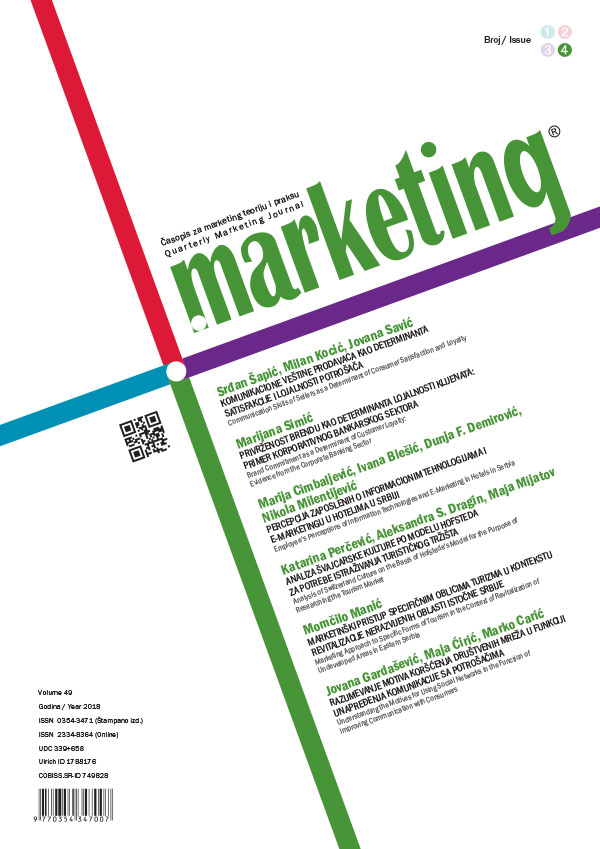
Communication skills of sellers as a determinant of consumer satisfaction and loyalty
Komunikacione veštine prodavaca kao determinanta satisfakcije i lojalnosti potrošača
Abstract
The quality of interaction between sellers and consumers is the starting point for developing satisfaction and establishing long-term relationships between enterprises and consumers. The aim of the paper is to examine the influ-ence of verbal and non-verbal communication skills of the sellers on consumer satisfaction and loyalty, relying on the dimensions of the SERVQUAL model. Empirical research was conducted on a sample of 229 consumers and the data were analyzed in statistical software SPSS. The research found that the possession of the verbal and non-verbal communication skills of sellers determines the consumer satisfaction and loyalty, where the strength of the influence of non-verbal communication skills in both cases is stronger than the strength of the influence of verbal communication skills. It has been additionally tested and confirmed that satisfaction has a mediating effect when considering the relationship between the verbal and non-verbal communication skills of the sellers and the consumer loyalty. The paper points to the importance of analysis of the communication relationship quality established between sellers and consumers, and its results can have practical implications in the business practice of modern enterprises.
Apstrakt
Kvalitet interakcije između prodavaca i potrošača polazna je osnova za razvoj zadovoljstva i uspostavljanje dugoročnih odnosa između preduzeća i potrošača. Cilj rada je da se ispita uticaj veština verbalne i neverbalne komunikacije prodavaca na satisfakciju i lojalnost potrošača oslanjajući se na dimenzije SERVQUAL modela. Sprovedeno je empirijsko istraživanje na uzorku od 229 potrošača a podaci su analizirani u statističkom softveru SPSS. Istraživanjem je utvrđeno da posedovanje veština verbalne i neverbalne komuniacije prodavaca determiniše satisfakciju i lojalnost potrošača, pri čemu je jačina uticaja veština neverbalne komunikacije u oba slučaja jača u odnosu na jačinu uticaja verbalne komunikacije. Dodatno je ispitano i potvrđeno da satisfakcija ima medijatorski efekat kada se posmatra odnos između veština verbalne i neverbalne komunikacije prodavaca i lojalnosti potrošača. Rad ukazuje na značaj analize kvaliteta komunikacionog odnosa koji se uspostavlja između prodavaca i potrošača a njegovi rezultati mogu imati praktične implikacije u poslovnoj praksi savremenih preduzeća.
References
- Agnihotri, R., Rapp, A., Trainor, K. (2009). Understanding the role of information communication in the buyer-seller exchange process: antecedents and outcomes, Journal of Business & Industrial Marketing, 24(7), 474-486.
- Albarq, A. N. (2013). Applying a SERVQUAL model to measure the impact of service quality on customer loyalty among local Saudi banks in Riyadh. American Journal of Industrial and Business Management, 3(8), 700-707.
- Ambady, N., Krabbenhoft, М., Hogan, D. (2006). The 30- sec Sale: Using Thin-Slice Judgments to Evaluate Sales Effectiveness. Journal of Consumer Psychology, 16 (1), 4-13.
- Bubnjević, D. (2013). Etički aspekti prodaje. Ekonomski vidici, 18(4), 507-518.
- Chen, C. (2015). Customer value and customer loyalty: Is competition a missing link?. Journal of Retailing and Consumer Services, 22, 107-116.
- Drinić, D., Vranješ, M., Gašević, D. (2014). Koncept lojalnosti potrošača u maloprodaji. Škola biznisa, 2, 91-106.
- Đukić, S., Đorđević, B., Berber, N. (2018). Uticaj ponašanja zaposlenih na percipirani kvalitet usluge. Marketing, 49(1), 19-29.
- Fehrić, F., Jerković, D. (2011). Marketing komuniciranje u funkciji uspješne prodaje, Tranzicija, 28, 89-103.
- Fernandes, A. A. R., Solimun, S. (2018). The mediation effect of customer satisfaction in relationship between service quality, service orientation and marketing mix strategy to customer loyalty. Journal of Management Development, 37(1), 76-87.
- Foster, B. D., Cadogan, J. W. (2000). Relationship selling and customer loyalty: an empirical investigation. Marketing Intelligence & Planning, 18(4), 185-199.
- Garber, L.L., Honeycutt Jr, E.D., Dotson, M.J. (2015). The use of personal appearance cues to infer sales rep character. International Journal of Management Practice, 8(1), 1–20.
- Gorondutse, A. H., Hilman, H. (2014). Mediation effect of customer satisfaction on the relationships between service quality and customer loyalty in the Nigerian foods and beverages industry: Sobel test approach. International Journal of Management Science and Engineering Management, 9(1), 1-8.
- Karunaratna, A. (2014). Service quality and customer loyalty: adequacy of servqual model. Global Journal of Commerce & Management Perspective, 3(4), 20-26.
- Kim, J. E., Ju, H. W., Johnson, K. K. (2009). Sales associate‘s appearance: Links to consumers’ emotions, store image, and purchases. Journal of Retailing and Consumer Services, 16(5), 407-413.
- Lam, Y., Shankar, V., Erramilli, K., Murthy, B. (2004). Customer value, satisfaction, loyalty, and switching costs: an illustration from a business-to-business service context. Journal of the academy of marketing science, 32(3), 293-311.
- Lewis, B. R., Soureli, M. (2006). The antecedents of consumer loyalty in retail banking. Journal of Consumer Behaviour: An International Research Review, 5(1), 15-31.
- Liu, A. H., Leach, M. P. (2001). Developing Loyal Customers with a Value-Adding Sales Force: Examining Customer Satisfaction and the Perceived Credibility of Consultative Salespeople. Journal of Personal Selling and Sales Management, 21(2), 147-156.
- Mađarac, S., Jelica, S. (2015). Poslovna komunikacija–poseban osvrt na njezinu ulogu u prodaji roba i usluga. Mostariensia, 19(1), 149-158.
- Maričić, B. (2011). Ponašanje potrošača. Beograd: Centar za izdavačku delatnost Ekonomskog fakulteta
- Maričić, B., Veljković, S., Đorđević, A. (2012). Merenje satisfkcije potrošača. Marketing, 43(4), 235-244.
- Marinković, V., Senić, V., Kocić, M., Šapić, S. (2013). Investigating the impact of SERVQUAL dimensions on customer satisfaction: The lessons learnt from Serbian travel agencies. International Journal of Tourism Research, 15(2), 184-196.
- Milner, R., Furnham, A. (2017). Measuring customer feedback, response and satisfaction. Psychology, 8(3), 350-362.
- Ndubisi, O. N. (2007). Relationship marketing and customer loyalty. Marketing intelligence & planning, 25(1), 98-106.
- Palmatier, W., Scheer, K., Steenkamp, E. (2007). Customer loyalty to whom? Managing the benefits and risks of salesperson-owned loyalty. Journal of marketing research, 44(2), 185-199.
- Parasuraman, A., Zeithaml, V. A., Berry, L. L. (1988). Servqual: A multiple-item scale for measuring consumer perceptions of service qulity. Journal of retailing, 64(1), 12-40.
- Pavlović, A., Grebenar, L., Zahirović, M. (2012). Izgradnja komunikacije s klijentima u bankama. U: Z. Grandov, M. Laketa & S. Jakupović (ur.), Zbornik radova 1. Međunarodni naučni skup „Moć komunikacije 2012“, (str. 173-187), Banja Luka: Panevropski univerzitet „Apeiron”
- Peterson, T. (2005). An examination of the relative effectiveness of training in nonverbal communication: Personal selling implications, Journal of Marketing Education, 27(2), 143-150.
- Plank, R. E., Belonex, J. J., Newell, S. J. (2008). Impact of Purchase Importance and Salesperson Behaviors on Relationship Loyalty. Journal of Selling & Major Account Management, 8(2), 8-25.
- Rahim, A. G. (2016). Perceived service quality and customer loyalty: The mediating effect of passenger satisfaction in the Nigerian Airline Industry. International journal of management and economics, 52(1), 94-117.
- Rakić, M., Rakić, B. (2011). Imidž maloprodavaca. Industrija, 39(3), 127-138.
- Reynolds, K. E., Arnold, M. J. (2000). Customer loyalty to the salesperson and the store: examining relationship customers in an upscale retail context. Journal of personal selling & sales management, 20(2), 89-98.
- Shao, Y., Baker, A., Wagner, J. (2004). The effects of appropriateness of service contact personnel dress on customer expectations of service quality and purchase intention: The moderating influences of involvement and gender. Journal of Business Research, 57(10), 1164-1176.
- Söderlund, M., Julander, C. R. (2009). Physical attractiveness of the service worker in the moment of truth and its effects on customer satisfaction. Journal of Retailing and Consumer Services, 16(3), 216-226.
- Šapić, S., Topalović, S., Marinković, V. (2014). Uticaj dimenzija percipirane vrednosti na lojalnost klijenata. Ekonomske teme, 52(4), 401-417.
- Ul Zia, N., Akram, M. W. (2016). Impact of Salesman Behavior on Customer Satisfaction: An Emprical Study of Dairy Retail Handlers. Kuwait Chapter of Arabian Journal of Business and Management Review, 5(8), 1-13.
- Williams, C., Spiro., L. (1985). Communication Style in the Salesperson-Customer Dyad. Journal of Marketing Research, 22(4), 434-442.
- Yoo, W., Mayberry, R., Bae, S., Singh, K., He, Q. P., Lillard Jr, J. W. (2014). A study of effects of multicollinearity in the multivariable analysis. International journal of applied science and technology, 4(5), 9-19.
- Yoon, S., Kim, S., Kim, J., You, Y. (2016). A study on the impact of consultants’ nonverbal communication on customer satisfaction, trust, and long-term relationship orientation of the client firm. Indian Journal of Science and Technology, 9(26), 1-8.
- Yilmaz, V., Ari, E., Gürbüz, H. (2018). Investigating the relationship between service quality dimensions, customer satisfaction and loyalty in Turkish banking sector: An application of structural equation model. International Journal of Bank Marketing, 36(3), 423-440.