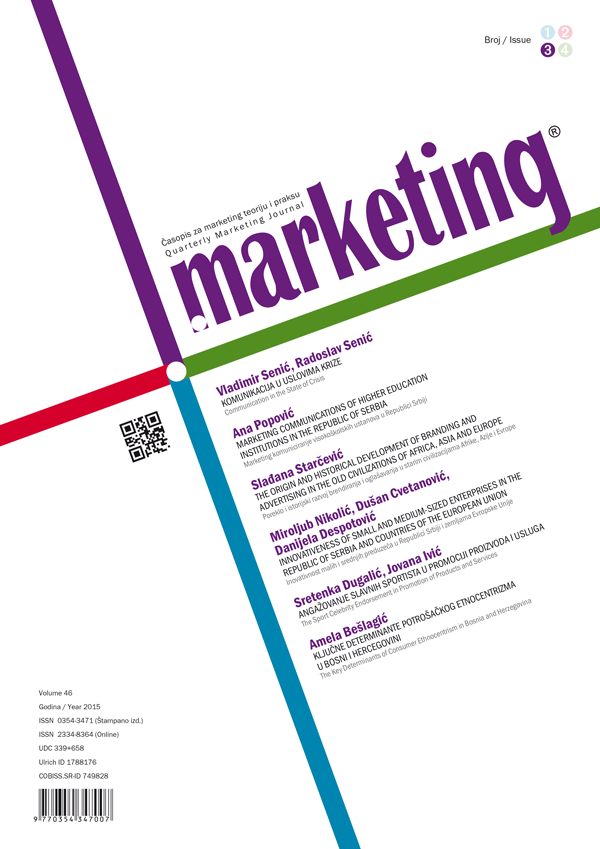
Innovativeness of Small and Medium-Sized Enterprises in the Republic of Serbia and Countries of the European Union
Inovativnost malih i srednjih preduzeća u Republici Srbiji i zemljama Evropske Unije
Abstract
The paper provides a comparative analysis of the results of innovation activities in enterprises of different size from EU member and candidate states during the period 2008-2010. Particularly, the paper considers position of Serbia compared to the EU average and average of some neighboring countries (Hungary, Slovenia, Croatia, Romania and Bulgaria). The results confirmed the existence of a high correlation between size of enterprise and its innovation activities. The percentage of innovation activities in large enterprises is higher than in small enterprises. Serbia is lagging behind the EU average, regarding innovativeness level in all types of enterprises (classified by size). However, when Serbia is compared to neighboring countries, the situation is much different. Small enterprises from Serbia are more innovative than small enterprises from neighboring countries. The situation is similar in medium-sized enterprises. Large enterprises from Serbia are more innovative than enterprises from Bulgaria, Hungary and Romania, and less innovative than large enterprises from Slovenia and Croatia.
Apstrakt
U radu je data komparativna analiza rezultata inovacionih aktivnosti preduzeća različitih veličina iz zemalja članica EU i zemalja kandidata za članstvo u EU u periodu 2008 – 2010. godine. Posebno je sagledavan položaj Srbije u odnosu na prosek EU i pojedinih zemalja iz okruženja (Mađarske, Slovenije, Hrvatske, Rumunije i Bugarske). Rezultati su potvrdili postojanje visoke korelacije između veličine preduzeća i njihovih inovacionih aktivnosti. U velikim preduzećima je procenat inovacionih aktivnosti veći u odnosu na mala preduzeća. Za Srbiju je karakteristično zaostajanje u nivou inovativnosti kod svih tipova preduzeća prema veličini u odnosu na prosek EU. Međutim u odnosu na zemlje u okruženju situacija je značajno drugačija. Mala preduzeća iz Srbije su inovativnija od malih preduzeća iz zemalja u okruženju. Slična je situacija i kod srednjih preduzeća. Velika preduzeća iz Srbije inovativnija su od preduzeća iz Bugarske, Mađarske i Rumunije, a manje su inovativna od istih iz Slovenije i Hrvatske.
References
- Acs, Z. J., de Groot, H. L., & Nijkamp, P. (Eds.). (2013). The emergence of the knowledge economy: A regional perspective. Springer Science & Business Media.
- Cvetanović, S. Despotovic, D.(2014) Knowledge as the component of human capital in economic growth models. Škola biznisa, 1, 1-17.
- Cvetanović, S., Despotović, D., & Nedić, V. (2012). Comparative analysis of business sophistication of Serbia and its neighboring countries. Industrija, 40(4), 89-106.
- Cvetanović, S., Ilić, V., Despotovic, D., & Nedić, V. (2015). Knowledge Economy Readiness, Innovativeness and Competitiveness of the Western Balkan Countries. Industrija, 43(3).
- Despotovic, D. Z., Cvetanović, S. Ž., & Nedić, V. M.(2014). Innovativeness and competitiveness of the Western Balkan countries and selected EU member states. Industrija, 42(1).
- Eurostat (online data code: inn_cis7_coop), accessed 15.9.2015. http://appsso.eurostat.ec.europa.eu/nui/show.do?dataset=inn_cis7_coop&lang=en,
- Eurostat (online data code: inn_cis7_coop), accessed 27.9.2015. http://appsso.eurostat.ec.europa.eu/nui/show.do?wai=true&dataset=inn_cis7_coop,
- Eurostat (online data code: inn_cis7_type), http://appsso.eurostat.ec.europa.eu/nui/submitViewTableAction.do, accessed 15.10.2015.
- Eurostat, http://appsso.eurostat.ec.europa.eu/nui/submitViewTableAction.d, accessed 22.10.2015.
- Filipović, M., Nikolić, M., & Cvetanović, S. [2015]. Razvoj preduzetničkog sektora kao osnove jačanja konkurentnosti privrede. Ekonomika preduzeća, 63(3-4), 205-221.
- Filipović, M., Nikolić, M., Ilić V. [2015], Razvoj privrede zasnovane na znanju kao faktor povećanja konkurentnosti privrede Srbije, Ekonomske teme, Vol 53(2), p.191-214
- Johannessen, J. A., & Olsen, B. (2010). The future of value creation and innovations: Aspects of a theory of value creation and innovation in a global knowledge economy. International Journal of Information Management, 30(6), 502-511.
- Kaufmann, H. R., Tsangar, H., & Vrontis, D. (2012). Innovativeness of European SMEs: Mission not yet accomplished1. Ekonomska Istrazivanja, 25(2), 333
- Lundvall, B. Å., & Lorenz, E. (2012). From the Lisbon strategy to Europe 2020. Towards a social investment welfare state, 333-351.
- Lundvall, B., & Rodrigues, M. J. (Eds.). (2002). The New Knowledge Economy in Europe: a strategy for international competitiveness and social cohesion. Edward Elgar Publishing.
- Nedic, V., Despotovic, D., Cvetanovic, S., Despotovic, M., & Eric, M. (2015). Innovation of IT metasystems by means of event-driven paradigm using QDMS. Enterprise Information Systems, (ahead-of-print), 1-18.
- Oksanen, J., & Rilla, N. (2009). Innovation and entrepreneurship: New innovations as source for competitiveness in Finnish SMEs. International Journal of Entrepreneurship, 13, 35.
- Pérez-Luño, A., Medina, C. C., Lavado, A. C., & Rodríguez, G. C. (2011). How social capital and knowledge affect innovation. Journal of Business Research, 64(12), 1369-1376.
- Pokrajac, S., (2010), Preduzetništvo: izazovai i putevi „kreativne destrukcije“ privrede Srbije, Beograd: Mašinski fakultet.
- Quintane, E., Mitch Casselman, R., Sebastian Reiche, B., & Nylund, P. A. (2011). Innovation as a knowledge-based outcome. Journal of Knowledge Management, 15(6), 928-947.
- Tilford, S., & Whyte, P. (2010). The Lisbon Scorecard X: The Road to 2020. London: Centre for European Reform.
- Van de Vrande, V., De Jong, J. P., Vanhaverbeke, W., & De Rochemont, M. (2009). Open innovation in SMEs: Trends, motives and management challenges. Technovation, 29(6), 423-437.
- Zhou, K. Z., & Li, C. B. (2012). How knowledge affects radical innovation: Knowledge base, market knowledge acquisition, and internal knowledge sharing. Strategic Management Journal, 33(9), 1090-1102.