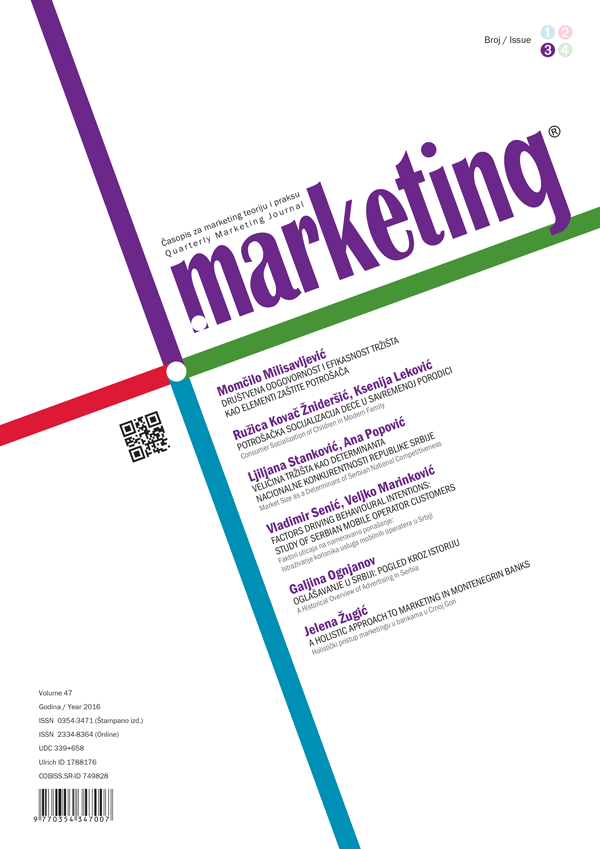
A Holistic Approach to Marketing in Montenegrin Banks
Holistički pristup marketingu u bankama u Crnoj Gori
Abstract
In modern conditions of market globalization and strong competition, it is necessary to improve a holistic approach to marketing in banks. This paper is based on the research conducted in the banks in Montenegro. The goal of this study was to determine whether the Montenegrin banks have clearly redefined the concept of marketing, recognized the specific nature of marketing in banking and adopted a holistic marketing concept in modern banking. The main purpose of marketing in banking is to attract, retain and develop long-term relationships with customers and other stakeholders. Also, the marketing concept in banking includes the achievement of full cooperation with customers through relationship marketing, customer relationship management (CRM), alternative distribution channels in modern banking and, in general, a holistic approach to marketing. Holistic marketing analysis will help identify the strengths and weaknesses in marketing in the banking sector of Montenegro and give platform for strategic planning for its further development.
Apstrakt
U savremenim uslovima globalizacije tržišta i jake konkurencije, neophodno je unaprediti holistički pristup marketingu u bankarstvu. Ovaj rad je zasnovan na istraživanju sprovedenom u bankama u Crnoj Gori. Cilj ovog istraživanja je bio utvrditi da li banke u Crnoj Gori imaju precizno definisan koncept marketinga, prepoznatu specifičnu prirodu marketinga u bankarstvu i prihvaćen holistički pristup koncepta modernog marketinga. Glavna svrha marketinga u bankarstvu je privući, zadržati i razviti dugoročne odnose s klijentima i drugim akterima. Takođe, koncept marketinga u bankarstvu uključuje ostvariva nje pune saradnje sa kupcima kroz relacioni marketing, upravljanje odnosima sa kupcima (CRM), alternativnih kanala distribucije u modernom bankarstvu i, uopšte, holistički pristup marketingu. Marketinške analize pomoći će identifikovanju prednosti i nedostataka u marketingu u bankarskom sektoru Crne Gore i dati platformu za strateško planiranje za njegov dalji razvoj.
References
- Babić-Hodović, V. (2012). Marketing in Banking, Sarajevo: Faculty of Economics.
- Barnes, J.G. (2001). Secrets of Customer Relationship Management. New York: McGraw Hill Co.
- Belgrade Institute of Economic Sciences (2011). Macroeconomic Analysis and Trends Research [online]. Available at: http://www.ecinst.org.rs (Accessed 15th September 2015).
- Berlon, D. (2009). Where Do People Do Their Banking? You Might Be Surprised, GALLUP Management Journal. Available at www.gmj.gallup.com/content/116488/people-banking.aspx
- Board of Governors of Federal Reserve System (2015, Consumers and Mobile Financial Services 2015. http://www.federalreserve.gov/econresdata/consumersand-mobile-financial-services-report-201503.pdf (Accessed 10th December, 2016)
- Cravens, W.D., Nigel, F.P. (2006). Strategic Marketing. McGraw-Hill.
- Central bank of Montenegro (2012). Chief economist annual report BCG [online]. Available at: http://www.cb-cg.org/eng (Accessed 16th September 2015).
- Commerzbank AG Germany (2014). The brand Commerzbank: The first step is followed by the next one [online]. Available at: https://www.commerzbank.com (Accessed 20th September 2015).
- Farquhar, J.&Meidan, A. (2010). Marketing Financial Services, Palgrave Macmillan.
- Filipović,V. &Janičić, R. (2010). Strategic Marketing. Belgrade: Faculty of Organizational Sciences.
- Haeckel S.H., Carbone L.P., Berry L.L. (2003). How to lead the customer experience. Marketing Management 12(1), 18–23.
- Jober, D., Fahy, J. (2006). Foundations of Marketing. Berkshire: McGraw Hill Education.
- Johnston, R., Kong X. (2011). The customer experience: a roadmap for improvement. ManagServQual 21(1), 5–24.
- Kaur, N. (2013). Customer Relationship Management in Indian Banking Sector. Management Edge. 6 (1), 33-43
- Kassim, N.M., Souiden, N. (2007). Customer retention measurement in the UAE banking sector. Journal of Financial Services Marketing. 11 (3), 217-228.
- King, B. (2010). What banking branches will become?[online]. Available at: http://www.banking4tomorrow.com/wp content/uploads/2010/06/CH3-1 (Accessed 17th September 2015).
- Kotler, P., Keller, K. (2006). Marketing Management, Belgrade: Data status.
- Lovreta, S., Barry, B., Petković, G., Veljković, S., Crnković, J., Bogetić, Z. (2010). Customer Relationship Management, Belgrade: Data Status.
- Lanning, M.J. (1998). Delivering profitable value: a revolutionary framework to accelerate growth, generate wealth and rediscover the heart of business, Reading: Perseus Books.
- Maričić, B. (2002). Consumer Behavior, Belgrade: Čugura print.
- Meidan, A. (1998). Marketing Financial Services. Glasgow: UniverstyofStrathclyde.
- Menconi, P. (2001). Building a Great Customer Relationship Management Strategy. White Paper. AMR-Research.
- Pine B.J II., Gilmore J.H. (1998) Welcome to the experience economy, Harvard Business Review 76 (4), 97–105.
- Peppers, D., Rogers, M. (1995). A New Marketing Paradigm, Planning Review, 23 (2), 14-18.
- Poulsson SHG, Kale S.H. (2004). The experience economy and commercial experiences, Marketing Review 4, 267–277.
- Raiffeisen Bank International (2014). RZB and RBI streamline Corporate Communications [online]. Available at: www.rbinternational.com/eBusines (Accessed 17th September 2015).
- Rakita, B. (2006). International Business and Management, Belgrade: Čugura print.
- Stevenson, B. (1989). Marketing Financial to Corporate Clients. Cambridge: Woodheand-Faulkner.
- The Statistics Portal, http://www.statista.com/statistics/293595/benefits-in-branch-banking-usmillenials/ (Accessed 10. December, 2016).
- Walter BE, Ostrom A (2010). Drivers of customers’ serviceexperiences: a study in the restaurant industry, ManagServQual 20 (3), 236–258.