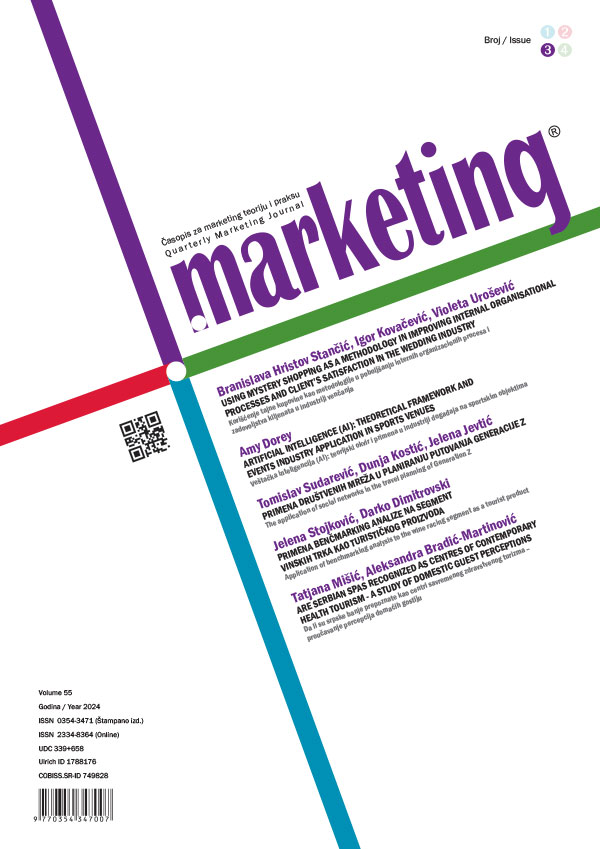
Are Serbian spas recognised as centres of contemporary health tourism – a study of domestic guest perceptions
Da li su srpske banje prepoznate kao centri savremenog zdravstvenog turizma – proučavanje percepcija domaćih gostiju
Abstract
This study assesses the current state and potential of Serbian spas as centers for contemporary health tourism, focusing on the perceptions and preferences of local guests. It examines how traditional spa services such as thermal pools and saunas are highly valued, while modern wellness programs and alternative treatments are less used but show growth potential. The survey assessing health and wellness service perceptions was carried out among Serbian citizens, particularly in Belgrade and the major spa towns of Sokobanja and Vrnjačka Banja, which together account for approximately half of the national spa turnover. Data was collected using both paper questionnaires and an online CAWI system, accumulating a total of 368 responses from June to September 2022. The study identifies significant opportunities for Serbian spas to expand and diversify their offering to meet changing market demands and emphasizes the need for strategic investment in infrastructure, service quality, and marketing. Through a comprehensive analysis, this research aims to inform and guide Serbian spas to adapt to global trends in health tourism and ensure their sustainable development and competitiveness.
Apstrakt
Rad procenjuje trenutno stanje i potencijal srpskih banja kao centara savremenog zdravstvenog turizma, fokusirajući se na percepcije i preferencije domaćih gostiju. Ispituje se kako su tradicionalne banjske usluge, kao što su termalni bazeni i saune, visoko cenjene, dok se savremeni velnes programi i alternativni tretmani manje koriste, ali pokazuju potencijal rasta. Istraživanje o percepciji zdravstvenih i velnes usluga sprovedeno je među građanima Srbije, posebno u Beogradu i većim banjama Sokobanji i Vrnjačkoj Banji, koje zajedno ostvaruju približno polovinu nacionalnog banjskog prometa. Podaci su prikupljeni korišćenjem papirnih upitnika i onlajn sistema (CAWI metodom), akumulirajući ukupno 368 odgovora od juna do septembra 2022. godine. Dobijeni rezultati identifikuju značajne mogućnosti srpskih banja da prošire i diversifikuju svoju ponudu kako bi odgovorile na promenljive zahteve tržišta i naglašavaju potrebu za strateškim ulaganja u infrastrukturu, kvalitet usluga i marketing. Kroz sveobuhvatnu analizu, ovo istraživanje ima za cilj da informiše i usmeri srpske banje da se prilagode svetskim trendovima u zdravstvenom turizmu i obezbedi njihov održivi razvoj i konkurentnost.
References
- Belij, M., Milosavlјević, J., Belij, J. and Perak, K. (2014). Indicators of touristic development of spa centres of Serbia. Collection of Papers – Faculty of Geography at the University of Belgrade, 62, 175-196. https://doi.org/10.5937/zrgfub1462175B
- Belij, M. (2016). Transformation of Serbia's Baths into Modern Centres of Spa and Wellness Tourism (Doctoral dissertation). University of Belgrade, Faculty of Geography, Belgrade.
- Berber, N., Gajić, T. and Đorđević, M. (2010). Management and development possibilities for spa tourism in Serbia. Revista de Turism: Studii si Cercetari in Turism, 9, 30-39.
- Cross Spa. (2013). Analysis of the situation and possibilities for the development of health tourism in the cross-border area of Serbia – Bosnia and Herzegovina. Tourist Organisation of the Western Serbia Region.
- Gulan, L., Penjisevic, I., Stajic, J., Milenkovic, B., Zeremski, T., Stevanović, V. and Valjarević, A. (2020). Spa environments in central Serbia: Geothermal potential, radioactivity, heavy metals and PAHs. Chemosphere, 242. https://doi.org/10.1016/j. chemosphere.2019.125171
- Dimitrovski, D. and Todorović, A. (2015). Clustering wellness tourists in spa environment. Tourism Management Perspectives, 16, 259-265. https://doi.org/10.1016/j.tmp.2015.09.004
- Holod, A., Holovchuk, Y., Moroz, S. and Dudash, O. (2022). Modernisation of the Spa and Wellness Industry as a Factor of the Marketing Policy of Regional Tourism Development. International scientific journal „Internauka“, Series: „Economic Sciences“, 9(65). https://doi.org/10.25313/2520-2294-2022-9-8235
- Hrabrovski Tomić, E. (2006). Destinations of Health Tourism (with a focus on the spas of Vojvodina). Novi Sad: Prometej.
- A Routledge Freebok. (2015). Health and Wellness Tourism – A Focus on the Global Spa Experience. London: Routledge.
- Kicošev, S. and Dunčić, D. (2007). Geographical Foundations of Spatial Planning. Novi Sad: University of Novi Sad, Faculty of Science, Institute of Geography.
- Konu, H. and Laukkanen, T. (2010). Predictors of tourists’ well-being holiday intentions in Finland. Journal of Hospitality and Tourism Management, 17(1), 144-149. https://doi.org/10.1375/jhtm.17.1.144
- Koskinen, V. and Wilska, T.A. (2019). Identifying and understanding spa tourists' wellness attitudes. Scandinavian Journal of Hospitality and Tourism, 19(3), 259-277. http://dx.doi.org/10.1080/15022250.2 018.1467276
- Ljubisavljević, T. and Radosavljević, Z. (2018). Ownership transformation of spa resorts in the Republic of Serbia (the model of the privatization of Gornja Trepča Ltd., Gornja Trepča). Hotel and Tourism Management, 6(2), 47–59. https://doi.org/10.5937/menhottur1802055L
- Lövei-Kalmár, K., Jeles, T. and Ráthonyi, G. (2019). Analysis of Bathing Habits among Spa Visitors. Applied Studies in Agribusiness and Commerce, 13(1-2), 81-90. https://doi.org/10.19041/APSTRACT/2019/1-2/9
- Marić Stanković, A., Radonjić, I., Petković, M. and Divnić, D. (2022). Climatic Elements as Development Factors of Health Tourism in South Serbia. Sustainability, 14(23). https://doi.org/10.3390/su142315757
- Meler, M. (2004). Marketing Approach to the Tourism Project Conceptualization in a Globalization Condition. In Byles, Cahrles M. (ed.), 16th International Conference, Association for Global Business (pp. 1-10), Association for Global Business, Cancun.
- Milićević, S. and Jovanović, D. (2015). Wellness tourism – Competitive basis of European health tourism destination. Dubrovnik International Economic Meeting, 2(1), 851-863.
- Mišić, T. and Bradić-Martinović, A. (2020). Medical Tourism in Serbian Spas: Are We Competitive? Tourism International Scientific Conference Vrnjačka Banja – TISC, 5(1), 296-313.
- Pelegrín-Borondo, J., Araújo-Vila, N. and Fraiz-Brea, J. A. (2020). Comparison of Spa Choice between Wellness Tourists and Healthcare/Medical Tourists. Healthcare, 8(4). https://doi.org/10.3390/healthcare8040544
- Petković, G., Pindžo, R. and Bradić-Martinović, A. (2022). Competitiveness Factors of Serbian Tourism. Ekonomika preduzeća, 70(1-2), 113-127. https://doi.org/10.5937/EKOPRE2202113P
- Pinos-Navarrete, A., Abarca-Álvarez, F. J. and Maroto-Martos, J. C. (2022). Perceptions and Profiles of Young People Regarding Spa Tourism: A Comparative Study of Students from Granada and Aachen Universities. International Journal of Environmental Research and Public Health, 19(5). https://doi.org/10.3390/ijerph19052580
- Popesku, J. (1991). Optimisation of marketing instruments in tourism enterprises. Belgrade: BEETRA.
- Smith, M. and Puczko, L. (2009). Health and wellness tourism. Oxford: Elsevier.
- Soh, C. H., Reijnierse, E. M., Tuttle, C., Marston, C., Goonan, R., Lim, W. K. and Maier, A. B. (2021). Trajectories of functional performance recovery after inpatient geriatric rehabilitation: an observational study. Medical Journal of Australia, 215(4), 173-179. https://doi.org/10.5694/mja2.51138
- Official Gazette of RS. (2016). Strategy for the Development of Tourism of the Republic of Serbia for the period from 2016 to 2025. Retrieved 02 September 2024, from: http://demo.paragraf.rs/demo/combined/Old/t/t2016_12/t12_0189.htm ,
- Zlatanović, D., Dukanac, M. and Erić Nielsen, J. (2024). New product launch: the importance of product, market and company marketing activities. Marketing, 55(1), 27-39.
https://doi.org/10.5937/mkng2401027Z