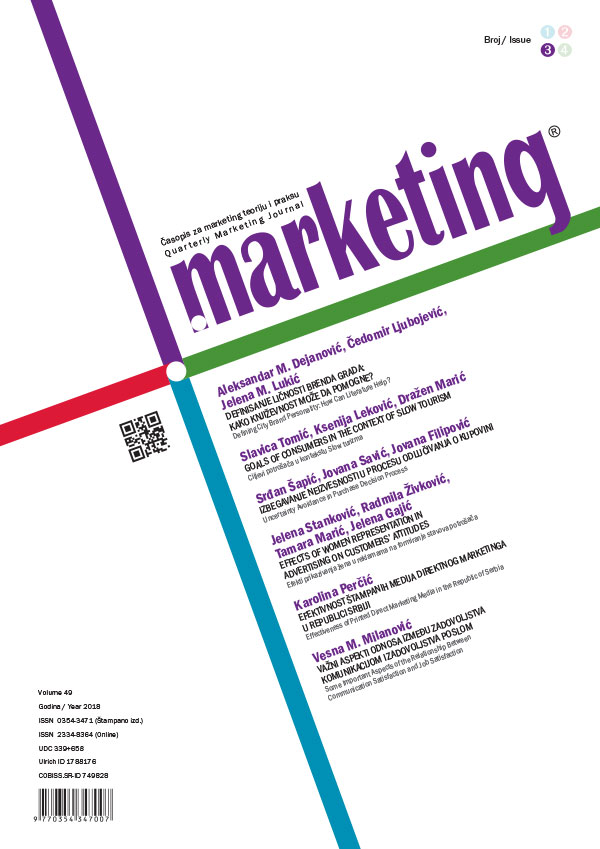
Goals of Consumers in the Context of Slow Tourism
Ciljevi potrošača u kontekstu Slow turizma
Abstract
The concept of slow tourism is gaining attention in terms of emphasized need for slowing down the pace of life. This concept is tied to sustainable tourism and linked to social movements such as: “Slow Food” (authentic, local food), “Slow Cities” (environmentally responsible and peaceful environment) and “Slow Transportation” (local buses and trains). This study provides insights into the phenomenon of slow tourism from the perspective of a goal-directed consumption process. The research was based on a model consisting of six slow tourism motivations (relaxation, self-reflection, escape, novelty-seeking, engagement, and discovery), two goals of slow tourism (revitalization and self-enrichment), and travel outcomes (satisfaction, future return intention, and recommendations). The sample included 320 respondents from the territory of the Republic of Serbia who had visited some of the destinations in Vojvodina labeled as “slow place” in the past two years.
Apstrakt
U uslovima naglašene potrebe za usporavanjem tempa življenja koncept Slow turizma dobija na značaju. Ovaj koncept vezuje se za pojam održivog turizma i društvene pokrete poput: „Slow Food“ (autentična, lokalna hrana), „Slow Cities“ (ekološki odgovorna i mirna okruženja) and „Slow Transportation“ (lokalni vidovi transporta). U radu je objašnjen fenomen Slow turizma iz perspektive ciljno-usmerenog ponašanja potrošača. Istraživanje se baziralo na modelu kojeg čine: motivi (opuštanje, samorefleksija, beg, otkrića, angažovanje i učenje), ciljevi (revitalizacija i samoobogaćenje) i ishodi putovanja (zadovoljstvo, ponovni dolazak u destinaciju i preporuke). Uzorak je obuhvatio 320 ispitanika sa teritorije Republike Srbije koji su u prethodne dve godine posetili neku od destinacija u Vojvodini označenu kao „slow place“.
References
- Bagozzi, R.P., Dholakia, U. (1999). Goal Setting and Goal Striving in Consumer Behavior. Journal of Marketing, 63, 19-32.
- Barbopoulos, I., Johansson, L. (2016). A multi-dimensional approach to consumer motivation: exploring economic, hedonic and normative consumption goals. Journal of Consumer Marketing, 33 (1), 75-84.
- Barbopoulos, I., Johansson, L. (2017). The Consumer Motivation Scale: Development of a multi-dimensional and context-sensitive measure of consumption goals. Journal of Business Research, 76, 118-126.
- Caffyn, A. (2012). Advocating and Implementing Slow Tourism. Tourism Recreation Research, 37 (1), 77-80.
- Conway, D., Timms, B. (2010). Re-branding alternative tourism in the Caribbean: The case for ‚slow tourism‘. Tourism and Hospitality Research, 10 (4), 329-344.
- Conway, D., Timms, B. (2012). Are Slow Travel and Slow Tourism Misfits, Compadres or Different Genres?. Tourism Recreation Research, 37 (1), 71-76.
- Dickinson, J., Lumsdon, L. (2010). Slow Travel and Tourism. UK: Earthscan.
- Fallon, J. (2012). If you‘re making waves then you have to slow down: Slow tourism and canals. In a book: Slow Tourism: Experiences and Mobilities, edited by S. Fullagar, K. Markwell, and E. Wilson. Bristol, UK: Channel View, 143-156.
- Fullagar, S., Markwell, K., Wilson, E. (2012). Slow Tourism: Experiences and Mobilities. UK: Channel View Publications.
- Gardner, N. (2009). A manifesto for slow travel. Hidden Europe 25. Retrieved from: https://www.hiddeneurope.co.uk/a-manifesto-for-slow-travel
- Georgica, G. (2015). The Tourist‘s Perception about Slow Travel – A Romanian Perspective. Procedia Economics and Finance, 23, 1596-1601.
- Guiver, J.W., McGrath, P. (2016). Slow Tourism: Exploring the discourses. Dos Algarves: A Multidisciplinary e-Journal, 27, 11-34.
- Lindenberg, S., Steg, L. (2007). Normative, gain and hedonic goal frames guiding environmental behavior. Journal of Social Issues, 63 (1), 117-137.
- Long, L.M. (2013). Culinary tourism. University Press of Kentucky.
- Lumsdon, L., McGrath, P. (2011). Developing a conceptual framework for slow travel: a grounded theory approach. Journal of Sustainable Tourism, 19 (3), 265-279.
- Meng, B., Choi, K. (2016). The role of authenticity in forming slow tourists‘ intentions: Developing an extended model of goal-directed behavior. Tourism Management, 57, 397-410.
- Moore, K. (2012). “On the Periphery of Pleasure: Hedonics, Eudaimonics, and Slow Travel.” In a book: Slow Tourism: Experiences and Mobilities, edited by S. Fullagar, K. Markwell, and E. Wilson. Bristol, UK: Channel View, 25-35.
- Novak, T.P., Hoffman, D.L., Duhachek, A. (2003). The Influence of Goal-Directed and Experiential Activities on OnlineFlowExperiences. Journal of Consumer Psychology, 13 (1/2), 3-16.
- Oh, H., Assaf, A.G., Baloglu, S. (2016). Motivations and Goals of Slow Tourism. Journal of Travel Research, 55 (2), 205-219.
- Parasecoli, F., Lima, P.A. (2012). Eat your way through culture: Gastronomic tourism as performance and bodily experience. In a book: Slow tourism aspects of tourism: Experiences and mobilities, edited by Simone, F., Kevin, M., Wilson, E. NY: Channel View Publications, 69-83.
- Yurtseven, H.R., Kaya, O. (2011). Slow Tourists: A Comparative Research Based on Cittaslow Principles. American International Journal of Contemporary Research, 1 (2), 91-98.