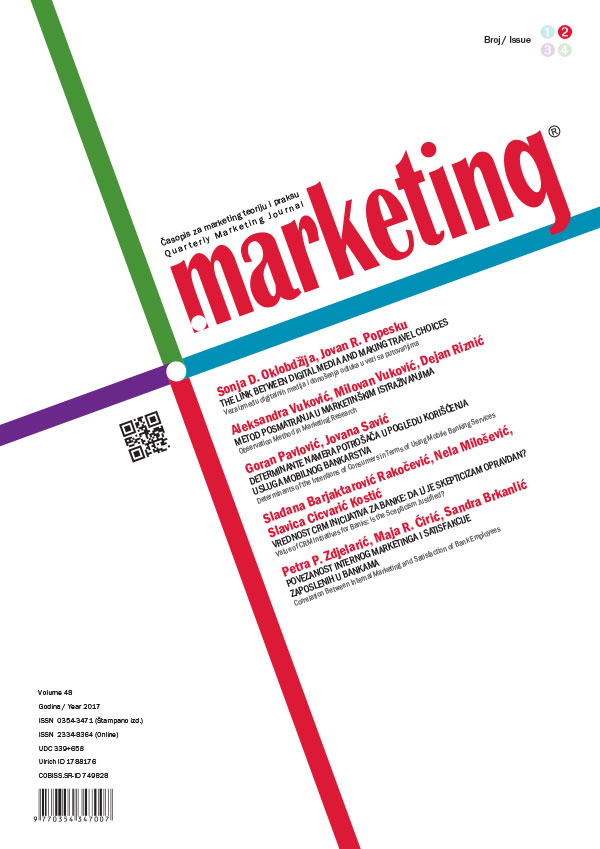
Vrednost CRM inicijativa za banke: da li je skepticizam opravdan?
Value of CRM Initiatives for Banks: Is the Scepticism Justified?
Apstrakt
Sektor finansijskih usluga karakteriše dinamičan razvoj i uočava se potreba za inovativnim poslovnim modelima koji će dovesti do zadržavanja postojećih klijenata, ali i pridobijanja novih. Upravljanje odnosima sa klijentima (engl. Customer Relationship Management - CRM) može se definisati kao strategija koja teži razumevanju potreba klijenata u cilju obezbeđivanja njihovog zadovoljstva, dugoročne saradnje i povećanja prodaje. Kako u literaturi i dalje postoji skepticizam oko vrednosti CRM inicijativa i dostignutih poboljšanja performansi poslovanja, cilj ovog rada je razumevanje osnova i pokazatelja uspeha CRM-a u bankarskom sektoru. Rad daje pregled literature u oblasti i utvrđuje neophodne resurse u cilju ostvarenja prednosti koju donose dugoročni i kvalitetni odnosi sa klijentima.
Abstract
Financial services sector has undergone through dynamic development and there is an obvious need for innovative business models that will contribute to the clients‘ satisfaction as well as to acquisition of new clients. Customer relationship management could be defined as a strategy for understanding clients‘ needs with the goal to provide higher level of satisfaction, long-term cooperation and sales increase. In literature is still present scepticism about the value of CRM initiatives and accomplished improve ments of business performances. Consequently, the aim of this paper is to understand basics and indicators of CRM success in banking sector. Paper gives literature review in this field and determines necessary resources to achieve advantages from long-term and good relationships with customers.
Reference
- Anderson, E. W., and Sullivan, M. W. (1993). The antecedents and consequences of customer satisfaction for firms. Marketing science, 12(2), 125-143.
- Araya, S., Chaparro, J., Orero, A., and Joglar, H. (2007). An integrative view of IS/IT and organizational resources and capabilities. Issues in Informing Science and Information Technology, 4, 629-639.
- Becker, J. U., Greve, G., and Albers, S. (2009). The impact of technological and organizational implementation of CRM on customer acquisition, maintenance, and retention. International Journal of Research in Marketing, 26(3), 207-215.
- Berger, S. C., Gensler, S., Skiera, B., and Wiesel, T. (2009, January). Customer relationship management processes in retail banking-best practice and business value evaluation. In System Sciences, 2009. HICSS‘09. 42nd Hawaii International Conference on (pp. 1-10). IEEE.
- Bhat, S. A., and Darzi, M. A. (2016). Customer relationship management An approach to competitive advantage in the banking sector by exploring the mediational role of loyalty. International Journal of Bank Marketing, 34(3), 388-410.
- Bos, J. W., Kolari, J. W., and Van Lamoen, R. C. (2013). Competition and innovation: Evidence from financial services. Journal of Banking & Finance, 37(5), 1590-1601.
- Boulding, W., Staelin, R., Ehret, M., and Johnston, W. J. (2005). A customer relationship management roadmap: What is known, potential pitfalls, and where to go. Journal of marketing, 69(4), 155-166.
- Chan, J. O. (2005). Toward a unified view of customer relationship management. Journal of American Academy of Business, 6(1), 32-38.
- Chang, W., Park, J. E., and Chaiy, S. (2010). How does CRM technology transform into organizational performance? A mediating role of marketing capability. Journal of Business Research, 63(8), 849-855.
- Chen, J. H., and Wang, E. T. (2006). Internalization in technology innovation: A case of CRM adoption. In System Sciences, 2006. HICSS‘06. Proceedings of the 39th Annual Hawaii International Conference on (Vol. 6, pp. 111a-111a). IEEE.
- Chen, J., Ching, R. K., Li, E. Y., and Liao, Y. (2004). An Exploratory Study of the Effects of CRM Practices on CRM Effectiveness and Business Performance. In ICEB (pp. 249-254).
- Chirica, C. (2013). Relationship marketing-best practice in the banking sector. Amfiteatru Economic, 15(33), 288.
- Dabić, S., Vasiljević, B., Barjaktarović Rakočević, S., i Milošević, N. (2013). Bankarski menadžment, Skripta, Univerzitet u Beogradu, Fakultet organizacionih nauka.
- Day, G. S. (2003). Creating a superior customer-relating capability. MIT Sloan Management Review, 44(3), 77.
- Đukić, S. (2015). Potrošač kao učesnik inovacionih mreža. Marketing, 46 (1). 3-12.
- Durkin, M. G., and Howcroft, B. (2003). Relationship marketing in the banking sector: the impact of new technologies. Marketing Intelligence & Planning, 21(1), 61-71.
- Eid, R. (2007). Towards a successful CRM implementation in banks: An integrated model. The Service Industries Journal, 27(8), 1021-1039.
- Fox, T., and Stead, S. (2001). Customer relationship management: Delivering the benefits. White Paper, CRM (UK) and SECOR Consulting, New Malden.
- Frame, W. S., and White, L. J. (2014). Technological change, financial innovation, and diffusion in banking. The Oxford Handbook of Banking, 2nd edn, by Allen N. Berger, Philip Molyneux and John OS Wilson, Oxford University Press, Oxford.
- Galbreath, J., and Rogers, T. (1999). Customer relationship leadership: a leadership and motivation model for the twenty-first century business. The TQM magazine, 11(3), 161-171.
- Garrido-Moreno, A., Lockett, N., and García-Morales, V. (2014). Paving the way for CRM success: The mediating role of knowledge management and organizational commitment. Information & Management, 51(8), 1031-1042.
- Geib, M., Reichold, A., Kolbe, L., and Brenner, W. (2005, January). Architecture for customer relationship management approaches in financial services. In Proceedings of the 38th Annual Hawaii International Conference on System Sciences (pp. 240b-240b). IEEE.
- Ghalenooie, M. B., and Sarvestani, H. K. (2016). Evaluating Human Factors in Customer Relationship Management Case Study: Private Banks of Shiraz City. Procedia Economics and Finance, 36, 363-373.
- Hooley, G. J., Piercy, N. F. and Nicouloud, B. (2008), Marketing strategy and competitive positioning. Pearson Education Limited
- Keramati, A., Mehrabi, H., and Mojir, N. (2010). A process-oriented perspective on customer relationship management and organizational performance: An empirical investigation. Industrial Marketing Management, 39(7), 1170-1185.
- Khodakarami, F., and Chan, Y. E. (2014). Exploring the role of customer relationship management (CRM) systems in customer knowledge creation. Information & Management, 51(1), 27-42.
- Kim, J., Suh, E., and Hwang, H. (2003). A model for evaluating the effectiveness of CRM using the balanced scorecard. Journal of interactive Marketing, 17(2), 5-19.
- Kracklauer, A. H., Mills, D. Q., and Seifert, D. (2004). Customer management as the origin of collaborative customer relationship management. In Collaborative Customer Relationship Management (pp. 3-6). Springer Berlin Heidelberg.
- Li, L., and Mao, J. Y. (2012). The effect of CRM use on internal sales management control: An alternative mechanism to realize CRM benefits. Information & management, 49(6), 269-277.
- Mendoza, L. E., Marius, A., Pérez, M., and Grimán, A. C. (2007). Critical success factors for a customer relationship management strategy. Information and software technology, 49(8), 913-945.
- Milošević, N., Cicvarić Kostić, S., i Barjaktarović Rakočević, S. (2015). Da li CRM uvodi promene u okviru kreditne politike?: Iskustva iz Srbije. Inovativna rešenja operacionog menadžmenta za revitalizaciju privrede Srbije. Zbornik radova: SPIN – Skup privrednika i naučnika: “Inovativna rešenja operacionog menadžmenta za revitalizaciju privrede Srbije”. Beograd: Fakultet organizacionih nauka. str. 596-603.
- Ngai, E. W., Xiu, L., and Chau, D. C. (2009). Application of data mining techniques in customer relationship management: A literature review and classification. Expert systems with applications, 36(2), 2592-2602.
- Ozatac, N., Saner, T., and Sen, Z. S. (2016). Customer Satisfaction in the Banking Sector: The Case of North Cyprus. Procedia Economics and Finance, 39, 870-878.
- Payne, A., and Frow, P. (2006). Customer relationship management: from strategy to implementation. Journal of Marketing Management, 22(1-2), 135-168.
- Peltier, J. W., Zahay, D., and Lehmann, D. R. (2013). Organizational learning and CRM success: a model for linking organizational practices, customer data quality, and performance. Journal of Interactive Marketing, 27(1), 1-13.
- Pfeifer, P. E., and Ovchinnikov, A. (2011). A note on willingness to spend and customer lifetime value for firms with limited capacity. Journal of Interactive Marketing, 25(3), 178-189.
- Reimann, M., Schilke, O., and Thomas, J. S. (2010). Customer relationship management and firm performance: the mediating role of business strategy. Journal of the Academy of Marketing Science, 38(3), 326-346.
- Santouridis, I., and Tsachtani, E. (2015). Investigating the impact of CRM resources on CRM processes: A customer life-cycle based approach in the case of a Greek Bank. Procedia Economics and Finance, 19, 304-313.
- Shang, S. S., and Lin, S. F. (2010). People-driven processes in customer relationship management. The Service Industries Journal, 30(14), 2441-2456.
- Shaw, M. J., Subramaniam, C., Tan, G. W., and Welge, M. E. (2001). Knowledge management and data mining for marketing. Decision support systems, 31(1), 127-137.
- Sin, L. Y., Tse, A. C., and Yim, F. H. (2005). CRM: conceptualization and scale development. European Journal of marketing, 39(11/12), 1264-1290.
- Sivaraks, P., Krairit, D., and Tang, J. C. (2011). Effects of e-CRM on customer–bank relationship quality and outcomes: The case of Thailand. The Journal of High Technology Management Research, 22(2), 141-157.
- Soltani, Z., and Navimipour, N. J. (2016). Customer relationship management mechanisms: A systematic review of the state of the art literature and recommendations for future research. Computers in Human Behavior, 61, 667-688.
- Wu, C. H., Kao, S. C., Su, Y. Y., and Wu, C. C. (2005). Targeting customers via discovery knowledge for the insurance industry. Expert Systems with Applications, 29(2), 291-299.
- Wu, W. (2002). Customer relationship management (CRM) technology, market orientation, and organizational performance (Doctoral dissertation, Concordia University).
- Zablah, A. R., Bellenger, D. N., and Johnston, W. J. (2004). An evaluation of divergent perspectives on customer relationship management: Towards a common understanding of an emerging phenomenon. Industrial marketing management, 33(6), 475-489.
- Zineldin, M. (2005). Quality and customer relationship management (CRM) as competitive strategy in the Swedish banking industry. The TQM magazine, 17(4), 329-344.