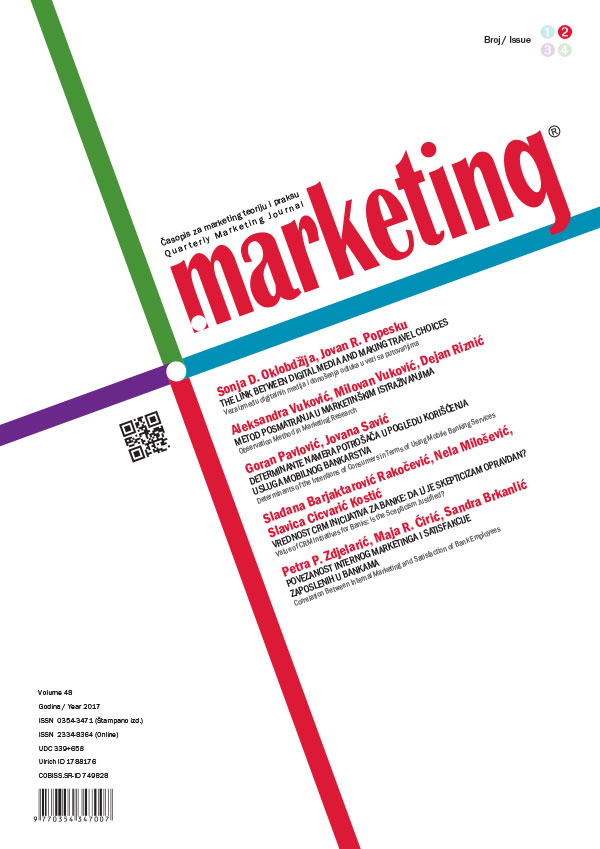
Povezanost internog marketinga i satisfakcije zaposlenih u bankama
Correlation Between Internal Marketing and Satisfaction of Bank Employees
Apstrakt
Apstrakt: Stvaranje baze zadovoljnih i lojalnih klijenata jedan je od preduslova za dugoročan opstanak banke na konkurentnom tržištu, kakvo je danas. Kako je za ostvarenje satisfakcije klijenata i izgradnju lojalnosti neophodno imati kompetentne, zadovoljne i motivisane zaposlene, banke sve veću pažnju pomeraju od tradicionalnog ka internom marketingu. Stoga je cilj ovog istraživanja da se utvrdi koje su to ključne aktivnosti internog marketinga koji su od presudnog značaja za percepciju ukupnog kvaliteta internog marketinga od strane zaposlenih u bankama. Osim toga, nastoji se utvrditi da li su sve ekstrahovane ključne aktivnosti internog marketinga povezane sa svim oblicima satisfakcije zaposlenih poslom. Istraživanje je sprovedeno u osam filijala dve banke u Beogradu i u Novom Sadu, a obuhvaćeno je 165 ispitanika zaposlenih u tim bankama. Na osnovu dobijenih rezultata data je naučna potvrda o značaju internog marketinga za satisfakciju zaposlenih u bankama, kao i preporuke za menadžere banke na koje aktivnosti internog marketinga je potrebno da se fokusiraju kako bi postigli sveukupnu satisfakciju svojih zaposlenih.
Abstract
Creating a satisfied and loyal customer base is one of the prerequisites for a long-term survival of the bank in a competitive market, such it is today. Considering that, to achieve a client satisfaction as well as to establish loyalty, it is necessary to have competent, satisfied and motivated employees. That is the reason why banks tend to increasingly shift their attention from traditional to internal marketing. Therefore, the aim of this research is to determine the key internal marketing activities which are crucial for the bank employees` perception of overall quality of internal marketing. Besides, it is necessary to find out are there correlations between all of the extracted key internal marketing activities and all forms of employee satisfaction. The research was conducted in eight branch offices of two banks in Belgrade and Novi Sad and includes 165 respondents employed in said banks. Based on the provided results, a scientific confirmation was given of the importance of internal marketing for the employees` satisfaction in banks. Also, managerial implications are given which internal marketing activities are crucial for achieving the overall employees` satisfaction.
Reference
- Ahmed, P. K., Rafiq, M., Saad, N. M. (2003). Internal marketing and the mediating role of organisational competencies, European Journal of Marketing, 37 (9), 1221–1241.
- Al-Hawary, S. I. S., Al-Qudah, K. A. M., Abutayeh, P. M., Abutayeh, S. M., Al-Zyadat, D. Y. (2013) The impact of internal marketing on employee’s job satisfaction of commercial banks in Jordan, Interdisciplinary Journal of Contemporary Research in Business, 4(9), 811-826.
- Alonderiene, R. (2010). Enhancing informal learning to improve job satisfaction: Perspective of SMEs managers in Lithuania, Baltic Journal of Management, 5(2), 257-287.
- Ćirić, M. (2013). Upravljanje odnosima sa klijentima u bankama, Fakultet za ekonomiju i inženjerski menadžment u bankama, Novi Sad.
- Ćorović, B., Šekularac Ivošević, S. (2011). Ljudski resursi kao ključna spona menadžmenta ljudskih resursa i marketinga uslužnog privrednog društva, Ekonomski pogledi, (3), 89–101
- Davis, T. R. V. (2001). Integrating internal marketing with participative management. Management Decision, 39 (1), 121–132.
- Davoudi, S. M. M., Kaur, R. (2012). The link between internal marketing and human resource management. Arth Prabhand: A Journal of Economics and Management, 1 (2), 59-72
- Dobrijević, G. (2008). Rastući značaj interne komunikacije za poslovni uspeh kompanija. Singidunum revija, 5 (1), 173–181.
- Domazet, I. (2011). Uloga internog marketinga u unapređenju kvaliteta ljudskih resursa. U: J. Zubović (ur.). Aktivne mere na tržištu rada i pitanja zaposlenosti (str. 260–280). Institut ekonomskih nauka, Beograd.
- Đurović, M. (2008). Strategija internog marketinga u upravljanju ljudskim resursima. Telekom Srbija, Beograd.
- Evanschitzky, H., Wangenheim, F.v., & Wunderlich, N. V. (2012), “Perils of Managing the Service Profit Chain: The Role of Time Lags and Feedback Loops,” Journal of Retailing, 88 (3), 356-366.
- Ferdous, A. S. (2008) Integrated internal marketing communication (IIMC). The Marketing Review, 8 (3), 223–235.
- George, W. R. (1990). Internal marketing and organisational behaviour: a partnership in developing customer-conscious employees at every level. Journal of Business Research, 20 (1), 63–70
- George, W. R., Grönroos, C. (1989). Developing customer conscious employees at every level –internal marketing. U: C. A. Congram (ur.), The AMA Handbook of Services Marketing Congram (str. 85–100). New York: AMACOM
- Gilmore, A. (2003). Services, Marketing and Managament. London: Sage Publications
- Glassman, M., McAfee, B. (1992). Integrating the personnel and marketing functions: the challenge of the 1990s. Business Horizons, 35 (3), 52–59
- Gounaris, S. P. (2006). Internal-market orientation and its measurement. Journal of Business Research, 59 (4), 432–448
- Grönroos, C. (1990). Service Management and Marketing – Managing the Moments of Truth in Service Competition. Lexington: Lexington Books
- Haghighikhah, M., Khadang, M., Arabi, M.. (2016). Internal Marketing: Employee Satisfaction and Word of Mouth in Guilan’s Saderat Bank, International Journal of Marketing Studies, 8(2), 147-158.
- Hartline, M. D., Keith, C. J. (1996). Employee performance cues in a hotel service environment: ınfluence on perceived service quality, value, and word-of-mouth ıntentions. Journal of Business Research, 35 (1), 207–215.,
- Homburg, C., Stock, R. (2005), “Exploring the Conditions Under Which Salesperson Work Satisfaction Can Lead to Customer Satisfaction,” Psychology and Marketing, 22 (5), 393-420.
- Hwang, I. S., Chi, D. J. (2005). Relationships among internal marketing, employee job satisfaction and international hotel performance: an empirical study. International journal of Management, 22(2), 285-293.
- Jarvi, P. (2009). Internal Marketing and Commitment of the Employees when Managing the Customer Oriented Business. Jyvaskyla: School of Business and Economics, University of Jyvaskyla.
- Kelemen, M., Papasolomou, I. (2007). Internal marketing: a qualitative study of culture change in the UK banking sector. Journal of Marketing Management, 23 (7–8), 745–767.
- Kotler, P. (2000). Marketing Management (11th ed.). Englewood Cliffs: Prentice Hall
- Kotler, P., Keller, K. L. (2006). Marketing menadžment. Data status, Beograd.
- Koys, D.J. (2001), “The Effects of Employee Satisfaction, Organizational Citizenship Behavior, and Turnover on Organizational Effectiveness: A Unit-Level, Longitudinal Study,” Personnel Psychology, 54 (1), 101-114.
- Lings, I. N. (2004). Internal market orientation: constructs and consequences. Journal of Business Research, 57 (4), 405–413.
- Lings, I. N., Greenley, G. E. (2005). Measuring internal market orientation. Journal of Service Research, 7 (3), 290–306.
- Little, R., Maradi, E. (2003). Relationship Marketing Management. London: Thomson Learaning
- Ljubojević, Č., Ćirić, M. (2017). Marketing usluga, Fakultet za ekonomiju i inženjerski menadžment, Novi Sad.
- Mitić S., Ognjanov G. (2013). Konkurentska prednost i korporativne komunikacije, Marketing, 44(4), 343-353.
- Pržulj, Ž. (2011). Menadžment ljudskih resursa. Univerzitet EDUCONS – Fakultet poslovne ekonomije, Sremska Kamenica.
- Salai, S., Kovač Žnideršić, R. (2012). Marketing trendovi i obrasci ponašanja. Škola biznisa, (1), 15–22.
- Shabbir, J., Salaria, R. A. (2014) Impact of Internal Marketing on Employee Job Satisfaction: An Investigation of Higher Education Institutes of Pakistan, Journal of Marketing Management, 2(2), 239-253.
- Shah, A. (2014). Internal Marketing’s Effects on Employee Satisfaction, Productivity, Product Quality, Consumer Satisfaction and Firm Performance, American Journal of Management, 14(4), 33-39.
- Stanković, Lj., Đukić, S., Popović, A. (2012). Razvoj teorije i prakse marketinga. Ekonomske teme, 50 (4), 599–614.
- Veljković, S. (2009), Marketing usluga, CID Ekonomskog fakulteta, Beograd.
- Wangenheim, F.v., Evanschitzky, H., Wunderlich, M.(2007). The Employee-Customer Satisfaction Link: Does It Hold For All Employee Groups?, Journal of Business Research, 60 (7), 690-7.
- Woodruffe, H. (1995). Services Marketing. M & E Pitman, London.
- Yoon, M. H., Sharon, E. B., Jaeboem, S. (2001). The effect of work climate on critical employee and customer outcomes. International Journal of Service Industry Management, 12 (5), 500–521.