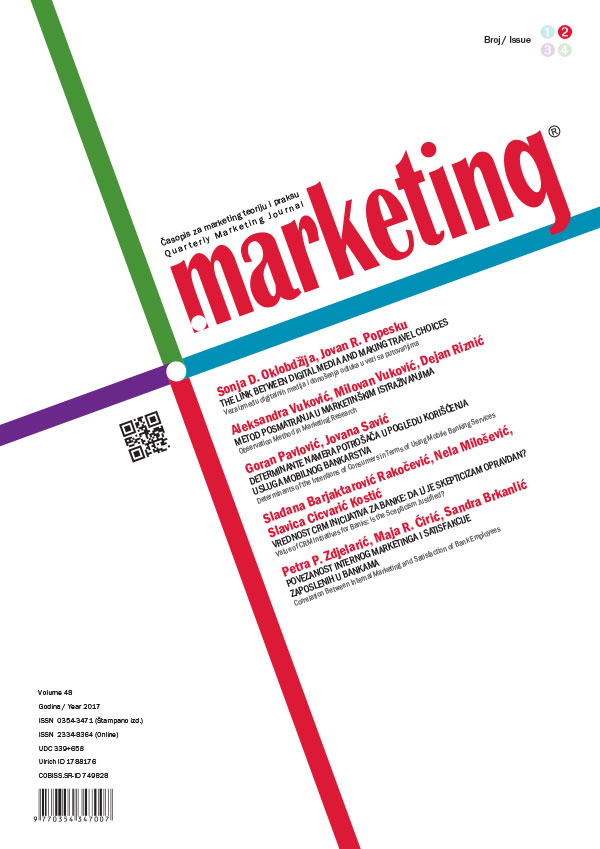
Determinante namera potrošača u pogledu korišćenja usluga mobilnog bankarstva
Determinants of the intentions of consumers in terms of using mobile banking services
Apstrakt
Sa razvojem tehnologije i promenom stila života ljudi, banke su prepoznale mogućnost uvođenja elektronskog bankarstva u svoje poslovanje, iz kojeg je proizašlo mobilno bankarstvo kao važan distributivni kanal. Za banke kao provajdere usluga mobilnog bankarstva je važno da identifikuju faktore koji utiču na namere potrošača da koriste mobilno bankarstvo. Istraživanje se sprovodi u cilju ispitivanja komponenti mobilnog bankarstva koje imaju uticaj na namere potrošača da počnu sa korišćenjem istog. Anketiranjem 208 ispitanika prikupljeni su primarni podaci koji su analizirani u softveru SPSS. Kao polazni model za istraživanje korišćen je prošireni model prihvatanja tehnologije (eng. Technology Acceptance Model - TAM). Dobijeni rezultati sprovedenog empirijskog istraživanja pokazuju da namere pojedinaca da koriste mobilno bankarstvo najviše zavise od percipiranog finansijskog troška a najmanje od percipirane korisnosti. Istraživanjem se popunjava gep u postojećoj domaćoj literaturi s obzirom da dobijeni rezultati potvrđuju polazne hipoteze koje postaju validna naučna saznanja i proširuju postojeća saznanja o uticaju determinanti mobilnog bankarstva na namere potrošača da koriste usluge istog. Takođe, istraživanje ima praktične implikacije za bankarski sektor.
Abstract
With the development of technology and the changing lifestyle of people, banks have recognized the possibility of introducing electronic banking into their business, which resulted in mobile banking as an important distribution channel. For banks as providers of mobile banking services it is important to identify factors that affect consumers‘ intentions to use mobile banking. The survey is conducted in order to examine mobile banking components that have an impact on consumers‘ intentions to start using it. A survey of 208 respondents collected primary data that have been analyzed in the SPSS software. The extended model of acceptance of technology (TAM) was used as the starting model for research. The obtained results of the conducted empirical research show that the intentions of individuals to use mobile banking are mostly dependent on the perceived financial cost and at least on the perceived utility. The research fills the pocket in the existing domestic literature since the obtained results confirm the starting hypotheses that become valid scientific knowledge and expands the existing knowledge of the impact of mobile banking determinants on the intentions of consumers to use the services of the same. Also, the research has practical implications for the banking sector.
Reference
- Agwu, E., Atuma, O., Ikpefan, A., & Iyoha, F. (2014). Adoption Triggers and Barriers of Mobile Banking Services in Nigeria. International Review of Social Sciences, 2(9), 374-386.
- Alalwan, A., Dwivedi, Y., & Rana, N. (2017). Factors influencing adoption of mobile banking by Jordanian bank customers: Extending UTAUT2 with trust. International Journal of Information Management, 37(3), 99-110.
- Al-Jabri, I. (2015). The intention to use mobile banking: Further evidence from Saudi Arabia. South African Journal of Business Management, 46(1), 23-34.
- Barnes, S.J., & Corbitt, B. (2003). Mobile banking: Concept and potential. International Journal of Mobile Communications, 1(3), 273-288. doi:10.1504/IJMC.2003.003494
- Bhatt, A., & Bhatt, S. (2016). Factors Affecting Customer‘s Adoption of Mobile Banking Services. Journal of Internet Banking and Commerce, 21(1), 1-22.
- Bjelić, P. (2001). Mobilni telefon kao kanal elektronskog poslovanja. Ekonomski Anali, 151(2), 81-98.
- Chawla, D., & Joshi, H. (2017). Consumer perspectives about mobile banking adoption in India-a cluster analysis. International Journal of Bank Marketing, 35(4), 616-636.
- Chitungo, S., & Munongo, S. (2013). Extending the technology acceptance model to mobile banking adoption in rural Zimbabwe. Journal of Business Administration and Education, 3(1), 51-79.
- Dasgupta, S., Paul, R., & Fuloria, S. (2011). Factors affecting behavioral intentions towards mobile banking usage: Empirical evidence from India. Romanian Journal of Marketing, 1, 6-28.
- Đorđević, B. (2007). Strategijske opcije u razvoju mobilnih bankarskih servisa. Bankarstvo, 3(4), 38-48.
- Gašević, D., Vranješ, M., & Drinić, D. (2016). Identification of Key Determinants of Satisfaction of Users of Electronic Banking Services. Economic Themes, 54(2), 301-321.
- Gu, J., Lee, S., & Suh, Y. (2009). Determinants of behavioral intention to mobile banking. Expert Systems with Applications, 36(9), 11605-11616.
- Hanafizadeh, P., Behboudi, M., Koshksaray, A., & Tabar, M. (2014). Mobile-banking adoption by Iranian bank clients. Telematics and Informatics, 31(1), 62-78.
- Iddris, F. (2013). Barriers to adoption of mobile banking: Evidence from Ghana. International Journal of Academic Research in Business and Social Sciences, 3(7), 356-370.
- Khalfan, S., Alrefaei, Y., & Al-Hajery, M. (2006). Factors influencing the adoption of Internet banking in Oman: A descriptive case study analysis. International Journal of Financial Services Management, 1(2), 155-172.
- Koufaris, M., & Hampton-Sosa, W. (2004). The development of initial trust in an online company by new customers. Information & management, 41(3), 377-397.
- Laforet, S., & Li, X. (2005). Consumers‘ attitudes towards online and mobile banking in China. International journal of bank marketing, 23(5), 362-380.
- Laukkanen, T., & Lauronen, J. (2005). Consumer value creation in mobile banking services. International Journal of Mobile Communications, 3(4), 325-338. doi:10.1504/IJMC.2005.007021
- Lotfizadeh, F., & Ghorbani, A. (2015). A multi-dimensional model of acceptance of mobile banking. International Journal of Management, Accounting and Economics, 2(5), 414-427.
- Luo, X., Li, H., Zhang, J., & Shim, J. (2010). Examining multi-dimensional trust and multi-faceted risk in initial acceptance of emerging technologies: An empirical study of mobile banking services. Decision support systems, 49(2), 222-234.
- Narodna Banka Srbije, Statistika, https://nbs.rs/internet/latinica/35/statistika/index.html, pristupljeno 15.7.2017.
- Sanader, D. (2014). Mobile banking: New trend in the contemporary banking sector. Bankarstvo, 43(5), 86-109.
- Shaikh, A., & Karjaluoto, H. (2015). Mobile banking adoption: A literature review. Telematics and Informatics, 32(1), 129-142.
- Singh, S., Srivastava, V., & Srivastava, R. (2010). Customer acceptance of mobile banking: A conceptual framework. Sies journal of management, 7(1), 55-64.
- Stojanović, M., & Đorđević, M. (2016). The importnace of mobile banking in the Nisava district. Economic Themes, 54(3), 385-402.
- Yang, A. (2009). Exploring adoption difficulties in mobile banking services. Canadian Journal of administrative sciences, 26(2), 157-179.
- Yogesh, J. (2013). Mobile Banking: A Study On Adoption & Challenges In Southern Rajasthan, India. International Journal Of Innovative Research & Development, 2(4), 902-914.
- Yu, C. (2012). Factors affecting individuals to adopt mobile banking: Empirical evidence from the UTAUT model. Journal of Electronic Commerce Research, 13(2), 104-121.