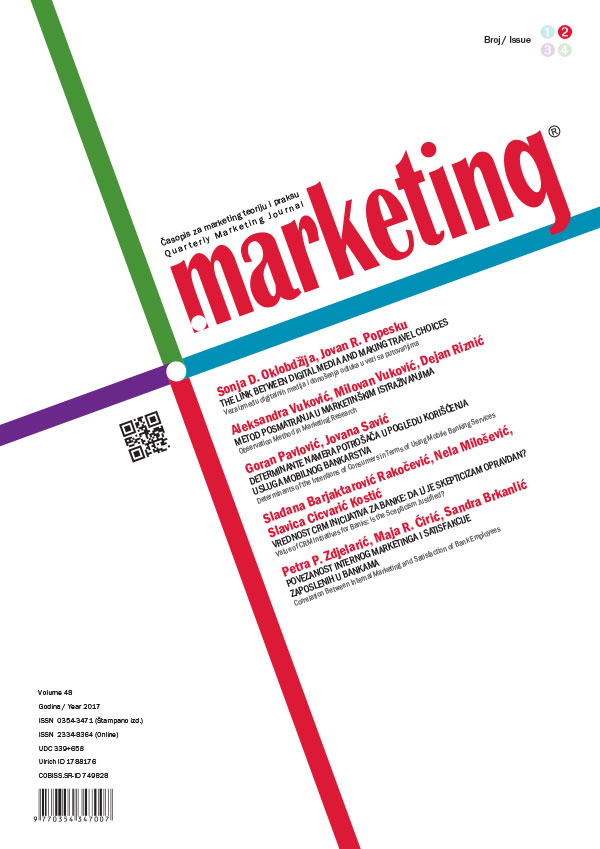
The Link Between Digital Media and Making Travel Choices
Veza između digitalnih medija i donošenja odluka u vezi sa putovanjima
Abstract
The development of new information technologies, especially the Internet, has led to changes in the approaches of applying marketing in tourism in many ways. Under these circumstances, digital marketing is gradually taking the leading role in every modern tourism marketing strategy. As the world becomes increasingly interconnected, keeping up with new developments and trends and adapting to the online sphere is vital for all tourism companies and organizations that want to maintain their current success and attract new tourists. The digital revolution has forever changed the way the media operate, and the changes brought about are far from over. The aim of this paper is to show the role and importance of digital marketing in modern tourism. In order to reach the conclusion, the paper will show the results of the research on the degree that Serbian tourists rely on digital media while choosing a tourism destination and making additional travel choices. The data collected were analyzed using the statistical analysis software SPSS, version 23.c
Apstrakt
Razvoj novih informacionih tehnologija, pre svega interneta, doveo je do brojnih promena načina primene marketinga u turizmu. Usled ovih okolnosti, digitalni marketing postepeno preuzima vodeću ulogu u svakoj modernoj marketing strategiji u turizmu. Kako svet postaje sve povezaniji, ići u korak sa novim dostignućima i trendovima i prilagođavanje online sferi poslovanja je od ključnog značaja za sva turistička preduzeća i organizacije koje žele da održe svoj trenutni uspeh i privuku nove turiste. Digitalna revolucija je zauvek promenila način na koji mediji funkcionišu, a promene koje je donela su konstantne i duboke. Cilj ovog rada je da predstavi ulogu i važnost primene digitalnog marketinga u modernom turizmu. U skladu sa tim, u radu će biti predstavljeni rezultati istraživanja o stepenu upotrebe digitalnih medija od strane turista u Republici Srbiji u svrhe izbora turističke destinacije i dodatnih elemenata putovanja. Prikupljeni podaci su analizirani korišćenjem softvera za statističku analizu SPSS, verzija 23.
References
- Adam, J., Cobos, X., & Liu, S. (2007). Travel 2.0: trends in industry awareness and adoption. New York University and PhoCusWright Inc., New York.
- Barassi, V., Treré, E. (2012). Does Web 3.0 come after Web 2.0? Deconstructing theoretical assumptions through practice. New media & society, 14(8), 1269-1285.
- Borges, B. (2009). Marketing 2.0: Bridging the gap between seller and buyer through social media marketing.Wheatmark, Inc.
- Brake, D., Safko, L. (2009). The social media bible. JohnWiley and Sons, Inc, Hoboken, NJ.
- Brown, B., Chalmers, M. (2003). Tourism and mobile technology. In ECSCW 2003, Springer Netherlands,
- 335-354.
- Buhalis, D., & Law, R. (2008). Progress in information technology and tourism management: 20 years on
- and 10 years after the Internet—The state of eTourism research. Tourism management, 29(4), 609-623.
- Christopher, M., Payne, A., & Ballantyne, D. (2013). Relationship marketing. Taylor & Francis.
- Chung, J. Y., Buhalis, D. (2008). Information needs in online social networks. Information Technology &
- Tourism, 10(4), 267-281.
- Del Chiappa, G. (2011). Trustworthiness of Travel 2.0 applications and their influence on tourist behaviour: an empirical investigation in Italy. In ENTER (pp. 331-342).
- Doolin, B., Burgess, L., Cooper, J. (2002). Evaluating the use of the Web for tourism marketing: a case study from New Zealand. Tourism management, 23(5), 557- 561.
- Finnemann, N. O. (2010). Christian Fuchs: Internet and society–Social theory in the information age. London: Routledge. 2008. MedieKultur: Journal of media and communication research, 26(48), 4.
- Friedman, T. (2006). The world is flat. Updated and expanded. New York, NY: Farrar, Straus and Giroux.
- Fuchs, C., et al. (2010). Theoretical foundations of the web: cognition, communication, and co-operation. Towards an understanding of Web 1.0, 2.0, 3.0. Future Internet, 2(1), 41-59.
- Gretzel, U. (2006). Consumer generated content–trends and implications for branding. E-review of Tourism Research, 4(3), 9-11.
- Gretzel, U., Yuan, Y., Fesenmaier, D. (2000). Preparing for the new economadvertising strategies and change in destination marketing organizations. Journal of Travel Research, 39, 146 –156.
- Gretzel, U., Yoo, K. H. (2008). Use and impact of online travel reviews. Information and communication
- technologies in tourism 2008, 35-46.
- Gunter, B. (2015). News and the Net (Vol. 9). Routledge.
- Hays, S., Page, S. J., Buhalis, D. (2013). Social media as a destination marketing tool: its use by national tourism organisations. Current issues in Tourism, 16(3), 211- 239.
- Kaplan, A., Haenlein, M. (2010). Users of the world, unite! The challenges and opportunities of Social Media, Business Horizons, 53(1), 59-68.
- Karjaluoto, H., Mustonen, N., & Ulkuniemi, P. (2015). The role of digital channels in industrial marketing
- communications. Journal of Business & Industrial Marketing, 30(6), 703-710.
- Kozinets, R. V. (1999). E-tribalized marketing?: The strategic implications of virtual communities of
- consumption. European Management Journal, 17(3), 252-264.
- Lagrosen, S. (2005). Effects of the internet on the marketing communication of service companies. Journal of Services Marketing, 19(2), 63-69.
- Law, R., Buhalis, D., & Cobanoglu, C. (2014). Progress on information and communication technologies
- in hospitality and tourism. International Journal of Contemporary Hospitality Management, 26(5), 727-
- 750.
- Leung, D., Law, R., Van Hoof, H., & Buhalis, D. (2013). Social media in tourism and hospitality: A literature review. Journal of Travel & Tourism Marketing, 30(1-2), 3-22.
- Levy, S., & Gvili, Y. (2015). How credible is e-word of mouth across digital-marketing channels?. Journal of Advertising Research, 55(1), 95-109.
- Litvin, S. W., Goldsmith, R. E., Pan, B. (2008). Electronic word-of-mouth in hospitality and tourism
- management. Tourism management, 29(3), 458-468.
- Munoz-Leiva, F., Hernández-Méndez, J., Sánchez- Fernández, J. (2012). Generalising user behaviour
- in online travel sites through the Travel 2.0 website acceptance model. Online Information Review, 36(6), 879-902.
- Musser, J., & O‘reilly, T. (2007). Web 2.0: Principles and best practices. O‘Reilly Media.
- Nelson, S. (1998). Tomorrow‘s technology: Marketing. Forbes, 1(1), 8.
- O’Connor, P. (2008). User-generated content and travel: A case study on Tripadvisor. com. Information and communication technologies in tourism 2008, 47-58.
- Oklobdžija, S. (2015). The role and importance of social media in promoting music festivals. Synthesis 2015 – International Scientific Conference of IT and Business-Related Research, Univerzitet Singidunum,
- Beograd, str. 583-587.
- O‘Reilly, T. (2009). What is web 2.0. „ O‘Reilly Media, Inc.“.
- Pan, B., MacLaurin, T., & Crotts, J. C. (2007). Travel blogs and the implications for destination
- marketing. Journal of Travel Research, 46(1), 35-45.
- Peltier, J. W., Schibrowsky, J. A., & Schultz, D. E. (2003). Interactive integrated marketing communication: combining the power of IMC, the new media and database marketing. International Journal of Advertising, 22(1), 93-115.
- Popesku, J. (2016). Destination Management. University of Singidunum, Belgrade.
- Ravald, A., & Grönroos, C. (1996). The value concept and relationship marketing. European journal of
- marketing, 30(2), 19-30.
- Schmallegger, D., & Carson, D. (2008). Blogs in tourism: Changing approaches to information
- exchange. Journal of vacation marketing, 14(2), 99- 110.
- Schwinger, W., Grün, C., Pröll, B., & Retschitzegger, W. (2009). Context-awareness in mobile tourist guides. In Handbook of Research on Mobile Multimedia, Second Edition (pp. 534-552). IGI Global.
- Scott, D. M. (2015). The new rules of marketing and PR: How to use social media, online video, mobile
- applications, blogs, news releases, and viral marketing to reach buyers directly. John Wiley & Sons.
- Senecal, S., & Nantel, J. (2004). The influence of online product recommendations on consumers’ online
- choices. Journal of retailing, 80(2), 159-169. DOI: 10.1016/j.jretai.2004.04.001
- Sharma, A., & Sheth, J. N. (2004). Web-based marketing: The coming revolution in marketing thought and strategy. Journal of Business Research, 57(7), 696-702.
- Sigala, M. (2007). WEB 2.0 in the tourism industry: A new tourism generation and new e-business models. University of the Aegean, Greece.
- Sigala, M., Christou, E., Gretzel, U. (Eds.). (2012). Social media in travel, tourism and hospitality: Theory,
- practice and cases. Ashgate Publishing, Ltd.
- Thevenot, G. (2007). Blogging as a social media. Tourism and Hospitality Research, 7(3/4), 282– 289.
- Tiago, M. T. P. M. B., & Veríssimo, J. M. C. (2014). Digital marketing and social media: Why bother?. Business Horizons, 57(6), 703-708.
- UNCTAD (2004) United Nations Conference on Trade and Development: “UNCTAD’S E-TOURISM
- INITIATIVE”.
- Voorveld, H. A., Van Noort, G., & Duijn, M. (2013). Building brands with interactivity: The role of prior
- brand usage in the relation between perceived website interactivity and brand responses. Journal of Brand Management, 20(7), 608-622.
- Weinberg, B. D., & Pehlivan, E. (2011). Social spending: Managing the social media mix. Business
- Horizons, 54(3), 275-282.
- Xiang, Z., Gretzel, U. (2010). Role of social media in online travel information search. Tourism
- management, 31(2), 179-188.
- Xiang, Z., Magnini, V. P., & Fesenmaier, D. R. (2015). Information technology and consumer behavior in
- travel and tourism: Insights from travel planning using the internet. Journal of Retailing and Consumer
- Services, 22, 244-249.
- Xiang, Z., Wöber, K., & Fesenmaier, D. R. (2008). Representation of the online tourism domain in
- search engines. Journal of Travel Research, 47(2), 137-150.