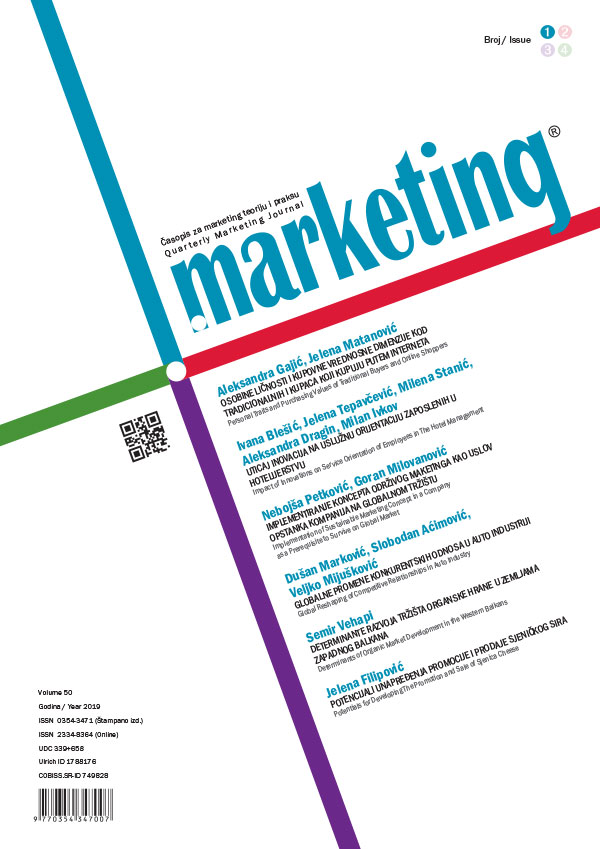
Impact of Innovations on the Service Orientation of Employees in Hotel Management
Uticaj inovacija na uslužnu orijentaciju zaposlenih u hotelijerstvu
Abstract
The characteristics of the hospitality related to the presence of tangible and non-tangible components, mutual interaction and simultaneous provision and use of services, point out the importance of employee service orientation. It is believed that the competitiveness of the company is made up of creative human resources, which will, through the introduction of products, services and processes, make the basis of successful economic development. Innovations, with the knowledge that enables them, become the most important source of market success and sustainable competitive advantage. For the purposes of this study, with theoretical approximation, a concrete research is carried out on the impact of innovations on the service orientation of employees in selected hotels on the territory of the Republic of Serbia. The survey was conducted in hotels with 3*, 4* and 5*, from January 2016 to July 2017. The results of the research presented how and to what extent introduction of innovation in hotel industry influences the work and motivation of employees in providing services to consumers, in what way innovations facilitate the work of employees and what kind of impact they have on the level of work commitment.
Apstrakt
Karakteristike ugostiteljske delatnosti koje se odnose na prisustvo opipljivih i neopipljivih komponenti, međusobnu interakciju, istovremenost pružanja i korišćenja usluga, zajedno ističu značaj uslužne orijentacije kod zaposlenih. Uvreženo je mišljenje da konkurentnost preduzeća čine kreativni ljudski resursi, koji će kroz uvođenje inovacija proizvoda, usluga i procesa činiti osnovu uspešnog ekonomskog razvoja. Inovacije, sa znanjem koje ih omogućava, postaju najvažniji izvor tržišnog uspeha i održive konkurentske prednosti. Za potrebe ovog rada, uz teorijsko približavanje, vrši se konkretno istraživanje uticaja inovacija na uslužnu orijentaciju zaposlenih u odabranim hotelima na teritoriji Republike Srbije. Istraživanje je sprovedeno u hotelima sa 3*, 4* i 5*, od januara 2016. do jula 2017. godine. Rezultati istraživanja su pokazali na koji način i u kojoj meri uvođenje inovacija u hotelsko poslovanje utiče na rad i motivisanost zaposlenih u pružanju usluga potrošačima, kako inovacije olakšavaju rad zaposlenih i kakav uticaj imaju na nivo posvećenosti poslu.
References
- Azila, N., Noor, M. and Muhamad, A. (2005). Individual Factors that Predict Customer-Orientation Behaviour of Malaysian Life Insurance Agents. Journal Pengursan, 24, 125-149.
- Anderson, J.C. and Gerbing, D.W. (1987). Structural equation modelling in practice: A review and recommended two-step approach. Psychological Bulletin, 103 (3), 411-423.
- Ansari, N.Y., Siddiqui, S. H., and Farrukh, M. (2018). Effect of High Performance Work Practices on Job Embeddedness and Employee Innovative Behavior. International Journal of Contemporary Economics and Administrative Sciences, 8(2), 64-88.
- Boles, J.S., Babin, B.J., Brashear, T.G. and Brooks, C. (2001). An examination of the relationship between retail work environments: Salespeople selling-orientation customer orientation and ob performance. Journal of Marketing Theory and Practise, 9, 1-13.
- Brown, S.P. and Peterson, R.A (1993). Antecedents and consequences of salesperson job satisfaction. Meta analysis and assessment of casual effects. Journal of Marketing Research, 30, 63-77
- Chan, A., Go, F.M. and Pine, R. (1998). Service innovation in Hong Kong: attitudes and practice. The Service Industries Journal, 18, 112-124.
- Chen, J.S., Tsou, H.T. and Huang, Y.H. (2009). Service deliver innovation: antecedents and impact on firm performance. Journal of Service Research, 12 (1), 36-55.
- Cohen, J. (1988). Statistical power analysis for the behavioural sciences (Second Edition). New York: Lawrence Erlbaum Associates Publishers.
- Deshpande, R., Farley, J. and Webster, F. (1993). Corporate culture, customer orientation and innovativeness in Japanese companies: a quadrat analysis. Journal of Marketing, 57(1), 23-37.
- Doyle, P. (1998). Innovate or die. Marketing Business, 20 (3), 20-23.
- Hjalager, A.M. (2002). Repairing Innovation Defectiveness in Tourism. Tourism Management, 23 (4), 465-474.
- Grissemann U., Plank, A. and Brunner-Sperdin, A. (2012). Enhancing business performance of hotels: The Role of Innovation and Customer Orientation. International Journal of Hospitality Management, 33, 347-356.
- Jaworski, B.J. and Kolhi, A.K. (1993). Market orientation: antecedents and consequences. Journal of Marketing, 57 (3), 53-70.
- Jones, P. (1996). Managing hospitality innovation. Cornell Hotel and Restaurant Administration Quarterly, 37, 86-95.
- Sandvik, I.L. and Sandvik, K. (2003). The impact of market orientation on product innovativeness and business performance. Journal of Product Innovation Management, 20 (4), 355-376.
- Saxe, R. and Weitz, B. A. (1982). The SOCO Scale: A Measure of the Customer Orientation of Salespeople. Journal of Marketing Research, 19 (3), 343-351.
- Sin, L.Y.M., Alan, C.B., Tse, V., Heung, C.S. and Yim, F.H.K. (2005). An analysis of the relationship between market orientation and business performance in the hotel industry. International Journal of Hospitality Management, 24 (4), 555-577.
- Snyder, M. and Gangestad, S. (1986). On the nature of self-monitoring: matters of assessment, matters of validity. Journal of Personality and Social Psychology, 51, 125-139.
- Stock, R.M. and Hoyer, W.D. (2002). Leadership style as driver of salespeople's customer orientation. Journal of Market – Focused Management, 5 (4), 355-376.
- Tajeddini, K. and Trueman, M. (2012). Managing Swiss hospitality: how cultural antecedents of innovation and customer-oriented value systems can influence performance in the hotel industry. International Journal of Hospitality Management, 31 (4), 1119-1129.
- Teng, C. and Barrows, C.W. (2009). Service orientation: antecedents, outcomes and implications for hospitality research and practice. The Service Industries Journal, 29 (10): 1413-1435.
- Lehman, A., O'Rourke, N., Hatcker, L. and Stepanski, E. J. (2005). JMP for Basic Univariate and Multivariate Statistics – A Step by Step Guide. North Carolina: SAS Institute Inc.
- Narver, J.C. and Slater, S.F. (1990). The effect of a market orientation on business profitability. Journal of Marketing, 54 (4), 20-35.
- Nieves, J., and Quintana, A. (2018). Human resource practices and innovation in the hotel industry: The mediating role of human capital. Tourism and Hospitality Research, 18(1), 72-83.
- Nunnally, J.C. (1978). Psychometric Theory (2nd Edition). New York: McGraw-Hill Book Company.
- Orfila-Sintes, F. and Mattsson, J. (2009). Innovation behaviour in the hotel industry. Omega – The International Journal of Management Science, 37 (2), 380-394.
- Orfila-Sintes, F., Crespi-Cladera, R. and Martinez-Ros, E. (2005). Innovation activity in the hotel industry: evidence from the Balearic Islands. Tourism Management, 26 (6), 851-865.
- Ottenbacher, M.C. and Harrington R.J. (2009). The product innovation process of quickservice restaurant chains. International Journal of Contemporary Hospitality Management, 21, 523-541.
- Ottenbacher, M.C. (2007). Innovation Management in the hospitality industry: different strategies for achieving success. Journal of hospitality and Tourism Research, 31, 431-454.
- Ottenbacher, M. and Gnoth, J. (2005). How to develop successful hospitality innovation. Cornell Hotel and Restaurant Administration Quarterly, 46, 205-222.
- Porter, L., Steers, R.M., Mowday, R.T. and Boulin, P.V. (1974). Organisational commitment, job satisfaction and turnover among psychiatric technicians. Journal of Applied Psychology, 59, 603-609.
- Quinn, J.B. (2000). Outsourcing Innovation: The New Engine of Growth. Sloan Management Review, 41 (4), 13-28.
- Victorino, L., Verma, R., Plaschka, G. and Dev, D. (2005). Service innovation and customer choices in the hospitality industry. Managing Service Quality, 15, 555-576.
- Wang, C.H., Chen, K.Y. and Chen, S.C. (2012). Total quality management, market orientation and hotel performance: the moderating effects of external environmental factors. International Journal of Hospitality Management, 31 (1), 119-129.
- Widmier, S. (2002). The effects of incentives and personality on salesperson's customer orientation. Industrial Marketing Management, 31, 609-618.
- Yfantidou, G., Spyridopoulou, E., Chatzigeorgiou, T., and Malliou, P. (2019). Hotel Innovation and the Creation of Competitive Advantage. In Smart Tourism as a Driver for Culture and Sustainability (pp. 135-144). Springer, Cham.
- Zhou, K.Z., Brown, J.R., Dev, C.S. and Agarwal, S. (2007). The effects of customer and competitor orientations on performance in global markets: a contingency analysis. Journal of International Business Studies, 38 (2), 303-319.
- http://www.enclaria.com/wp-content/uploads/2008/09/innovation-survey-key.pdf