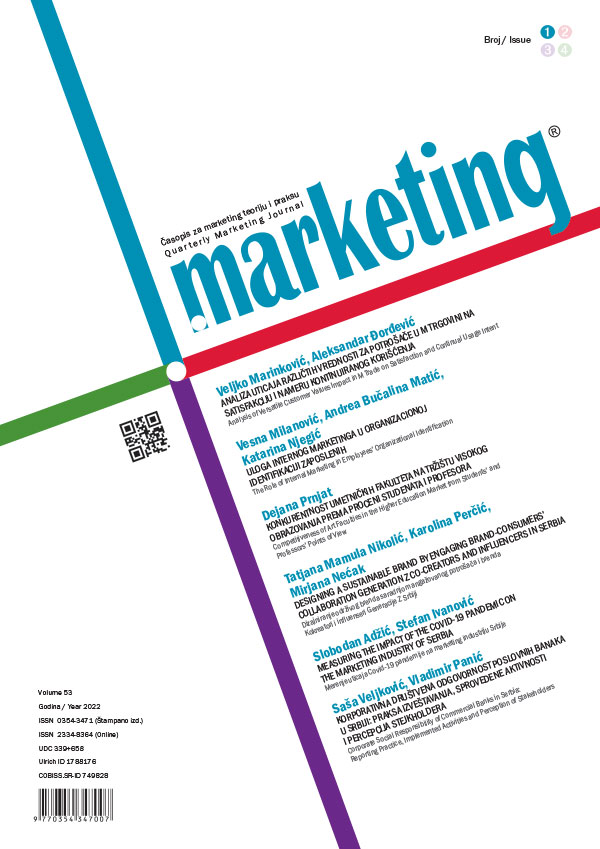
The Role of Internal Marketing in Employees’ Organisational Identification
Uloga internog marketinga u organizacionoj identifikaciji zaposlenih
Abstract
In this paper, we have tried to present the role of internal marketing (IM) in employees’ organizational identification (OI) based on the review and analysis of relevant empirical studies that were published in the period from 2009 to the present. The analysis showed that IM has a significant role in increasing employees’OI (the direct impact). The impact of IM on OI also takes place through two groups of mediators: internal marketing orientation (IMO) and the adoption of IM philosophy by managers, i.e. employees‘ job satisfaction and organizational commitment. Employees‘ experience of the programmes of IM and their perceptions of IMO affect OI, rather than management‘s attitude. However, IM programmes without managerial support do not provide the best levels of employees‘ OI. When employees are encouraged by managerial support to perceive IM, then their perceptions of IM are facilitated. In addition, the similarity between the perceptions of the organization‘s value by the manager and his employees leads to the harmonious growth of their identification with the organization. The transfer of OI from manager to employees encourages performance growth, and improves the perceptions of service quality by customers. OI mediates the relationship between IM and employees‘ outcomes. In accordance with the above, this topic is recommended to both theorists and practitioners; it is still insufficiently researched i.e. applied.
Apstrakt
U ovom radu, pokušali smo da predstavimo ulogu internog marketinga (IM) u organizacionoj identifikaciji (OI) zaposlenih bazirajući se na pregledu i analizi relevantnih empirijskih studija koje su objavljene u periodu od 2009. do danas. Analiza je pokazala da IM ima značajnu ulogu u povećanju OI zaposlenih (direktan uticaj). Uticaj IM na OI se odvija i posredstvom dve grupe medijatora: interne marketinške orijentacije (IMO) i usvojene filozofije IM od strane menadžera, odnosno zadovoljstva zaposlenih poslom i organizacione posvećenosti. Iskustvo zaposlenih sa IM programima i njihove percepcije IMO utiču na OI pre nego stav menadžmenta. Međutim, programi IM bez podrške menadžmenta ne daju najbolje nivoe OI zaposlenih. Kada su zaposleni podstaknuti menadžerskom podrškom da percipiraju IM, tada su njihove percepcije IM olakšane. Osim toga, sličnost između percepcija vrednosti organizacije od strane menadžera i od strane njegovih zaposlenih vodi usklađenom rastu njihove identifikacije s organizacijom. Transfer OI sa menadžera na zaposlene podstiče rast performansi, i poboljšava percepcije kvaliteta usluge od strane potrošača. OI posreduje u odnosu IM - ishodi zaposlenih. U skladu s navedenim, ova tema se preporučuje i teoretičarima i praktičarima; još uvek je nedovoljno istražena odnosno primenjena.
References
- Ahmed, P. K., & Rafiq, M. (2002). Internal Marketing: Tools and Concepts for Customer-Focused Management. Oxford: Butterworth-Heinemann.
- Ahmed, P. K., & Rafiq, M. (2003). Internal Marketing Issues and Challenges. European Journal of Marketing, 37 (9), 1177–1186.
http://dx.doi.org/10.1108/03090560310498813 - Ahmed, P. K., Rafiq, M., & Saad, N. M. (2003). Internal Marketing and the Mediating Role of Organizational Competencies. European Journal of Marketing, 37 (9), 1221–1241.
http://dx.doi.org/10.1108/03090560310486960 - Ashforth, B. E., & Mael, F. (1989). Social Identity Theory and the Organization. Academy of Management Review, 14 (1), 20–39.
https://doi.org/10.2307/258189 - Bailey, A. A., Albassami, F., & Al-Meshal, S. (2016). The Roles of Employee Job Satisfaction and Organizational Commitment in the Internal Marketing-Employee Bank Identification Relationship. International Journal of Bank Marketing, 34 (6), 821–840.
https://doi.org/10.1108/IJBM-06-2015-0097 - Berry, L. L., Hensel, J. S., & Burke, M. C. (1976). Improving Retailer Capability for Effective Consumerism Response. Journal of Retailing, 52 (3), 3–14.
- Berry, L. L. (1981).The Employee as a Customer. Journal of Retail Banking, 3 (2), 33–44.
- Berry, L. L., & Parasuraman, A. (1991). Marketing Services: Competing through Quality. New York: The Free Press.
- Berry, L. L., & Parasuraman, A. (1992). Services Marketing Starts from Within. Marketing Management, 1 (1), 24–34.
- Bogićević-Milikić, B., i Ognjanov, G. (2019). Uloga internog marketinga u unapređenju posvećenosti organizaciji, Marketing, 50 (2), 94–110.
doi: 10.5937/markt1902094B - Boukis, A., Kaminakis, K., Siampos, A., & Kostopoulos, I. (2015). Linking Internal Marketing with Customer Outcomes. Marketing Intelligence and Planning, 33 (3), 394–413. doi: 10.1108/MIP-02-2014-0024
- Buil, I., Martínez, E., & Matute, J. (2019). Transformational Leadership and Employee Performance: The Role of Identification, Engagement and Proactive Personality. International Journal of Hospitality Management, 77, 64–75.
https://doi.org/10.1016/j.ijhm.2018.06.014 - Ellemers, N., de Gilder, D., & Haslam, S. A. (2004). Motivating Individuals and Groups at Work: ASocial Identity Perspective on Leadership and Group Performance. Academy of Management Review, 29 (3), 459–478. https://doi.org/10.2307/20159054
- Ferdous, A. S., & Polonsky, M. (2014). The Impact of Frontline Employees‘ Perceptions of Internal Marketing on Employee Outcomes. Journal of Strategic Marketing, 22 (4), 300–315.
https://doi.org/1 0.1080/0965254X.2013.876077 - Grönroos, C. (1981). Internal marketing: An Integral Part of Marketing Theory. In: J. H. Donnelly, & W. E. George (Eds), Marketing of Services (pp. 236–238). Chicago: AMA.
- Gross, H. P., & Rottler, M. (2019). Nonprofits‘ Internal Marketing and its Influence on Volunteers‘ Experiences and Behavior: A Multiple Mediation Analysis. Nonprofit and Voluntary Sector Quarterly, 48 (2), 388–416. https://doi.org/10.1177/0899764018815614
- Hernández-Díaz, A., Calderon-Abreu, T., Amador-Dumois, M., & Córdova-Claudio, M. (2017). Internal Marketing and Customer-Contact Employees‘ Attitudinal Outcomes. Academia Revista Latinoamericana de Administración, 30 (1), 124–143.
https://doi.org/10.1108/ARLA-08-2015-0190 - Hsu, K. T. (2016). Internal Marketing Based on the Hierarchy of Effects Model for the Life Insurance Industry. International Business Research, 9 (10), 1–12. doi:10.5539/ibr.v9n10p1
- Johnson, M. D., Morgeson, F. P., & Hekman, D. R. (2012). Cognitive and Affective Identification: Exploring the Links between Different Forms of Social Identification and Personality with Work Attitudes and Behavior. Journal of Organizational Behavior, 33 (8), 1142–1167.
https://doi.org/10.1002/job.1787 - Judge, T. A., Thoresen, C. J., Bono, J. E., & Patton, G. K. (2001). The Job Satisfaction-Job Performance Relationship: A Qualitative and Quantitative Review. Psychological Bulletin, 127 (3), 376–407.
https://doi.org/10.1037/0033-2909.127.3.376 - Kale, S. H., & De, S. (2013). A Diagnosis of Inherent Problems in Enhancing Service Quality through Internal Marketing and Organizational Identification in Macau and Singapore Casinos. UNLV Gaming Research and Review Journal, 17 (1), 31–42.
- Karanika-Murray, M., Duncan, N., Pontes, H. M., & Griffiths, M. D. (2015). Organizational Identification, Work Engagement, and Job Satisfaction. Journal of Managerial Psychology, 30 (8), 1019–1033. http://dx.doi.org/10.1108/JMP-11-2013-0359
- Kaurav, R. P. S., Prakash, M., Chowdhary, N., & Briggs, A. D. (2016). Internal marketing: Review for Next Generation Businesses. Journal of Services Research, 16 (1), 81–95.
- Khalid, Z., & Hadi, N. U. (2021). Theoretical Approach towards Internal Marketing and Customer Oriented Behavior: A Developing World Perspective. Pacific Business Review International, 13 (8), 64–75.
- Lee, E. S., Park, T. Y., & Koo, B. (2015). Identifying Оrganizational Identification as a Basis for Аttitudes and Behaviors: A Meta-Аnalytic Review. Psychological Bulletin, 141 (5), 1049–1080. doi: 10.1037/bul0000012
- Lings, I. N., & Greenley, G. E. (2009). The Impact of Internal and External Market Orientations on Firm Performance. Journal of Strategic Marketing, 17 (1), 41–53. https://doi.org/10.1080/09652540802619251
- Mael, F. & Ashforth, B. E. (1992). Alumni and their Alma Mater: A Partial Test of the Reformulated Model of Organizational Identification. Journal of Organizational Behavior, 13 (2), 103–123.
https://doi.org/10.1002/job.4030130202
28. Miao, Q., Eva, N., Newman, A., & Schwarz, G. (2019). Public Service Motivation and Performance: The Role of Organizational Identification. Public Money & Management, 39 (2), 77–85.
doi:10.1080/09540962.2018.1556004 - Musa, A., Ijaiya, M. A., & Mustapha, Z. U. (2021). The Internal Marketing in the Last Decade: A Systematic Review. International Review Of Communication And Marketing Mix, 2 (4), 35–45.
- Rafiq, M., & Ahmed, P. K. (2000). Advances in the Internal Marketing Concept: Definition, Synthesis and Extension. Journal of Services Marketing, 14 (6), 449–462. https://doi.org/10.1108/08876040010347589
- Riketta, M. (2005). Organizational Identification: A Meta-Analysis. Journal of Vocational Behavior, 66 (2), 358–384. doi:10.1016/j.jvb.2004.05.005
32. Riketta, M. (2008). The Causal Relation Between Job Attitudes and Performance: A Meta-analysis of Panel Studies. Journal of Applied Psychology, 93 (2), 472–481. doi: 10.1037/0021-9010.93.2.472 - Sinčić Ćorić, D., & Pološki Vokić, N. (2009). The Roles of Internal Communications, Human Resource Management and Marketing Concepts in Determining Holistic Internal Marketing Philosophy. Zagreb International Review of Economics & Business, 12 (2), 87–105.
- Tajfel, H. (1978) The Achievement of Group Differentiation. In: H. Tajfel (Ed.), Differentiation between Social Groups: Studies in the Social Psychology of Intergroup Relations (pp. 77–98). London: Academic Press.
- Turner, J. C. (1975). Social Comparison and Social Identity: Some Prospects for Intergroup Behaviour. European Journal of Social Psychology, 5, 5–34.
- Tajfel, H. (1978) The Achievement of Group Differentiation. In: H. Tajfel (Ed.), Differentiation between Social Groups: Studies in the Social Psychology of Intergroup Relations (pp. 77–98). London: Academic Press.
- Turner, J. C. (1975). Social Comparison and Social Identity: Some Prospects for Intergroup Behaviour. European Journal of Social Psychology, 5, 5–34.
- Van Dick, R. (2001). Identification in Organizational Contexts: Linking Theory and Research from Social and Organizational Psychology. International Journal of Management Reviews, 3 (4), 265–283. doi: 10.1111/1468-2370.00068
- Van Dick, R., Christ, O., Stellmacher, J., Wagner, U., Ahlswede, O., Grubba, C., Hauptmeier, M., Höhfeld, C., Moltzen, K., & Tissington, P. A. (2004). Should I stay or should I go? Explaining turnover intentions with organizational identification and job satisfaction. British Journal of Management, 15 (4), 351–360. https://doi.org/10.1111/j.1467-8551.2004.00424.x
- Van Dick, R., Grojean, M. W., Christ, O., & Wieseke, J. (2006). Identity and the Extra Mile: Relationships Between Organizational Identification and Organizational Citizenship Behaviour. British Journal of Management, 17 (4), 283–301. doi: 10.1111/j.1467-8551.2006.00520.x
- Van Knippenberg, D., Van Knippenberg, B., de Cremer, D., & Hogg, M. A. (2004). Leadership, bSelf, and Identity: A Review and Research Agenda. Leadership Quarterly, 15 (4), 825–856 doi:10.1016/j. leaqua.2004.09.002
- Wieseke, J., Ahearne, M., Lam, S. K., & Van Dick, R.(2009). The Role of Leaders in Internal Marketing. Journal of Marketing, 73 (2), 123–145. https://doi.org/10.1509/jmkg.73.2.123