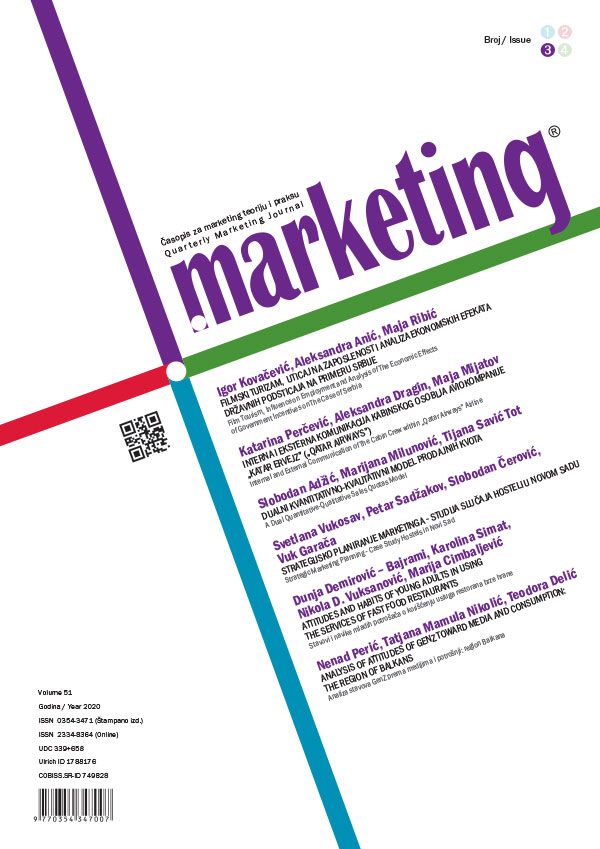
Strategic Marketing Planning - Case Study: Hostels in Novi Sad
Strategijsko planiranje marketinga – studija slučaja hosteli u Novom Sadu
Abstract
Novi Sad as the European Youth Capital for 2019 and the European Capital of Culture for 2021, with a large number of world-renowned manifestations, becomes a city tourist destination for young people who are mostly users of this type of accommodation, which indicates that hostels have great significance in the development of tourism in Novi Sad. Hostels have only recently been introduced as a term in legal acts in the hospitality which is the result of adjusting to the needs of the market, which has shown a great interest in this type of accommodation in our area, and therefore caused the opening of a large number of hostels, especially in major cities. Like the rest of the hospitality and tourism entreprises, hostels are facing major business challenges and a turbulent and dynamic business environ-ment, which implies that much attention from owners and management must be directed to strategic marketing planning. Therefore, the aim of this paper is to determine the extent to which the strategic marketing planning process is being implemented in selected hostels in Novi Sad, as well as the extent to which the owners of these facilities are focused on formulating and implementing development strategies as the end result of this process.
Apstrakt
Novi Sad kao Evropska omladinska prestonica za 2019. godinu i Evropska prestonica kulture za 2021. godinu uz veliki broj svetski poznatih manifestacija postaje gradska turistička destinacija za mlade koji su u najvećoj meri korisnici ovog vida smeštaja, što ukazuje da hosteli imaju izuzetan značaj u razvoju turizma Novog Sada. Hosteli su tek nedavno uvedeni kao pojam u pravne akte iz oblasti ugostiteljstva što je rezultat prilagođavanja potrebama tržišta koje je pokazalo veliko interesovanje za ovu vrstu smeštaja na našim prostorima i samim tim izazvalo otvaranje velikog broja hostela, pre svega u većim gradovima. Kao i ostala preduzeća ugostiteljsko-turističke privrede i hosteli se susreću sa velikim izazovima u poslovanju u turbulentnom i dinamičnom poslovnom okruženju, što implicira da se velika pažnja vlasnika i uprave mora posvetiti strategijskom planiranju marketinga. Stoga, cilj ovog rada je da se utvrdi u kojoj meri se sprovodi proces strategijskog planiranja marketinga u odabranim hostelima u Novom Sadu, kao i koliko su vlasnici ovih objekata usmereni na formulisanje i implementaciju razvojnih strategija kao krajnjeg rezultata ovog procesa.
References
- Agarwal, R., Grassl, W. & Pahl, J. (2012). Meta-SWOT: introducing a new strategic planning tool. Journal of Business Strategy, 33(2), 12-21.
- Aldehayyat, J.S. (2011). Organisational characteristics and the practice of strategic planning in Jordanian hotels. International Journal of Hospitality Management, 30(1), 192-199.
- Armstrong, G. & Kotler, P. (2013). Marketing: An introduction (12th ed.). New Jersey: Upper Saddle River, Pearson Education.
- Ayub, A., Razzaq, A., Salman Aslam, M., & Iftekhar, H. (2013). A conceptual framework on evaluating swot analysisas the mediator in strategic marketing planning through marketing intelligence. European. Journal of Business and Social Sciences, 2(1), 91-98.
- Bagnall, D. (1996). Razor gang creates tourism jitters. The Bulletin, 25, 46.
- Baker, M. J. (2000). Marketing strategy and management (3rd ed.). New York: Palgrave.
- Barktus, B., Glassman, M. & Mcafee, R. B. (2000). Mission statements: Are they smoke and mirrors?. Business Horizons, 43(6), 23-28.
- Bergeron, F, Raymond, L. & Rivard, S. (2004). Ideal patterns of strategic alignment and business performance. Information and Management, 41(8), 1003-1020.
- Blery, E. K. & Kapetaniou, E. (2008), Holiday Inn hotel: A case study from Greece. Journal of International Business and Entrepreneurship Development. 3(3–4), 308–320.
- Cashman S. (2010). Thinking Big: A Guide to Strategic Marketing Planning for Arts Organisations. London: Arts Council England.
- Cooper, C., Fletcher, J., Fyall, A., Gilbert, D. & Wanhill, S. (2008). Tourism; Principles and Practice. (fourth edition). Great Britain: Pearson Education Limited.
- Cravens, W. (2009). Strategic Marketing. New York: McGraw-Hill Higher Education.
- Cravens, W. & Piercy N. (2012), Strategic marketing. New York: McGraw-Hill Education.
- Čerović, S. (2009). Strategic Management in Tourism. Belgrade: University of Singidunum, Faculty of Hotel and Tourism Management.
- Čerović, S. and Knežević, M. (2019). Management in Hospitality. Belgrade: Singidunum University.
- David, R. (2011). Strategic Management: Concepts and Cases. New Jersey: Prentice Hall, Upper Saddle River.
- Dess G.G., Lumpkin T.G. & Eisner B.A. (2007). Strategic Management. Belgrade: Data status.
- Drummond, G., Ensor, J. & Ashford, R. (2008). Strategic marketing: planning and control. Oxford: Butterworth-Heinemann.
- Edgell, D., Kurtis, R. & Agarwal, A. (2000). Strategic Marketing Planning for the Tourism Industry. Journal of Travel & Tourism Marketing, 8(3), 111-120.
- Feifan, X. P. (2006). Developing industrial heritage tourism: A case study of the proposed jeep museum in Toledo, Ohio. Tourism Management, 27(1), 1321–1330.
- Filipović, V. and Janičić, R. (2010). Strategic Marketing. Belgrade: Faculty of Organizational Sciences.
- Glaister, K. W. & Falshaw, J. R. (1999). Strategic planning still going strong. Long Range Planning, 32(1), 107-116.
- Greenley, G. E. (1986). Does Strategic Planning Improve Company Performance? Long Range Planning, 19(2), 101-109.
- Harrington, R. (2004). The environment, involvement and performance: implicationfor the strategic process of food service firms. International Journal of Hospitality Management, 23, 317–341.
- Helms, M. M. & Nixon, J. (2010) Exploring SWOT analysis – where are we now?: A review of academic research from the last decade. Journal of Strategy and Management, 3(3), 215-251.
- Ilić, B. S. and Stefanović, V. (2018). Planning as an Element of Strategic Management in Tourism, Trends in Business, 2(12), 11-18.
- Johnson, G., Scholes, K. & Whittington, R. (2008). Exploring Corporate Strategy. New Jersey: Pearson Education Limited, Essex.
- Kee, L. W. & Ghosh, B. C. (1990). Strategies for hotels in Singapore. Cornell Hotel and Restaurant Administration Quarterly, 31(1), 74–79.
- Kotler, P. & Keller, K. L. (2009). Marketing Management. New Jersey: Pearson/Prentice Hall.
- Kosar, LJ. (2015). Fundamentals of Hospitality Management. Belgrade: Higher Hotel School.
- Krešić, D. and Miličević, K. (2010). Handbook – how to set up and manage a hostel. Zagreb: Croatian Ferial Union.
- Lin, X. (2016). Strategy analysis of a boutique and lifestyle hotel: a SWOT analysis. Retrieved from http://broncoscholar.library.cpp.edu/bitstream/handle/10211.3/174609/XiaomeLin_Project2016.pdf?sequence=4
- Marketing plan for the development of tourism in Vojvodina, INTERREG IPA CBC Croatia-Serbia 2014-2020, (2014). Novi Sad
- Mašić, B. (2009). Strategic Management. Belgrade: University of Singidunum.
- Meredith, D., Fred, D. & Forest, D. (2016). The quantitative strategic planning matrix: a new marketing tool. Journal of Strategic Marketing, 25(1), 1-12.
- Mc Carthy, J. (2009). Essentials of Marketing. Illinois: Irwin, Homewood.
- Milisavljević, M. (2012). Strategic Management: Analysis, Selection and Change. Belgrade: Centre for Publishing Activities of the Faculty of Economics.
- Morgan, R. E., McGuinness, T. & Thorpe, E. R. (2000). The contribution of marketing to business strategy formation: a perspective on business performance. Journal of Strategic Marketing, 8(4), 341-62.
- Nikolić, D. (2007). Management of Financial Operations and Pricing Policy in Hospitality and Tourism. Belgrade: FTHM, University of Singidunum.
- Ogunmokun, G. & Chen Hsin Tang, E. (2012). The Effect of Strategic Marketing Planning Behaviour on the Performance of Small-to Medium-Sized Firms. International Journal of Management, 29(1), 159-169.
- Parnell, J. A. (2000). Reframing the combination strategy debate: Defining forms of combination. Journal of Applied Management Studies, 9(1), 33-54.
- Perreault, W.D., Cannon, J. P., & McCarthy, J. E. (2008), Marketing: A Strategic Planning Approach. New York: McGraw-Hill Higher Education.
- Regulations on the conditions and manner of conducting catering activities, the manner of providing catering services, the classification of catering establishments and the minimum technical conditions for the arrangement and equipment of catering establishments, („Official Gazette of the RS‘, No. 48/2012 and 58/2016‘).
- Peng, W., Litteljohn, D., (2001), „Organisational communication and strategy implementation—a primary inquiry”, International Journal of Contemporary Hospitality Management Vol. 13, No. 7, pp. 360–363.
- Popesku, J. (2018), Marketing in Tourism and Hospitality. Belgrade: Singidunum University.
- Pride, W. M. & Ferrell, O. C. (2010). Marketing Concepts and Strategies. Boston: Houghton Mifflin Company.
- Tourism Development Programme of the City of Novi Sad for the period 2018-2022, (2018). Novi Sad.
- Radnić, R. & Gračan, D. (2003). The role of strategic marketing planning in the repositioning of the Opatija Riviera in the tourist market. Tourism and hospitality management, 9(1), 153-165.
- Rajaratnam, D. & Chonko, L. B. (1995). The effect of business strategy type on marketing organisation design, product-market growth strategy, relative marketing effort, and organisation performance. Journal of Marketing, 3(3), 60-75.
- Republican Statistical Office, (2008-2018), Belgrade
- Riege, A. M. & Perry, C. (2000). National marketing strategies in international travel and tourism. European Journal of Marketing, 34(11/12), 1290–1304.
- Senić, R. and Senić, V. (2016). Marketing Management in Tourism. Vrnjačka Banja: University of Kragujevac, Faculty of Tourism and Hospitality Management.
- Simons, T. & Namasivayam, K. (1999). The eye of the beholder: Hotel company CEO perceptions of threats and opportunities. Journal of Hospitality & Tourism Research, 23(4), 354–370.
- Spasić V. and Čerović S. (2016). Economic and Financial Analysis of Business Operations in Hospitality and Tourism. Belgrade: University of Singidunum.
- Stanton, W. (2008). Fundamentals of Marketing. New Jersey: John Wiley & Sons.
- Starčević, M. (2014). Strategic Marketing Planning in Cultural Institutions, Doctoral Dissertation, in manuscript. Faculty of Organisational Sciences. Belgrade.
- Development Strategy for Tourism of the Republic of Serbia for the period 2016-2025, (2016). Belgrade.
- Tourist Organisation of Novi Sad, (2019). Internal data, Novi Sad.
- Tsiotsou, R., & Ratten, V. (2010), „Future research directions in tourism marketing”, Marketing Intelligence & Planning, Vol. 28, No. 4, pp. 533–544.
- Tsiotsou, R. & Goldsmith, R. (2012). Strategic marketing in tourism services. Bingley (UK): Emerald Group.
- Vargo, S. L. & Lusch, R. F. (2004). Evolving to a new dominant logic for marketing. Journal of Marketing, 68(1), 1–17.
- Vukosav, S. (2016). Strategic Management of Hospitality and Tourism Enterprises. Novi Sad: Faculty of Science, Department of Geography, Tourism and Hotel Management, Novi Sad.
- Weihrich, H. (1993). The TOWS matrix—A tool for situational analysis. Long range planning, 15(2), 54-66.
- Williams, A. (2006). Tourism and hospitality marketing: Fantasy, feeling and fun. International Journal of Contemporary Hospitality Management, 18(6), 482–495.
- Yu, L. & Gu, H. (2005). Hotel reform in China: A SWOT analysis. Cornell Hotel and Restaurant Administration Quarterly, 46(2), 153–169.
- https://www.wysetc.org/