Market Segmentation Based on Value
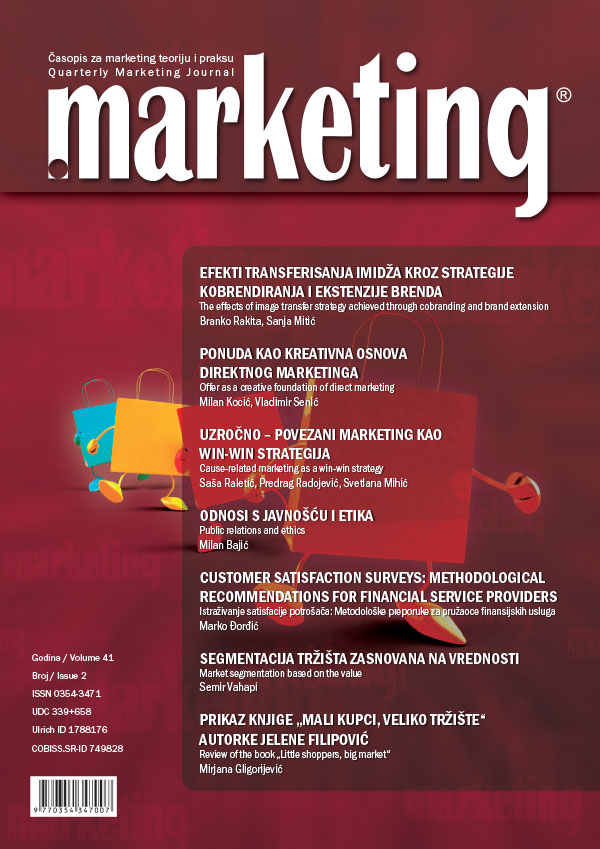
Segmentacija tržišta zasnovana na vrednosti
Abstract
The value that represents the contribution of a customer to the firm has become a key metric in marketing research and practice. However, neither are all customers equally valuable for the company nor is their value constant in time. For these reasons, it is necessary to classify customers into segments according to the present and future value and allocate resources to different segments accordingly in order to increase customer equity. In other words, more and more attention is dedicated to the analysis of a dinamic customer portfolio. In this paper the content and the significance of dinamic customer portfolio analysis are emphasized and the results obtained on the basis of this analysis are discused. In addition, this paper discribes a segment-based customer-lifetime-value model as one of the basic methods for customer portfolio analysis.
Apstrakt
Vrednost koju potrošač donosi firmi postala je ključno merilo u marketinškom istraživanju i praksi. Međutim, nisu svi potrošači podjednako vredni za preduzeće niti je njihova vrednost konstantna u vremenu. Iz tih razloga neophodno je potrošače grupisati u određene segmente prema sadašnjoj i budućoj vrednosti i shodno tome alocirati resurse na određene segmente sa ciljem povećanja vrednosti potrošača za preduzeće. Drugim rečima, sve veću pažnju zaokuplja analiza dinamičnog portfolia potrošača. U radu se ukazuje na sadržaj i značaj analize dinamičnog portfolia potrošača i razmatraju rezultati dobijeni na osnovu ove analize. Pored toga, opisan je i model životne vrednosti potrošača zasnovan na segmentu kao jedan od osnovnih metoda za analizu portfolia potrošača.
References
- Glady N., Croux,Ch. (2009), „Predicting Customer Wallet without Survey Data“, Journal of Service Research, Vol. 11, No. 3, pp. 219-231.
- Hanić H., (2008), Principles of Marketing, 2nd edition, Belgrade Banking Academy, Belgrade
- Homburg C., Steiner V. V., Totzek D. (2009), „Managing Dynamics in a Customer Portfolio“, Journal of Marketing, Vol. 79, no. 5, pp. 70-86.
- Johnson M.D., Selnes F. (2004), „Customer Portfolio Management: Towards a Dynamic Theory of Exchange Relationships“, Journal of Marketing, Vol. 68, No. 4, pp. 1-17.
- Kotler F., Vong V., Sonders Dž., Amstrong G. (2007), Principles of Marketing, Mate, Belgrade
- Kotler, P. (1974), „Marketing During Periods of Shortage“, Journal of Marketing, Vol. 38, No. 3, pp. 20-29.
- Milisavljević M. (2006) Strategic Marketing, Faculty of Economics, Belgrade
- Milisavljević M., Maričić B., Gligorijević M. (2009), Fundamentals of Marketing, CIT, Faculty of Economics, Belgrade
- Pfeifer P. E., Carraway R. L. (2000), „Modelling Customer Relationship as Markov Chains“, Journal of Interactive Marketing, Vol. 14, No. 2, pp. 43-55.
- Richards K. A., Jones E., (2005), „Customer relationship management: Finding value drivers“, Industrial Marketing Management, Vol. 37, No. 2, pp. 120-130.
- Rosenberg J.L., Czepiel A. J. (2000), „A Marketing Approach for Customer Retention“, in: Relationship Marketing, Chaining Competitive Advantage through Customer Satisfaction and Customer Retention (editors: Henning-Thoreau, Th., Hansen, U.) Springer
- Senić R., (2003), Marketing, Prizma, Kragujevac
- Soldić-Aleksić J. (2009), „A Predictive Model of Market Segmentation: Application of Logistic Regression and the CHAID Procedure“, Marketing, Vol. 40, No. 3, pp. 127-138.
- Stanković, Lj., Đukić, S., (2009), Marketing, Faculty of Economics, Niš
- Terho H., Halinen A., (2007), „Customer portfolio analysis practices in different exchange contexts“, Journal of Business Research, Vol. 60, No. 7, pp. 720-730.
- Venkatesan R., Kumar V. (2004), „A Customer Lifetime Value Framework for Customer Selection and Resource Allocation Strategy“, Journal of Marketing, Vol. 68, No. 4, pp. 106-125.
- Zeithaml V. A., Rust R. T., Lemon K. N. (2001), „The Customer Pyramid: Creating and Serving Profitable Customers“, California Management Review, Vol. 43, No. 4, pp. 118-142.