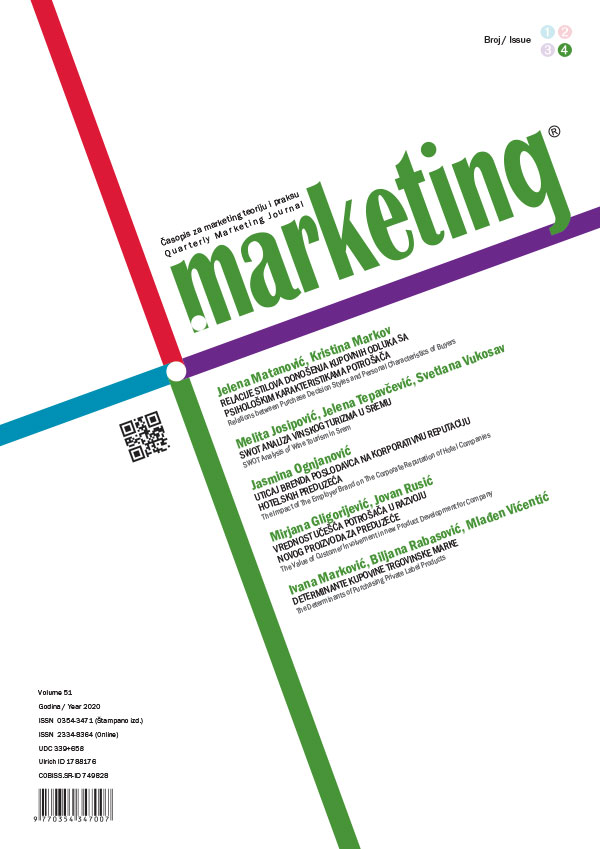
Relations between Purchase Decision Styles and Personal Characteristics of Buyers
Relacije stilova donošenja kupovnih odluka sa psihološkim karakteristikama potrošača
Abstract
The aim of the presented research is to examine whether certain personality traits can predict the decision-making styles in the context of purchasing among Serbian customers. The research involved 462 respondents of different genders, ages and levels of education. The decision-making styles of purchasing were examined using the SDKO questionnaire. SDKO questionnaire measures purchasing decision-making styles (Planners, Ethno-eco oriented, Trendsetters, Bargain hunters, Sceptics). Personality traits like Extraversion, Neuroticism and Openness to experience were measured with subscales from the Big Five Inventory, Impulsiveness was measured with Scale of Innovativeness; and Impulsiveness with the Impulsive Buying Scale (BIC). Regression analyzes were performed on the data and the results show that a set of predictors can be used to predict three purchasing decision-making styles: Planners, Ethno-eco oriented and Trendsetters. The obtained results were discussed in relation to their theoretical and practical significance for marketing practice.
Apstrakt
Prikazano istraživanje imalo je cilj da ispita da li pojedine osobine ličnosti mogu da predvide stil donošenja kupovnih odluka kod potrošača iz Srbije. U istraživanju je učestvovalo 462 ispitanika, različitog pola, uzrasta i nivoa obrazovanja. Stil donošenja kupovne odluke ispitivan je pomoću upitnika SDKО. Upitnik meri stilove donošenja kupovne odluke (Planeri, Etno-eko orijentisani, Trendseteri, Lovci na popuste, Sumnjičavi), a osobine ličnosti merene su supskalama Ekstraverzija, Neuroticizam i Otvorenost ka iskustvu iz upitnika Big Five Inventory; Inovativnost upitnikom – Scale of Innovativeness; i Impulsivnost Skalom impulsivne kupovine – Impulsive Buying Scale (BIC). Nad podacima su sprovedene regresione analize, a rezultati pokazuju da se pomoću seta prediktora može predvideti tri stila donošenja kupovnih odluka: Planeri, Etno-eko orijentisani i Trendseteri. Dobijeni rezultati su prodiskutovani spram njihovog teorijskog i praktičnog značaja za marketinšku praksu. Studija nudi teorijski doprinos u razumevanju značaja osobina ličnosti za predikciju kupovnog ponašanja, te razmatra upotrebnu vrednost dobijenih rezultata za kreiranje marketing strategija.
References
- Balushi A, Khamis Maha. (2018), An integrated theory of emerging market consumer behaviour: A qualitative investigation. Journal of Customer Behaviour. Vol. 17 Issue 1, p99-119.
- Bayley, G., Nancarrow, C. (1998). Impulse Purchasing: A Qualitative Exploration of the Phenomenon. Qualitative Market Research: An International Journal, 1(2), 99-114.
- Belch, G. E., Belch, M. A. (2004), Advertising and Promotion: An Integrated Marketing Communications Perspective. New York: McGraw–Hill.
- Bošnjak, M., Bandl, A., Bratko, D. (2007). Measuring impulsive buying tendencies in Croatia: Towards a parsimonious measurement scale. Marketing u društvu znanja i suvremenoj poslovnoj stvarnosti. CROMAR.
- Burroughs, J. E. (1996), Product Symbolism, Self Meaning, and Holistic Matching: The Role of Information Processing in Impulsive Buying. Advances in Consumer Research, 23, 463- 469.
- Cabrera, A. (2006). Determinants of individual engagement in knowledge sharing. International Journal of Human Resource Management, 17(2), 245–264.
- Costa, P. T., McCrae, R. R. (1980). Influence of extraversion and neuroticism on subjective well-being: happy and unhappy people. Journal of personality and social psychology, 38(4), 668.
- Dobre, C., Dragomir, A., i Preda, G. (2009). Consumer Innovativeness: A Marketing Approach. Management & Marketing, Vol. 4, No. 2, pp. 19-34.
- Foxall, G. R., Goldsmith, R.E., Brown, S. (2007). Psihologija potrošenje u marketingu. Naklada slap, Zagreb.
- Goldsmith, R. E., i Foxall, G. R. (2003). The measurement of innovativeness. The international handbook on innovation, 321-330.
- Guido, G. (2006). Shopping motives, big five factors, and the hedonic/utilitarian shopping value: An integration and factorial study. Innovative Marketing, 2(2), 57-67.
- Im, S., Bayus, B. L., Mason, C. H. (2003). An empirical study of innate consumer innovativeness, personal characteristics, and new-product adoption behavior. Journal of the academy of marketing science, 31(1), 61-73.
- Jocković, Markov, Matanović, Stilovi donošenja kupovnin odluka, materijal u pripremi.
- John, O. P., Donahue, E. M., Kentle, R. L. (1991). Big five inventory. Journal of Personality and Social Psychology.
- Khare, A. (2013). Credit Card Use and Compulsive Buying Behavior. Journal of Global Marketing, 26(1), 28-40.
- Kotler, P., Keller, K.L. (2006). Marketing menadžment. Data status. Beograd.
- Lastovicka, J. (1982). On the validation of lifestyle traits: A review and illustration. Journal of Marketing Research. 19, 126-138.
- Midgley, D. F. i Dowling, G. R. (1978). Innovativeness: The concept and its measurement. Journal of consumer research, 4 (4), 229 – 242.
- Mihić, M., Kursan, I. (2010). Segmentacija tržišta na temelju impulzivnosti u kupovnom ponašanju potrošača. Ekonomski vjesnik: Review of Contemporary Entrepreneurship, Business, and Economic Issues, 23(2), 385-398.
- Moschis, G.P. (1976). Shopping orientations and consumer use of information. Journal of Retailing. 52, 61–70.
- Munthiu, M. C. (2009). The Buying Decision Process and Types of Buying Decision Behavior. Sibiu Alma Mater University Journals. Series A. Economic Sciences, 2(4), 27-33.
- Okanović, P., Okanović, D., Majstorović, N. (2009). Provera metrijskih karakteristika upitnika stilova donošenja kupovnih odluka primenjenog u uslovima sa i bez vezanosti za proizvod. Primenjena psihologija, 2(2), 167-189.
- Raja, J. I Malik J. (2014). Personality Dimension and Decision Making: Exploring Consumers Shopping Styles. Journal of Behavioural Sciences, 24(2).
- Rook, D. W. i Hoch, S. J. (1985) Consuming impulse. Advances in consumer research, 12, 23-27.
- Rook, D. W., Gardner, M. P. (1993). In the mood: impulse buyings’ affective antecedents. Research in Consumer Behavior, 6(7), 1-28.
- Smederevac, S. i Mitrović, D. (2006). Ličnost-metodi i modeli. Beograd: Centar za primenjenu psihologiju.
- Steenkamp, J. B. E., Gielens, K. (2003). Consumer and market drivers of the trial probability of new consumer packaged goods. Journal of Consumer Research, 30(3), 368-384.
- Verplanken, B., Herabadi, A. (2001). Individual differences in impulse buying tendency: Feeling and no thinking. European Journal of personality, 15(S1), S71-S83.
- Wang, C. C., Yang, Y. J. (2007). Personality and intention to share knowledge: An empirical study of scientists in an R&D Laboratory. Journal of Social Behavior and Personality, 35(10), 1427–1436
- Whelan, S., Davies, G. (2006). Profiling consumers of own brands and national brands using human personality. Journal of Retailing and Consumer Services, 13(6), 393-402.
- Wood, S. L., Swait, J. (2002). Psychological indicators of innovation adoption: Cross–classification based on need for cognition and need for change. Journal of Consumer Psychology, 12(1), 1-13.