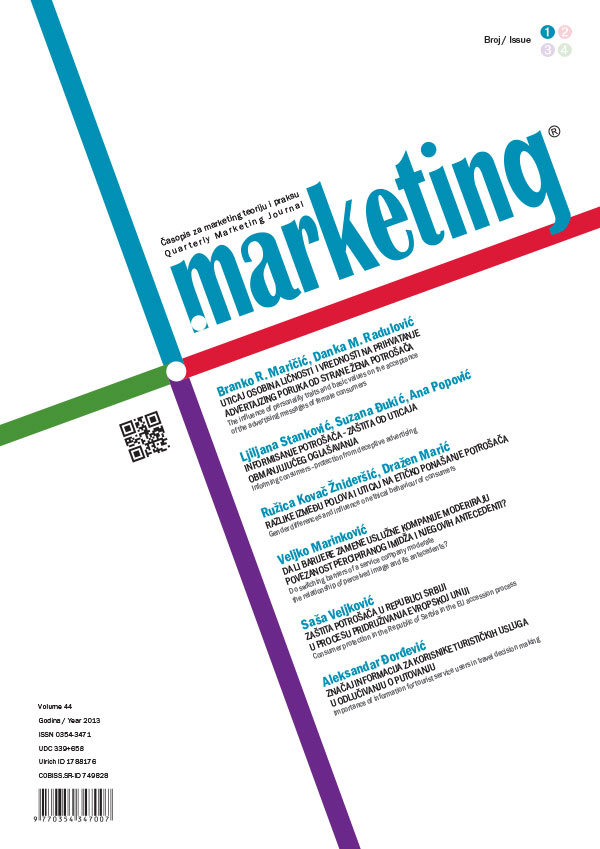
Gender Differences and Influence on Ethical Behaviour of Consumers
Razlike između polova i uticaj na etičko ponašanje potrošača
Abstract
Consumerism, human existence, and the current business environment in which companies exist, are characterized by extreme complexity and dynamism, as a result of the simultaneous action of a large number of various fac-tors, different in orientation and intensity. At a time when natural resources are consumed faster than they can be renewed, when the gap between rich and poor deepens, when the issue of sustainable development and socially responsible business practices are becoming a priority, the phenomena of ethical consumption and ethical consumer behaviour play a more prominent role in marketing theory and practice research. It is evident that consumers in both – developed and developing economies, are including the ethical evaluation of companies and their products and services on the market, in the process of forming their own opinions, preferences, and purchase decision. The modern consumer is sophisticated, knowledgeable and well informed, and as such is ready to decisively influence the companies to apply ethical practice. In order to fulfil these ethical demands of the market, marketing theory and practice pays great attention to the research of factors that influence the ethical behaviour of consumers. This paper tries to find an answer to the question – is there a significant difference between the ethical behavior of women and men as consumers.
Apstrakt
Potrošačko, ljudsko bitisa-nje, kao i aktuelni poslovni ambijent u kojem egzistiraju preduzeća, karakterišu kompleksnost i izrazita dinamičnost, što je posledica istovremenog delovanja velikog broja faktora različite prirode, smera i intenziteta. U uslovima kada se prirodni resursi troše brže nego što ih je moguće obnoviti, kada se jaz između bogatih i siromašnih sve više rodubljuje, kada pitanja održivog razvoja i društve-no odgovorne poslovne prakse postaju prioritetna, fenomen etičke potrošnje i etičkog ponašanja potrošača zauzima sve značajnije mesto u istraživanjima marketing teorije i prakse. Primetno je da potrošači, kako u razvijenim, tako sve više i u tranzicionim ekonomijama, uključuju etičku evaluaciju preduzeća i njihovih proizvoda i usluga na tržištu, u proces formiranja vlastitih stavova, preferencija, i donošenja odluke o kupovini. Savremeni potrošač je sofisticiran, edukovan i dobro informisan, te je kao takav spreman da odlučno utiče na preduzeća da primenjuju etičku praksu. U nameri da odgovore ovim etičkim zahtevima tržišta, marketing teorija i praksa veliku pažnju poklanjaju istraživanju faktora koji utiču na etičko ponašanje potrošača. Rad nastoji pronaći odgovor na pitanje – da li postoji značajna razlika između etičkog ponašanja žena i muškaraca kao potrošača?
References
- Bray J., Johns N., Kilburn D. (2011.), “An Exploratory Study into the Factors Impeding Ethical Consumption“, Journal of Business Ethics, Vol 98. No 4., str. 597-608.
- Brenkert Dž. Dž. (2011.), Marketinška Etika, JP Službeni Glasnik.
- Brinkmann J., Peattie K. (2008.), “Consumers Ethics Research: Reframing the Debate about Consumption for Good”, EJBO Electronic Journal of Business Ethics and Organization Studies, Vol 13. No 1., str. 22-31.
- Carrigan M., Attala A. (2001.), “The myth of the ethical consumer – do ethics matter in purchase behavior?”, Journal of Consumer Marketing, Vol. 18., No. 7, str. 560-577.
- Chiu Y.F., Spindel B. (2009.), “Effect of Age and Gender on Ethical Decision Making”, http://www.mikedillinger.com/szsupapers/ChiuSpindel2009_ decisionMaking.pdf , datum pristupa: 11.03.2013.
- De Pelsmacker P., Driesen L., Rayp G. (2005.), „Do Consumers Care about Ethics? Willingness to pay for fair-trade coffee“, The Journal of Consumer Affairs, Vol 39. No 2., str. 363-385.
- Ethical Consumerism Report 2011, http://www.co-operative.coop/PageFiles/416561607/Ethical-Consumerism-Report-2011.pdf datum pristupa: 16.03.2013.
- Flavin C. (2004.), State of the World 2004: A worldwatch institute report on progress toward a sustainable society (preface), W.W.Norton & Company Inc., New York.
- Glover S.H., Bumpus M.A., Sharp G.F., Munchus G.A. (2002.), „Gender Differences in Ethical Decision Making“, Women in Management Review, Vol. 17, No. 5, str. 217-227.
- Harrison R., Newholm T., Shaw D. (2005.), The Ethical Consumer, Sage Publications Ltd., London.
- Kovač Žnideršić R., Marić D., Salai S., Grubor A. (2012.), Ethical Consumer Behavior in Marketing, Proceedings of the 1st International Scientific Conference FOR MULTIDISCIPLINARITY IN BUSINESS AND SCIENCE – M-Sphere 2012 (ured. Tihomir Vranešević) Dubrovnik, Hrvatska, str. 261-271.
- Loo R. (2003.) “Are Women More Ethical Than Men?Findings from three independent studies”, Women in Management Review, Vol. 18, No. 4, str. 169-181.
- Maričić B. (2011.), Ponašanje potrošača, Centar za izdavačku delatnost Ekonomskog fakulteta u Beogradu, Beograd.
- Marić D. (2012.), Ethical Consumer Action in Achieving Social and Political Goals, Proceedings of the 2nd International Scientific Conference CONTEMPORARY ISSUES IN ECONOMICS, BUSINESS and MANAGEMENT – EBM 2012 (ured. Verica Babić, PhD) Kragujevac, Srbija, str. 189-199.
- Palan K.M. (2001.) “Gender Identity in Consumer Behavior Research: A Literature Review and Research Agenda“, Academy of Marketing Science Review, Vol. 2001, No. 10, str. 1-24.
- Stedham Y., Yamamura J.H., Beekun R.I. (2007.), “Gender Differences in Business Ethics: Justice and Relativist Perspectives“, Business ethics: A European Review,, Vol. 16, No. 2, str. 163-174.
- Szmigin I., Carrigan M. (2006.), „Expolring the Dimensions of Ethical Consumption“, European Advances in Consumer research, Vol. 7, str. 608-613.