
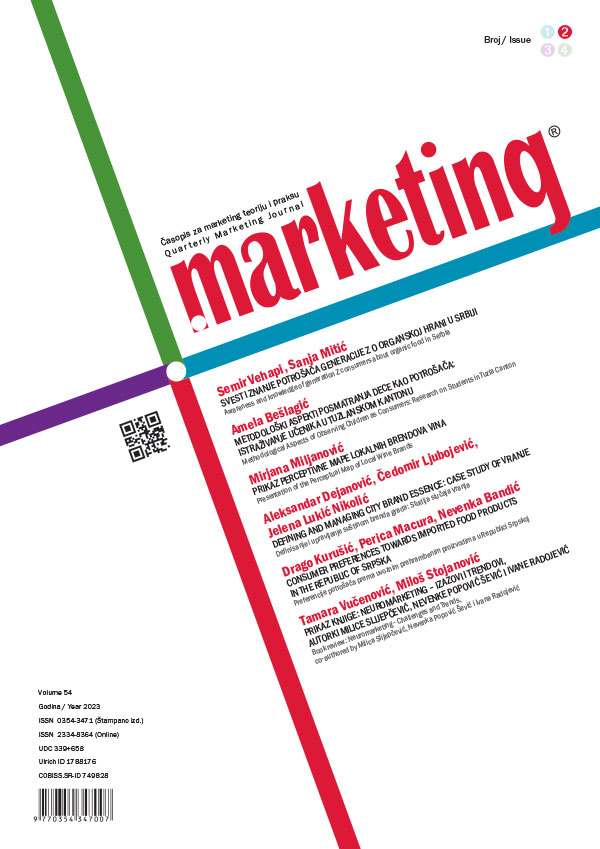
Consumer preferences towards imported food products in the Republic of Srpska
Preferencije potrošača prema uvoznim prehrambenim proizvodima u Republici Srpskoj
Abstract
The research of preferences towards imported products, primarily food products, is very current in marketing research and studies today. In various studies, evaluations of specific attributes of imported food products were taken as factors that determine preferences towards imported food products. The subject of this research is to investigate the influence of consumer evaluations according to various attributes of food products, such as quality, price, brand, design, and packaging and packing, on the evaluation of preferences for imported food products in the Republic of Srpska. The population included in this research refers to the total population in the Republic of Srpska aged 18 and over. For the purpose of empirical research, a sample of 297 respondents in the territory of the Republic of Srpska was processed, out of which 195 respondents were female (65. 66%), and 102 respondents were male (34.34%) aged eighteen and over. After the primary data were collected, the processing and analysis of the obtained data were carried out. The analysis of the collected primary data was carried out on the basis of applied factor analysis using principal component analysis (PCA) methods. The results of the research that we obtained through the empirical part of the work showed that the ranking of the brand and design of food products with higher ratings are the determining attributes on the basis of which respondents rate imported food products as more preferred. The implications of the research results can be viewed through different prisms of observation (from the perspective of consumers, producers, competitors, and the public).
Apstrakt
Istraživanje preferencija prema uvoznim proizvodima, prvenstveno prehrambenim, veoma je aktuelno u marketinškim istraživanjima i studijama danas. U različitim studijama ocjene specifičnih atributa uvoznih prehrambenih proizvoda uzeti su kao faktori koji determinišu preferencije prema uvoznim prehrambenim proizvodima. Predmet ovog istraživanja jeste da se istraži uticaj ocjene potrošača prema različitim atributima prehrambenih proizvoda, kao što su kvalitet, cijena, brend, dizajn, te ambalaža i pakovanje, na ocjenu preferencija prema uvoznim prehrambenim proizvodima u Republici Srpskoj. Populacija obuhvaćena ovim istraživanjem odnosi se na ukupnu populaciju u Republici Srpskoj starosti od 18 i više godina. U svrhu empirijskog istraživanja obrađen je uzorak od 297 ispitanika na teritoriji Republike Srpske, od čega je 195 ispitanika ženskog pola (65.66%), a 102 ispitanika su pripadnici muškog pola (34.34%) starosti od osamnaest i više godina. Nakon prikupljenih primarnih podataka vršena je njihova obrada te analiza dobijenih podataka. Analiza prikupljenih primarnih podataka vršena je na osnovu primijenjene faktorske analize (engl. Factor Analysis) pomoću metoda analize glavnih komponenti (eng. Principal Component Analysis – PCA). Rezultati istraživanja koje smo dobili kroz empirijski dio rada pokazali su da su rangiranje brenda i dizajna prehrambenih proizvoda sa višim ocjenama opredjeljujući atributi na osnovu kojih ispitanici uvozne prehrambene proizvode ocjenjuju kao više preferirane. Kroz različite prizme posmatranja (sa aspekta potrošača, proizvođača, konkurenata i javnosti) mogu se sagledati implikacije rezultata istraživanja.
References
- Aaker, D. A. (1991). Managing Brand Equity: Capitalizing in Value of Brand Name. New York: The Free Press.
- Baldi, L., Trentinaglia, M., Mancuso, T., & Peri, M. (2021). Attitude toward Environmental Protection and toward Nature: How do They Shape Consumer Behaviour for a Sustainable Tomato? Food Quality and Preference, 90.
- Bannister, J., & Saunders, J. A. (1978). U.K. Consumers’ Attitudes towards Imports: The Measurement of National Stereotype Image. European Journal of Marketing, 562-570.
- Bartikowski, B., & Walsh, G. (2015). Attitude toward cultural diversity: A test of identity-related antecedents and purchasing consequences. Journal of Business Research, 68 (3), 526–533.
- Batra, R., Ramaswamy, V., Alden, D. L., Steenkamp, J.-B. E., & Ramachander, S. (2000). Effects of Brand Local and Nonlocal Origin on Consumer Attitudes in Developing Countries. Journal of Consumer Psychology, 1, 83-95.
- Bilkey, W. J., & Nes, E. (1982). Country-of-Origin Effects on Product Evaluations. Journal of International Business Studies, 8(1), 89-99.
- Cateora, P. R., Gilly, M. C., Graham, J. L., & Money, B. R. (2009). International Marketing. New York: McGraw-Hill Education.
- Chao, P. (1993). Partitioning Country of Origin Effects: Consumer Evaluations of a Hybrid Product. Journal of International Business Studies, 24(2), 291-306.
- Cornelis, P. C. (2010). Effects of co-branding in the theme park industry: a preliminary study. International Journal of Contemporary Hospitality Management, 22(6), 775-796.
- Coulthard, H., Sharps, M., Cunliffe, L., & van den Tol, A. (2021). Eating in the lockdown during the Covid 19 pandemic; self-reported changes in eating behaviour, and associations with BMI, eating style, coping and health anxiety. Appetite, 161 (105082), 1-10.
- Cover, J. P. (1992). Asymmetric Effects of Positive and Negative Money-Supply Shocks. The Quarterly Journal of Economics, 107(4), 1261-1282. doi:10.2307/2118388
- Dickerson, K. G. (1982). Imported Versus U.S.-Produced Apparel: Consumer Views and Buying Patterns. Home Economics Research Journal, 10(3), 241-252.
- Engel, J., Blackwell, R. D., & Miniard, P. W. (1995). Consumer Behaviour. 6th Edition. Chicago: Dryden Press.
- Exenberger, E., Bucko, J., & Rabatin, P. (2020). An Assessment of Consumer Behavior in the Quality to Price Relationship of Tomatoes in the Slovak Republic Environment. Journal of Eastern European and Central Asian Research (JEECAR), 7(3), 267-279.
- Ferguson, B., & Thompson, C. (2020). Why buy local?Journal of Applied Philosophy, 38 (1), 104–120.
- Flax, V. L., Thakwalakwa, C., Schnefke, C., Phuka, J., & Jaacks, L. (2021). Food Purchasing Decisions of Malawian Mothers with Young Children in Households Experiencing the Nutrition Transition. Appetite, 156.
- Frez-Muñoz, L., Steenbekkers, B. L., & Fogliano, V. (2016). The Choice of Canned Whole Peeled Tomatoes is Driven by Different Key Quality Attributes Perceived by Consumers Having Different Familiarity with the Product: Key Quality Attributes on Purchasing CWPT…. Journal of Food Science, 81(12).
- Grzybowska-Brzezińska, M., Kuberska, D., Ankiel, M., & Brelik, A. (2020). Consumer's Behavior in a Multi-Attribute Concept of a Food Product. European Research Studies Journal, 23(1), 526-551.
- Guo, X. (2013). Living in a global world: Influence of consumer global orientation on attitudes toward global brands from developed versus emerging countries. Journal of International Marketing, 21(1), 1–22.
- Han, C. M. (1989). Country Image: Halo or Summary Construct? Journal of Marketing Research, 222-229.
- Han, C. M., & Terpstra, V. (1988). Country-of-Origin Effects for Uni-National and Bi-National Products. Journal of International Business Studies, volume 19, 235-255.
- Häubl, G. (1996). A cross-national investigation of the effects of country of origin and brand name on the evaluation of a new car. International Marketing Review, 13(5), 76-97.
- Herche, J. (1992). A note on the predictive validity of the CETSCALE. Journal of the Academy of Marketing Science, 20(3), 261-264.
- Hobbs, J. E. (2020). Food supply chains during the COVID-19 pandemic. Canadian Journal of Agricultural Economics/Revue canadienne d'agroeconomie, 68(2), 171–176.
- Howard, J. (1989). Consumer behaviour in marketing strategy. Englewood Cliffs, NJ: PrenticeHall.
- Howard, J. A., & Seth, J. N. (1969). Theory of Buyer Behavior. New York: Wiley.
- Jürkenbeck, K. S. (2021). Importance of Sensory Quality Signals in Consumers’ Food Choice. Food Quality and Preference, 90.
- Kaynak, E., & Cavusgil, T. S. (1983). Consumer attitudes towards products of foreign origin: do they vary across product classes. International Journal of Advertising, 2(2), 147-157.
- Keega, W. J., Moriartry, S. E., & Duncan, T. R. (1992). Marketing. New Jersey: Prentice Hall.
- Khamitov, M., Wang, X., & Thomson, M. (2019). How Well Do Consumer-Brand Relationships Drive Customer Brand Loyalty? Generalisations from a Meta-Analysis of Brand Relationship Elasticities. Journal of Consumer Research, 46(3), 435-359.
- Kinra, N. (2006). The effect of country-of-origin on foreign brand names in the Indian market. Marketing Intelligence & Planning, 24(1), 15-30.
- Kipnis, E., Demangeot, J. C., Pullig, C., & Broderick, A. J. (2019). Consumer multicultural identity affiliation: Reassessing identity segmentation in multicultural markets. Journal of Business Research, 126–141.
- Kirk, C. P., & Rifkin, L. (2020). I'll trade you diamonds for toilet paper: Consumer reacting, coping and adapting behaviours in the COVID-19 pandemic. Journal of Business Research, 117, 124–131.
- Kotler, P. (2000). Marketing Management, Millennium Edition. New Jersey: Prentice Hall.
- Kotler, P., Wong, V., Saunders, J., & Armstrong, G. (2005). Principles of Marketing. Essex: Pearson Education Limited.
- Macura, P. (2009). Marketing: fundamentals. Banja Luka: Faculty of Economics.
- Neven, D. J., Norman, G., & Thisse, J. F. (1991). Attitudes towards Foreign Products and International Price Competition. The Canadian Journal of Economics, 24(1), 1-11.
- Oh, H. (2003). Price fairness and its asymmetric effects on overall price, quality, and value judgments: the case of an upscale hotel. Tourism Management, 24(4), 387-399.
- Omar, N. A. (2021). The panic buying behaviour of consumers during the COVID-19 pandemic: Examining the influences of uncertainty, perceptions of severity, perceptions of scarcity, and anxiety. Journal of Retailing and Consumer Services, 1-12.
- Parameswaran, R., & Pisharodi, M. R. (1994). Facets of Country of Origin Image: An Empirical Assessment. Journal of Advertising, 23(1), 43-56.
- Rakita, B. (2009). International Marketing – From a Local to a Global Perspective. Belgrade: CID - Faculty of Economics.
- Rebollar, R., Lidón, I., Serrano, A., Martín, J., & Fernández, M. J. (2012). Influence of chewing gum packaging design on consumer expectation and willingness to buy. An analysis of functional, sensory and experience attributes. Food Quality and Preference, 24(1), 162-170.
- Sahagun, M., & Vasquez-Parraga, A. Z. (2017). How Do Consumers Adopt Imported Products in an Era of Product Overveowding? Theoretical Economics Letters, 7, 2019-2039.
- Samiee, S. (1994). Customer Evaluation of Products in a Global Market. Journal of International Business Studies, 25(3), 579-604.
- Saunders, C., Guenther, M., Saunders, J., Dalziel, P., & Rutherford, P. (2016). Consumer Preferences for Attributes in Food and Beverages in Developed and Emerging Export Markets and their Impact on the European Union and New Zealand. Australia and New Zealand Journal of European Studies, 8(1), 53-68.
- Stolzenbach, S., Bredie, W. P., & Byrne, D. V. (2013). Consumer concepts in new product development of local foods: Traditional versus novel honeys. Food Research International, 52(1), 144–152.
- Strizhakova, Y., & Coulter, R. (2019). Consumer cultural identity: Local and global cultural identities and measurement implications. International Marketing Review, 36 (5), 610–627.
- Šugrova, M., Plachy, M., Nagyova, Ľ., & Šumichrast, J. (2020). Innovative Marketing, 16(1), 66-78.
- Tribst, A. A., Tramontt, C. R., & Baraldi, L. G. (2021). Factors associated with diet changes during the COVID-19 pandemic period in Brazilian adults: Time, skills, habits, feelings and beliefs. Appetite, 163(105220), 1–10.
- Utami, H. N., Sadeli, A., & Perdana, T. (2016). Customer Value Creation of Fresh Tomatoes Through Branding and Packaging as Customer Perceived Quality. J. ISSAAS, 22(1), 123-136.
- Velasco, C., Woods, A. T., Petit, O., Cheok, A. D., & Spence, C. (2016). Crossmodal correspondences between taste and shape, and their implications for product packaging: A review. Food Quality and Preference, 52, 17-26.
- Walley, K., Custance, P., Feng, T., Yang, X., Cheng, L., & Turner, S. (2014). The Influence of Country of Origin on Chinese Food Consumers. Transnational Marketing Journal, 2(2), 78-98.
- Yagci, M. I. (2001). Evaluating the Effects of Country-of-Origin and Consumer Ethnocentrism: A Case of a Transplant Product. Journal of International Consumer Marketing, 13(3), 63-85.
- Zhang, A., & Jakku, E. (2021). Australian Consumers’ Preferences for Food Attributes: A Latent Profile Analysis. Foods, 10(56).