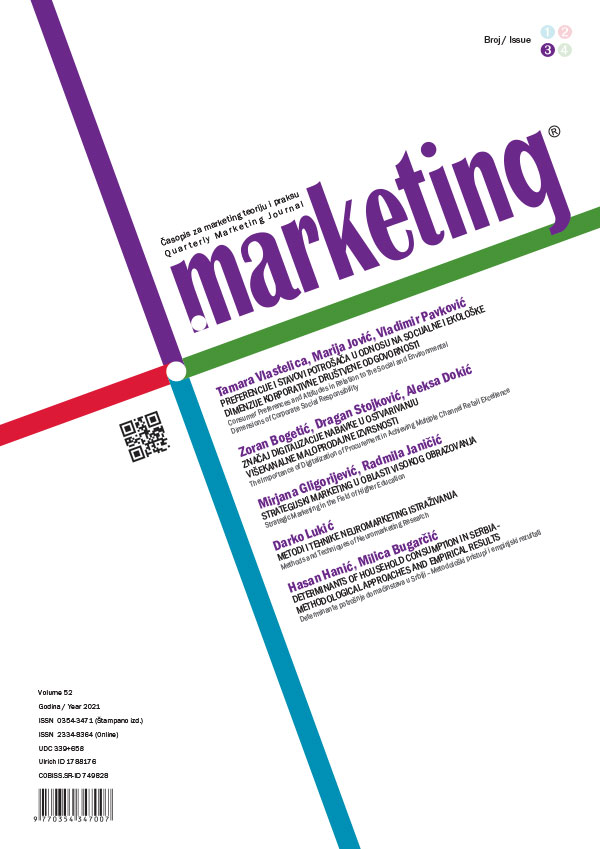
Consumer Preferences and Attitudes in Relation to The Social and Environmental Dimensions of Corporate Social Responsibility
Preferencije i stavovi potrošača u odnosu na socijalne i ekološke dimenzije korporativne društvene odgovornosti
Abstract
Corporate social responsibility, as a business philosophy and managerial concept, is increasingly represented in contemporary business operations and marketing, as well as in the scientific literature in this field. The importance that consumers attach to different aspects of social responsibility when evaluating companies and products and making purchasing decisions, is determined by economic, sociological, institutional and technological development of the environment, differing in developed countries and emerging markets. The aim of this paper is to investigate how consumers perceive the responsibility of companies operating in the market of the Republic of Serbia and which aspects of social responsibility they perceive as crucial or more important. In order to examine how consumers perceive the social and environmental dimensions of corporate social responsibility, an empirical study was conducted, using the survey method. For the purposes of the research, the questionnaire was adapted from the similar studies in foreign countries, which enables a compari son of the importance of different dimensions of corporate responsibility with consumers from different markets. In addition to standard demographic questions, the questionnaire also contains questions related to different perception, beliefs and attitudes, as well as expectations of respondents‘ in relation to the social and environmental dimension of company responsibility. The results of the research showed that there is a significant correlation between the perception of environmental and social aspects of corporate social responsibility and consumer preferences, expressed in company’s evaluation and intention to buy its products or services. One of the conclusions of the survey is that demographic characteristics of respondents determine this connection.
Apstrakt
Korporativna društvena odgovornost, kao poslovna filozofija i menadžerski koncept, sve više je zastupljena kako u savremenom poslovanju i marketingu, tako i u naučnoj literaturi iz ove oblasti. Značaj koji potrošači pridaju različitim aspektima društvene odgovornosti prilikom evaluacije kompanije i proizvoda, kao i odlučivanja za kupovinu, se razlikuje u zavisnosti od stepena ekonomskog, sociološkog, institucionalnog i tehnološkog razvoja okruženja, odnosno nije isti u razvijenim zemljama i na tržištima u razvoju. Cilj rada je da se istraži na koji način potrošači percipiraju društvenu odgovornost kompanija koje posluju na tržištu Republike Srbije i kojim aspektima društvene odgovornosti pridaju najveći značaj. Kako bi se ispitalo koja su očekivanja potrošača i na koji način oni percipiraju socijalne i ekološke dimenzije društvene odgovornosti, sprovedeno je empirijsko istraživanje, primenom metode anketiranja. Za potrebe istraživanja prilagođen je upitnik koji je primenjivan u sličnim studijama na inostranim tržištima, što omogućava i poređenje značaja različitih dimenzija korporativne odgovornosti kod potrošača iz različitih tržišnih okruženja. Rezultati istraživanja su pokazali da postoji značajna veza između percepcije ekoloških i socijalnih aspekata društvene odgovornosti kompanija i preferencija potrošača, izraženih u evaluaciji kompanije i nameri za kupovinu, kao i da demografske karakteristike ispitanika u jednom delu determinišu tu vezu.
References
- Abdeen, A., Rajah, E. and Gaur, S.S. (2016). Consumers’ beliefs about firm’s CSR initiatives and their purchase behaviour. Marketing Intelligence and Planning, 34 (1), 2–18.
https://doi.org/10.1108/MIP-06-2014-0107 - Baden, D. (2016). A reconstruction of Carroll’s pyramid of corporate social responsibility for the 21st century. International Journal of Corporate Social Responsibility, 1 (8), 1-15. https://doi.org/10.1186/s40991-016-0008-2
- Bowen, H. R. (1953). Social responsibilities of the businessman. Iowa: University of Iowa Press.
- Carroll, A. B. (1991). The pyramid of corporate social responsibility: Toward the moral management of organizational stakeholders. Business Horizons, 34 (4), 39–48.
- Carroll, A. B. (1999). Corporate Social Responsibility: Evolution of a Definitional Construct. Business and Society, 38 (3), 268–295. https://doi.org/10.1177%2F000765039903800303
- Carroll, A. B. (2015). Corporate social responsibility: The centerpiece of competing and complementary frameworks. Organizational Dynamics, 44 (2), 87–96. https://psycnet.apa.org/doi/10.1016/j. orgdyn.2015.02.002
- Cattell, R. B. (1966). The Scree Test For The Number Of Factors. Multivariate Behavioral Research, 1(2), 245–276. https://doi.org/10.1207/s15327906mbr0102_10
- Chandler, D. (2016). Strategic corporate social responsibility: sustainable value creation. United States of America: SAGE Publications.
- Chang, K., Kim, I. and Li, Y. (2014). The heterogeneous impact of corporate social responsibility activities that target different stakeholders. Journal of Business Ethics, 125 (2), 211–234. https://doi.org/10.1007/s10551-013-1895-8
- Chetty, S., Naidoo, R. and Seetharam, Y. (2015). The impact of corporate social responsibility on firms’ financial performance in South Africa. Contemporary Economics, 9 (2),193–214.
- Cohen, J. (1992). A power primer. Psychological Bulletin, 112(1), 155–159.
https://doi.org/10.1037/0033-2909.112.1.155 - Coombs, T. W. and Holladay, S. J. (2012). Managing Corporate Social Responsibility: A Communication Approach. New Jersey: Wiley-Blackwell.
- Cronbach, L.J. (1943). On estimates of test reliability. Journal of Educational Psychology, 34 (8), 485–494. https://doi.org/10.1037/h0058608
- Dilling, F.A.P. (2011). Stakeholder Perception of Corporate Social Responsibility. International Journal of Management and Marketing Research, 4 (2), 23-34.
- European Commission. (2011). Corporate social responsibility: a new definition, a new agenda for action. Preuzeto sa: http://europa.eu/rapid/press-release_MEMO-11-730_en.html (10.9.2021.)
- Ferreira, A.I. and Ribeiro, I. (2017). Are you willing to pay the price? The impact of corporate social (IR) responsibility on consumer behavior towards national and foreign brands. Journal of Consumer Behavior, 16 (1), 63–71. https://doi.org/10.1002/cb.1603
- Gupta, M. and Hodges, N. (2012). Corporate social responsibility in apparel industry; An exploration of Indian consumers’ perceptions and expectations. Journal of Fashion Marketing and Management: An International Journal, 16 (2), 216-233. https://doi.org/10.1108/13612021211222833
- Gupta, S.S. and Wadera, D. (2019). Awareness and Understanding of Corporate Social Responsibility (CSR) Among Indian Consumers. International Journal of Research and Analytical Reviews, 6 (2), 570-587.
- International Organization for Standardization. (2018). ISO 26000 Guidance on social responsibility: Discovering ISO 26000. ISO. Geneve. Switzerland. Preuzeto sa: https://www.iso.org/files/live/sites/isoorg/files/store/en/PUB100258.pdf (5.9.2021.)
- Kotler, F. and Li, N. (2007). Korporativna društvena odgovornost – Učiniti najviše za svoju kompaniju i za izabrani društveni cilj. Beograd: Hesperia.
- Latapí Agudelo, M.A., Jóhannsdóttir, L. and Davídsdóttir, B. (2019). A literature review of the history and evolution of corporate social responsibility. International Journal of Corporate Social Responsibility, 4 (1), 1-23. https://doi.org/10.1186/s40991-018-0039-y
- MapChange (2008). Preuzeto sa: http://consumer.environics.net/files/Change_MapChange_Doc.pdf. (25.8.2021)
- Mohr, L.A. and Webb, D.J. (2005). The effects of corporate social responsibility and price on consumer responses. Journal of Consumer Affairs, 39 (1), 121–147.
https://doi.org/10.1111/j.1745-6606.2005.00006.x - Mohr, L.A., Webb, D.J. and Harris, K.E. (2001). Do consumers expect companies to be socially responsible? The impact of corporate social responsibility on buying behavior. The Journal of Consumer Affairs, 35 (1), 45-72. https://doi.org/10.1111/j.1745-6606.2001.tb00102.x
- Onkila, T. (2009). Corporate Argumentation for Acceptability: Reflections of Environmental Values and Stakeholder Relations in Corporete Environmental Statements. Journal of Business Ethics, 87, 285-298. https://doi.org/10.1007/s10551-008-9885-y
- Perera, L.C.R. and Chaminda, J.W.D. (2013). Corporate social responsibility and product evaluation: the moderating role of brand familiarity. Corporate Social Responsibility and Environmental Management, 20 (4), 245–256. https://doi.org/10.1002/csr.1297
- Porter Novelli (2020). Introducing Porter Novelli‘s Covid-19 Tracker: Insights for a Time of Crisis. Preuzeto sa: https://www.porternovelli.com/intelligence/2020/04/14/porter-novelli-covid-19-tracker-insights-for-a-time-of-crisis/. (7.9.2021.)
- Porter, M. E. and Kramer, M. R. (2011). Creating shared value. Harvard Business Review (January-February 2011), 1-17.
- Rahim, A.R., Jalaluddin, F.W. and Tajuddin, K. (2011). The importance of corporate social responsibility on consumer behavior in Malaysia. Asian Academy of Management Journal, 16 (1), 119-139
- Ramasamy, B. and Yeung, M. (2009). Chinese consumers’ perception of corporate social responsibility. Journal of Business Ethics, 88 (1), 119-132.
https://doi.org/10.1007/s10551-008-9825-x - Sardianou, E., Stauropoulou, A. and Kostakis, I. (2017). Analysing consumers’ awareness towards CSR, focusing on environmental management. Environmenal Management and Sustainable Development, 6 (2), 51-64.
- Sen, S. and Bhattacharya, C. B. (2001). Does doing good always lead to doing better? Consumer reactions to corporate social responsibility. Journal of Marketing Research, 38 (2), 225-243. https://doi.org/10.1509%2Fjmkr.38.2.225.18838
- Shukla, A., Goel, G. and Tiwari N. (2019). Consumer perception of corporate social responsibility and purchase behavior. International Journal of Business Excellence, 18 (1), 22-41.
- Smith, N. C. (2001). Changes in corporate practices in response to public interest advocacy and actions. U: P. N. Bloom and G. T. Gundlach (ur.). Handbook of Marketing and Society (140-161). London: Sage Publications, Thousand Oaks.
- Strategija razvoja i promocije društveno odgovornog poslovanja u Republici Srbiji za period od 2010. do 2015. godine (2010). Službeni glasnik RS, Br. 51. Preuzeto sa: https://www.pravno-informacioni-sistem.rs/SlGlasnikPortal/eli/rep/sgrs/vlada/strategija/2010/51/1. (10.9.2021.)
- Tian, Z., Wang, R. and Yang, W. (2011). Consumer responses to CSR in China. Journal of Business Ethics, 101 (2), 197-212. https://doi.org/10.1007/s10551-010-0716-6
- Tsai, Y.H., Joe, S.W., Lin, C.P., Chiu, C.K. and Shen, K.T. (2015). Exploring corporate citizenship and purchase intention: mediating effects of brand trust and corporate identification. Business Ethics: A European Review, 24 (4), 361–377. https://doi.org/10.1111/beer.12073
- Tschopp, D. and Nastanski, M. (2014). The harmonization and convergence of corporate social responsibility reporting standards. Journal of Business Ethics, 125 (1), 147–162. https://doi.org/10.1007/s10551-013-1906-9
- Turkel, S., Uzunoglu, E., Kaplan, M.D. and Vural, B.A.(2015). A strategic approach to CSR communication: examining the impact of brand familiarity on consumer responses. Corporate Social Responsibility and Environmental Management, 4 (23), 228–242. https://doi.org/10.1002/csr.1373
- Visser, W. (2008). Corporate social responsibility in developing countries. U: A. Crane, D. Matten, A. McWilliams, J.Moon and D.S. Siegel (ur.). The Oxford Handbook of Corporate Social Responsibility (1-28). Oxford: Oxford University Press
- Vlastelica Bakić T., Mijatović I. i Marinović N. (2016). Key CSR Initiatives in Serbia: A New Concept with New Challenges. U: S. Idowu (ur.). Key Initiatives in Corporate Social Responsibility. CSR, Sustainability, Ethics & Governance (201-220). Springer, Cham.
https://doi.org/10.1007/978-3-319-21641-6_9 - Vlastelica, T. (2016). Korporativna reputacija i društvena odgovornost. Beograd: Zadužbina Andrejević.
- Vlastelica, T., Cicvarić Kostić, S., Okanović, M. i Milosavljević, M. (2018). How Corporate Social Responsibility Affects Corporate Reputation? The evidence from an emerging market. JEEMS – Journal of East European Management Studies, 23 (1), 6-25. https://doi.org/10.5771/0949-6181-2018-1-10
- Wagner, T., Lutz, R. and Weitz, B. (2009). Corporate Hypocrisy: Overcoming the Threat of Inconsistent Corporate Social Responsibility Perceptions. Journal of Marketing, 73 (6), 77-91.
https://doi.org/10.1509%2Fjmkg.73.6.77 - Weber, M. (2008). The business case for corporate social responsibility: A company-level measurement approach for CSR. European Management Journal, 26 (4), 247–261. https://doi.org/10.1016/j. emj.2008.01.006
- Williams, G. and Zinkin, J. (2006). The Effect of Culture on Consumer Willingness to Punish Irresponsible Corporate Behaviour’, Social Science Research Network. Preuzeto sa:
http://papers.ssrn.com/sol3/papers.cfm?abstract_id=905202 (2.9.2021.) - Youn, S. and Kim, H. (2008). Antecedents of consumer attitudes towards cause-related marketing. Journal of Advertising Research, 48 (1), 23-13. doi: 10.2501/S0021849908080136