
Prospects and Motives of Internationalization of China’s Auto Companies – Case Studies Geely and Great Wall
Motivi i perspektive internacionalizacije kineskih auto kompanija – Studije slučaja Geely i Great Wall
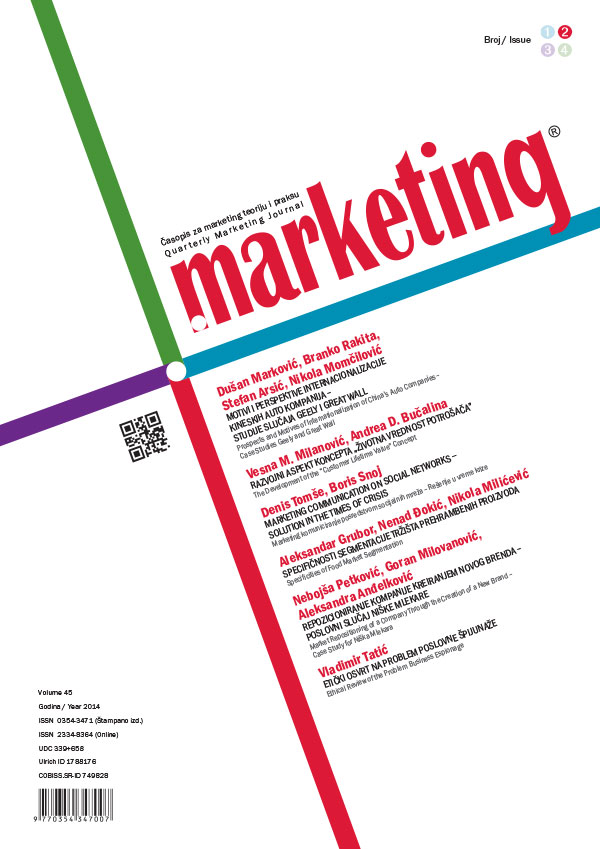
Abstract
The beginning of the 21st century is characterized by huge socio – economic changes. Rising economic importance of densely populated emerging markets has been one of the most important changes in this period. China stands out among other emerging markets. Vibrant economic development pushes up the number of multinational companies from China with growing competitive importance on the global market. China’s multinational companies as a recent phenomenon cannot be completely explained by the earlier theories of multinational companies which are based on institutional context and business characteristics of multinational companies from developed countries. Internationalization of multinational companies from China and other emerging markets is driven by slightly different motives. Internationalization motives of China’s companies from technology intensive industries, such as auto industry, will be analyzed in this paper. The paper comprises two case studies: auto companies Geely and Great Wall. The case studies will refute the thesis that companies internationalize their business operations with the aim of additionally exploiting domestic competitive advantage. China’s auto companies internationalize their operations primarily to develop their own business capabilities and gain positive reputation.
Apstrakt
Početak 21. veka obeležile su krupne socio–ekonomske promene. Jedna od glavnih promena u ovom periodu je rastući značaj brzorastućih ekonomija. Među ovim zemljama se posebno izdvaja Kina. Zbog ubrzanog ekonomskog rasta povećao se broj i konkurentski značaj multinacionalnih kompanija iz Kine. Fenomen kineskih multinacionalnih kompanija, koji je novijeg datuma, ne može u potpunosti biti objašnjen ranijim teorijama o multinacionalnim kompanijama. Ranije teorije su se bazirale na institucionalnom kontekstu razvijenih zemalja i poslovnim karakteristikama njihovih multinacionalnih kompanija. Motivi internacionalizacije preduzeća iz Kine i ostalih brzorastućih ekonomija su u određenoj meri drugačiji. U ovom radu biće analizirani motivi internacionalizacije kineskih preduzeća u tehnološki intenzivnoj grani, kao što je auto industrija. Rad će se bazirati na dve studije slučaja: 1) auto kompanije Geely i 2) auto kompanije Great Wall. Rezultati studija slučaja pokazuju da tradicionalna pretpostavka da kompanije internacionalizuju poslovanje kako bi i u inostranstvu eksploatisale konkurentsku prednost koju poseduju na domaćem tržištu, u ovom slučaju ne važi. Glavni motiv internacionalizacije kineskih auto kompanija je da razviju poslovne kompetencije i steknu pozitivnu poslovnu reputaciju.
References
- Abrami, R. M., Kirby C., W., McFarlen F.W. (2014), “Why China Can’t Innovate and What It’s Doing about It”, Harvard Business Review, Vol. 92, No. 3, str. 107–111.
- Авторевю, „Geely Otaka Review”, “ http://www.autoreview.ru/arcap/cars/geely_otaka/: pristupljeno 01.05.2014.
- Automotive News China, http://www.autonewschina.com/en/article.asp?id=11714, pristupljeno: 01.05.2014.
- Automotive News China, http://www.autonewschina.com/en/article.asp?id=8738, pristupljeno 01.05.2014.
- Barbosa F, Hattingh D., Kloss, M. (2010), Applying Global Trends: A Look at China’s Auto Industry, McKinesey&Company, New York.
- Barnard, H. (2010), “Overcoming the Liability of Foreignness without Strong Firm Capabilities – the Value of Market Based Resources”, Journal of International Management, Vol. 16, No. 2, str. 165–176.
- Barney, J., Tong, T. (2004), Building versus Acquiring Resources: Analysis and Application to Learning Theory”, Strategy and Performance: Achieving Competitive Advantage in the Global Marketplace, (ured. Ghobadian, A., O’Regan, N., Galler, D. Viney, H.), str. 57 – 81.
- Buckley, P., Clegg, J. L., Cross, A., Voss, H. and Zheng, P. (2007) “The Determinants of Chinese Outward Foreign Direct Investments”, Journal of International Business Studies, Vol. 38, No. 4, str. 499–518.
- Caves, R. (1980) Multinational Enterprise and Economic Analysis, Cambridge University Press.
- CCPIT Patent and Trademarke Office, „Toyota Lost a Lawsuit Against a Chinese Car Manufacturer“, http://www.ccpit-patent.com.cn/News/2003123006.htm, pristupljeno: 01.05.2014.
- Chattopadhyay A., Batra R, Ozsomer, A. (2012), The New Emerging Market Multinationals, McGraw Hill.
- Child, J. (2009), China and International Business, The Oxford Handbook of International Business, (ured. Rugman Alan), Oxford, str. 623-647.
- Christensen, C., Alton, R., Rising, C., Waldeck, A. (2011), “The M&A Playbook”, Harvard Business Review, Vol. 89. No. 3., str. 48–57.
- Chu, W. (2011), “How the Chinese Government Promoted a Global Automobile Industry”, Industrial and Corporate Change, Vol. 20, No. 5, str. 1235–1276.
- Complex Rides (2013), „A Recent History of Chinese Car Companies Blatantly Stealing Designs“, http://www.complex.com/rides/2013/10/chinese-car-company-knockoffs/merrie-300: pristupljeno 01.05.2014.
- Daily Mail, „A £30,000 copycat Rolls-Royce? It must be made in China“ http://www.dailymail.co.uk/news/article-1172635/A-30-000-copycat-Rolls-Royce-It-China.html, pristupljeno 01.05.2014.
- Dunning, H.J., Lundan, M.S. (2008), Multinational Enterprises and the Global Economy, Edward Elgar Publishing Limited.
- Dunning, J.H. (2000) “The Electic Paradigm as an Envelope for Economic and Business Theories of MNE Activity”, International Business Review, Vol. 9, No. 2, str. 163–190.
- Euron NCAP, „Geely Emgrand EC7 Review“, http://www.euroncap.com/results/geely_emgrand/ec7/2011/462.aspx: pristupljeno 01.05.2014.
- Financial Times – Markets Data, http://markets.ft.com/research/Markets/Tearsheets/Financials?s=601633:SHH&subview=IncomeStatement, pristupljeno 01.05.2014.
- Geely (2013), Geely Annual Report, Geely.
- Giles C. (2014), „China poised to pass US as world’s leading economic power this year“ http://www.ft.com/intl/cms/s/0/d79ffff8-cfb7-11e3-9b2b-00144feabdc0.html#axzz31WuQMStA: pristupljeno 01.05.2014.
- Global Times (2012), „Chinese self-owned auto brand takes root in Latin America“, http://www.globaltimes.cn/content/843669.shtml#.Uxxexz9dWSo: pristupljeno 01.05.2014
- Govindarajan, V., Ramamurti, R. (2011), “Reverse Innovation, Emerging Markets and Global Strategy” Global Strategy Journal, Vol. 1, No. 3-4, str. 191–205.
- Great Wall, (2013), Great Wall Annual Report, Great Wall.
- Great Wall Motor Company Limited, http://gwm.co.za/great-wall-motors-china/, pristupljeno: 19.05.2014.
- Great Wall Motor Company Limited, „Company History“, http://www.gwm-global.com/company/history.html pristupljeno: 19.05.2014.
- Jullens, J. (2013), “How Emerging Giants Can Take on the World”, Harvard Business Review, Vol. 91, No. 12, str. 121–125.
- KPMG (2012), KPMG’s Automotive Executive Survey 2012, KPMG.
- KPMG (2014), KPMG’s Automotive Executive Survey 2014, KPMG.
- Krieger, A., Rathke, P., Wang, L. (2012), Recharging China’s Electric Vehicle Aspirations, McKinesey&Company, New York.
- Krugman, P. Obstfeld, M. (2003), International Economics: Theory and Policy, Addison Wesley.
- Kumar, N. (2009), „How Emerging Giants Rewriting the Rules of M&A“, Harvard Business Review, Vol. 87, No. 5, str. 115-121.
- Latin NCAP (2010), „Geely CK 1 Eithout Airbag“, http://www.latinncap.com/data/pdf/geely-ck1-en.pdf: pristupljeno 01.05.2014.35.
- Luo, Y., Xue, Q., Han, B. (2010), “How Emerging Market Governments Promote Outward FDI: Experience from China”, Journal of World Business, Vol. 45, No. 1, str. 68-79
- Mathews A.J., (2006), “Dragon Multinationals: New Players in 21st Century Globalization”, Asia Pacific Journal of Management, Vol. 23, No. 1, str. 5–27.
- Oica, http://www.oica.net/category/production-statistics: pristupljeno 01.05.2014.
- Peng W.M. (2012), „The Global Strategy of Emerging Multinationals from China“, Global Strategy Journal, Vol.2, No. 2, str. 97–107.
- PWC, (2011), Automotive M&A Insights, PWC.
- PWC, (2012), Automotive M&A Insights, PWC.
- PWC, (2013), Automotive M&A Insights, PWC.
- Rakita, B. Marković, D. (2012), The Process of Evolutionary Business Internationalization – Case of Chinese Car Industry, The Role of Contemporary Management and Marketing Methods in Improvement of Competitiveness of the Companies in Serbia within the Process of its Integration to the European Union, (ured. Nebojša Janjićijević), str. 385–406.
- Rugman A. (2008), How Global are TNCs from Emerging Markets?, The Rise of Transnational Corporations from Emerging Markets, (ured. Sauvant Karl), Edvard Elgar Publishing, str. 86 – 106.
- Rugman, A. (1980), “A New Theory of Multinational Enterprises: Internationalization vs .Internalization”, Columbia Journal of World Business, Spring, str. 23-29.
- Rugman, A., Verbeke A. (2009), Location, Competitiveness and Multinational Enterprise, The Oxford Handbook of International Business (ured. Rugman Alan), Oxford, str. 146 -178.
- Russo, B., Tse, E., Ke, T. and Peng, B. (2009), The Eight Overarching China Automotive Trend that are Revolutionizing the Auto Industry, China, The Booz&Co.
- Schmid, C. (2011), “The Battle for China‘s Talent”, Harvard Busines Review, Vol. 91, No. 3, str. 25-27.
- Sun, L.S., Peng, W.M., Ren, B., Daying, Y. (2012), “A Comparative Ownership Advantage Framework for Cross Border M&As: The Rise of Chinese and Indian MNEs”, Journal of World Business, Vol. 47, No. 1, str. 4–14.
- Tao QT (2011) Competing in China’s automobile industry, Global Business, (ured. Mike Peng), str. 288–294.
- The Wall Street Journal, http://online.wsj.com/news/articles/SB100014240527023040710045794122418062 20008, pristupljeno: 01.05.2014.
- The World Data bank, http://databank.worldbank.org/data/views/variableselection/selectvariables.aspx?source=world-development-indicators, pristupljeno 01.05.2014.
- UNCTAD (2013) , World Investment Report 2013, UNCTAD.
- Verbeke, A. (2009), International Business Strategy, Cambridge.
- Vernon, R. (1966) “International Investment and International Trade in the Product Cycle”, The Quarterly Journal of Economics, Vol. 80, str. 190-207.
- Williamson, P., Raman, A. (2011), “How China Reset Its Global Acquisitions Agenda“, Harvard Business Review, Vol. 89, No. 4, str. 109–114.
- Williamson, P.J., Ming, Z. (2009) Chinese Multinationals: Emerging through New Global Gateways, Emerging Multinationals in Emerging Markets, (ured. Ravi Ramamurti i Singh V. Jitendra), Cambridge str. 81–109.
- World Trade Organization – Country Profile China, http://stat.wto.org/CountryProfile/WSDBCountryPFView.aspx?Language=E&Country=CN, pristupljeno: 01.05.2014
- Yadong, L., Tung, R. (2007) “International Expansion of Emerging Market Enterprises: A Springboard Perspective”, Journal of International Business Studies, Vol. 38, No. 4, str. 481–498.