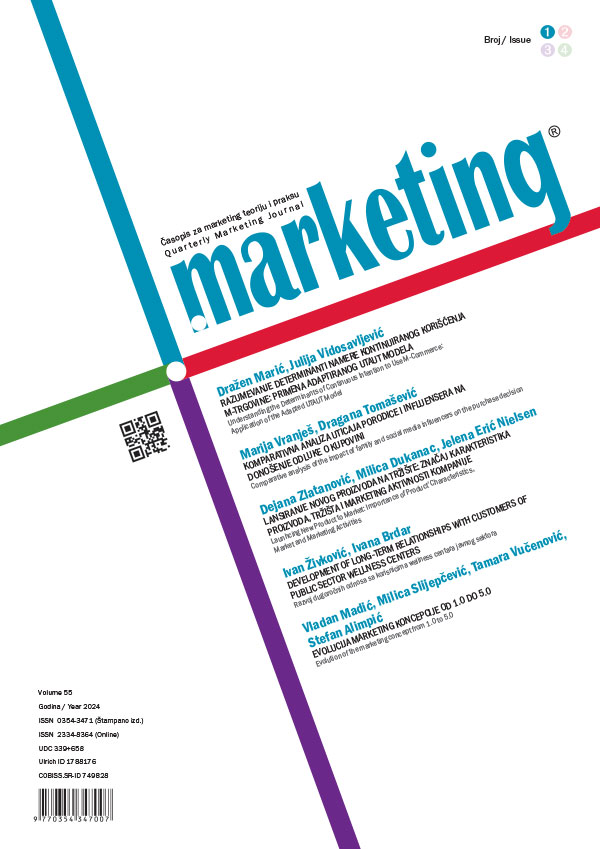
Comparative analysis of the impact of family and social media influencers on the purchase decision
Komparativna analiza uticaja porodice i influensera na donošenje odluke o kupovini
Abstract
The intensification of the digitization process has signifi-cantly transformed media habits and consumer behavior. Current statistical data indicate a growing prevalence of internet users, social platforms, and mobile devices within the global population. This has created a new digital reality that coexists with traditional aspects of people‘s lives. In this context, influencers are gaining increasing power as opinion leaders in the digital environment, alongside the influence of family, friends, and colleagues. Accordingly, this paper sought to compare the impact of family and influencers on purchasing decisions. Additionally, it examined the differences in the influence of family and influenc-ers on the decision to buy various categories of products/services. In this regard, a paired samples t-test was con ducted. Based on research that included 340 respondents, it was concluded that generally, family has a more significant influence on the purchase decision than influencers. The analysis of various product and service categories revealed that family members have a more substantial influence on purchasing decisions related to clothing, footwear, technical devices, tourist services and food products. Conversely, influencers have a greater impact on purchasing decisions related to cosmetic products. The study‘s findings offer valuable insights for managers in developing effective marketing strategies.
Apstrakt
Intenziviranje procesa digitalizacije značajno je transformisalo medijske navike i ponašanje potrošača. Aktuelni statistički podaci jasno ukazuju na sve značajniji udeo korisnika interneta, društvenih platformi i mobilnih uređaja u globalnoj populaciji. Na ovaj način, oblikovana je nova, digitalna stvarnost koja koegzistira sa tradicionalnim aspektima života ljudi. U takvim okolnostima, pored uticaja članova porodice, prijatelja i kolega, sve veću moć dobijaju i influenseri, kao lideri mišljenja u digitalnom okruženju. U skladu sa tim, ovim radom nastojao se uporediti uticaj porodice i influensera na donošenje odluke o kupovini. Dodatno, ispitane su i razlike u uticaju porodice i influensera na odluke o kupovini različitih kategorija proizvoda/usluga. S tim u vezi, sproveden je t test uparenih uzoraka. Na osnovu istraživanja koje je obuhvatilo 340 ispitanika, zaključeno je da porodica ima veći uticaj na donošenjе odlukе o kupovini u poređenju sa influenserima. Analizom pojedinačnih kategorija proizvoda i usluga utvrđeno je da članovi porodice imaju veći uticaj prilikom donošenja odluke o kupovini garderobe, obuće, tehničkih uređaja, turističkih usluga i prehrambenih proizvoda, dok je uticaj influensera snažniji pri donošenju odluka o kupovini kozmetičkih proizvoda. Nalazi sprovedene studije pružaju značajne smernice menadžerima pri kreiranju odgovarajuće marketing strategije.
References
- Aleti, T., Brennan, L. and Parker, L. (2015). Family communication for the modern era: A typology. Young Consumers, 16(4), 367-384. https://doi.org/10.1108/YC-01-2015-00500
- Baía, J. P. (2018). Mothers’ perceptions of adolescents’ influence on the purchase decisions of family vacations. Athens Journal of Tourism, 5(2), 111-132. https://doi.org/10.30958/ajt.5-2-3
- Baía, J. P. (2021). Culture and consumer socialization effects on adolescent's influence on family purchase decision of mobile phone: A comparison between mother's and adolescent's perceptions. American Journal of Humanities and Social Sciences Research, 5(2), 122-137.
- Bešlagić, A. (2023). Methodological aspects of observing children as consumers: a study of pupils in the Tuzla Canton. Marketing, 54(2), 94-102. https://doi.org/10.5937/mkng2302094B
- Biloš, A., Budimir, B. and Jaška, S. (2021). The Position and Significance of Influencers in Croatia. CroDiM: International journal of Marketing Science, 4(1), 57-68.
- Buijzen, M. and Valkenburg, P. M. (2005). Parental mediation of undesired advertising effects. Journal of Broadcasting & Electronic Media, 49(2), 153-165. https://doi.org/10.1207/s15506878jobem4902_1
- Chiu, L.K., Ting, C.S., Alananzeh, O.A. and Hua, K.P. (2019). Perceptions of risk and outbound tourism travel intentions among young working Malaysians. Dirasat: Human and Social Sciences, 46(1), 365 – 379.
- Chung, S. and Cho, H. (2017). Fostering parasocial relationships with celebrities on social media: Implications for celebrity endorsement. Psychology & Marketing, 34(4), 481-495. https://doi.org/10.1002/mar.21001
- Collier, K. M., Coyne, S. M., Rasmussen, E. E., Hawkins, A. J., Padilla-Walker, L. M., Erickson, S. E. and Memmott-Elison, M. K. (2016). Does parental mediation of media influence child outcomes?Does parental mediation of media influence child outcomes? A meta-analysis on media time, aggression, substance use, and sexual behaviour. Developmental psychology, 52(5), 798–812. https://doi.org/10.1037/dev0000108
- De Jesus Oliveira Mota, J., de Almeida, L. C., Sarges Neves, V. H., da Silva, E. B., and de Almeida Oliveira, D. (2019). Analysis of posts contents on food posted by digital influencers on the Instagram social media. Demetra: Food, Nutrition & Health/Alimentação, Nutrição & Saúde, 14, 1-18.
- De Veirman, M., Cauberghe, V. and Hudders, L. (2017). Marketing through Instagram influencers: the impact of number of followers and product divergence on brand attitude. International journal of advertising, 36(5), 798-828. https://doi.org/10.1080/02 650487.2017.1348035
- Etuk, A., Anyadighibe, J. A., James, E. E., and Ukpe, M. U. (2022). Sociological factors and consumer buying behaviour towards fashion clothing. International Journal of Applied Research in Social Sciences, 4(2), 21-34. https://doi.org/10.51594/ijarss.v4i2.305
- Fleck, N., Korchia, M. and Le Roy, I. (2012). Celebrities in advertising: looking for congruence or likability?. Psychology & marketing, 29(9), 651-662. https://doi.org/10.1002/mar.20551
- Freberg, K., Graham, K., McGaughey, K. and Freberg, L. A. (2011). Who are the social media influencers? A study of public perceptions of personality. Public Relations Review, 37, 90–92. https://doi:10.1016/j. pubrev.2010.11.001
- Gulati, S. (2017). Impact of peer pressure on buying behaviour. International journal of Research-Granthaalayah, 5(6), 280-291. https://doi.org/10.29121/granthaalayah.v5.i6.2017.2027
- Hanifah, R. D. (2019). The influence of Instagram travel influencer on visiting decision of tourist destinations for generation. Tourism Proceeding, (S.I.), 235-247.
- Hanifati, A. N. (2015). The impact of food blogger towards consumer's attitude and behaviour in choosing a restaurant. International Journal of Humanities and Management Services, 3(3), 149-154.
- Hermanda, A., Sumarwan, U. and Tinaprillia, N. (2019). The effect of social media influencer on brand image, self-concept, and purchase intention. Journal of Consumer Sciences, 4(2), 76-89. https://doi.org/10.29244/jcs.4.2.76-89
- Hwang, K. and Zhang, Q. (2018). Influence of parasocial relationship between digital celebrities and their followers on followers’ purchase and electronic word-of-mouth intentions, and persuasion knowledge. Computers in Human Behavior, 87(C), 155–173. http://doi:10.1016/j.chb.2018.05.029
- Hwang, Y. and Jeong, S. H. (2016). “This is a sponsored blog post, but all opinions are my own”: The effects of sponsorship disclosure on responses to sponsored blog posts. Computers in Human Behavior, 62, 528-535. https://doi.org/10.1016/j. chb.2016.04.026
- Ishaque, A. and Tufail, M. (2014). Influence of children on family purchase decision: Empirical evidence from Pakistan. International review of Management and Business Research, 3(1), 162-173.
- Jin, S. A. and Phua, J. (2014). Following celebrities‘ tweets about brands: The impact of twitter-based electronic word-of-mouth on consumers‘ source credibility perception, buying intention, and social identification with celebrities. Journal of Advertising, 43(2), 181–195. http://dx.doi.org/10.1080/00913367.2 013.827606.
- Kaur, P. and Singh, R. (2006). Children in family purchase decision making in India and the West: A review. Academy of Marketing Science Review, 8(8), 1-30.
- Kembau, A. and Mekel, P. A. (2014). Reference groups, family, roles and status on young consumer bahvior towards purchase intentions of luxury fashion brands. JurnaleMBA: Jurnal riset Ekonomi, Manajemen, Bisnis dan Akuntansi, 2(2), 1169-1179.
- Kesić T. (2006). Consumer Behaviour. Zagreb: Opinio.
- Kwak, N. and Radler, B. (2002). A comparison between mail and web surveys: Response pattern, respondent profile, and data quality. Journal of official statistics, 18(2), 257-273.
- Ladhari, R., Massa, E. and Skandrani, H. (2020). YouTube vloggers’ popularity and influence: The roles of homophily, emotional attachment, and expertise. Journal of Retailing and Consumer Services, 54, 102027. https://doi.org/10.1016/j.jretconser.2019.102027
- Lafferty, B. A., Goldsmith, R. E. and Newell, S. J. (2002). The dual credibility model: The influence of corporate and endorser credibility on attitudes and purchase intentions. Journal of marketing theory and practice, 10(3), 1-11. https://doi.org/10.1080/10696679 .2002.11501916
- Lim, X. J., Radzol, A. M., Cheah, J. and Wong, M. W. (2017). The impact of social media influencers on purchase intention and the mediation effect of customer attitude. Asian Journal of Business Research, 7(2), 19-36. http://dx.doi.org/10.14707/ajbr.170035
- Lin, C. A., Crowe, J., Pierre, L. and Lee, Y. (2021). Effects of Parasocial interaction with an Instafamous Influencer on Brand Attitudes and Purchase Intentions. The Journal of Social Media in Society, 10(1), 55-78.
- Livingstone, S. and Helsper, E. J. (2008). Parental mediation of children's internet use. Journal of broadcasting & electronic media, 52(4), 581-599. https://doi.org/10.1080/08838150802437396
- Lou, C. and Kim, H. K. (2019). Fancying the New Rich and Famous? Explicating the Roles of Influencer Content, Credibility, and Parental Mediation in Adolescents’ Parasocial Relationship, Materialism, and Purchase Intentions. Front. Psychol. 10, 1-17. https://doi:10.3389/fpsyg.2019.02567
- Lou, C. and Yuan, S. (2019). Influencer marketing: how message value and credibility affect consumer trust of branded content on social media. Journal of Interactive Advertising, 19(1), 58-73. https://doi.org/10 .1080/15252019.2018.1533501
- Lugonja, K. (2021). Analysis of consumer preferences in offline and online shopping for retail products. Proceedings of the Faculty of Technical Sciences in Novi Sad, 36(08), 1340-1343.
https://doi.org/10.24867/13GI08Lugonja - Maričić, B. (2005). Consumer Behaviour. Belgrade: CID of the Faculty of Economics.
- Mirić, M., and Marinković, V. (2023). Perceived risk and tourist motivation as determinants of the intention to travel abroad during the COVID–19 pandemic. Marketing, 54(1), 17-32. https://doi.org/10.5937/mkng2301017M
- More, J. S. and Lingam, C. (2019). A SI model for social media influencer maximization. Applied Computing and Informatics, 15(2), 102-108. https://doi.org/10.1016/j.aci.2017.11.001
- Nurhandayani, A., Syarief, R. and Najib, M. (2019). The impact of social media influencer and brand images to purchase intention. Jurnal aplikasi Manajemen, 17(4), 650-661.
- Ocokoljić, M. (2022). Representations of genders in advertising narratives in the Republic of Serbia. Marketing, 53(4), 252-263. https://doi.org/10.5937/mkng2204252O
- Pallant, J. (2011). SPSS: A Survival Manual. Belgrade: Mikrobook.
- Peković, J., Zdravković, S., and Pavlović, G. (2019). Social media influencers as a predictor of consumer intentions. Marketing, 50(3), 207-216. https://doi.org/10.5937/markt1903207P
- Pittman, M. and Reich, B. (2016). Social media and loneliness: Why an Instagram picture may be worth more than a thousand Twitter words. Computers in Human Behavior, 62, 155–167. http://dx.doi.org/10.1016/j.chb.2016.03.084
- Radanielina Hita, M. L., Kareklas, I. and Pinkleton, B. (2018). Parental mediation in the digital era: Increasing children's critical thinking may help decrease positive attitudes toward alcohol. Journal of health communication, 23(1), 98-108. https://doi.org/1 0.1080/10810730.2017.1411997
- Saldamlı, A., and Özen, F. (2019). The effect of influencer marketing on consumer purchasing decision in food and beverage industry. Journal of Tourism Theory and Research, 5(2), 327-339. https://dergipark.org.tr/tr/pub/jttr/issue/43713/523237
- Schooler, D., Kim, J. L. and Sorsoli, L. (2006). Setting rules or sitting down: Parental mediation of television consumption and adolescent self-esteem, body image, and sexuality. Sexuality Research & Social Policy, 3, 49-62. https://doi.org/10.1525/srsp.2006.3.4.49
- Schouten, A. P., Janssen, L. and Verspaget, M. (2020). Celebrity vs. Influencer endorsements in advertising: the role of identification, credibility, and Product-Endorser fit. International journal of advertising, 39(2), 258-281., https://doi.org/10.1080/02 650487.2019.1634898
- Shoham, A. and Dalakas, V. (2003). Family consumer decision making in Israel: the role of teens and parents. Journal of Consumer Marketing, 20(3), 238-251. https://doi.org/10.1108/07363760310472263
- Smith, T. M., Dunton, G. F., Pinard, C. A. and Yaroch, A. L. (2016). Factors influencing food preparation behaviours: findings from focus groups with Mexican-American mothers in southern California. Public health nutrition, 19(5), 841-850. https://doi.org/10.1017/S1368980015001949
- Sokolova, K. and Kefi, H. (2020). Instagram and YouTube bloggers promote it, why should I buy? How credibility and parasocial interaction influence purchase intentions. Journal of retailing and consumer services, 53, 101742. https://doi.org/10.1016/j. jretconser.2019.01.011
- Sundermann, G. and Raabe, T. (2019). Strategic communication through social media influencers: Current state of research and desiderata. International Journal of Strategic Communication, 13(4), 278-300. https://doi.org/10.1080/1553118X.2019.1618306
- Tang, C. S. and Koh, Y. Y. (2017). Online social networking addiction among college students in Singapore: Comorbidity with behavioural addiction and affective disorder. Asian Journal of Psychiatry, 25, 175–178. https://doi.org/10.1016/j.ajp.2016.10.027
- Taylor, C. R. (2020). The urgent need for more research on influencer marketing. International Journal of Advertising, 39(7), 889-891. https://doi.org/1 0.1080/02650487.2020.1822104
- Warren, R. (2001). In words and deeds: Parental involvement and mediation of children's television viewing. The Journal of Family Communication, 1(4), 211-231. https://doi.org/10.1207/S15327698JFC0104_01