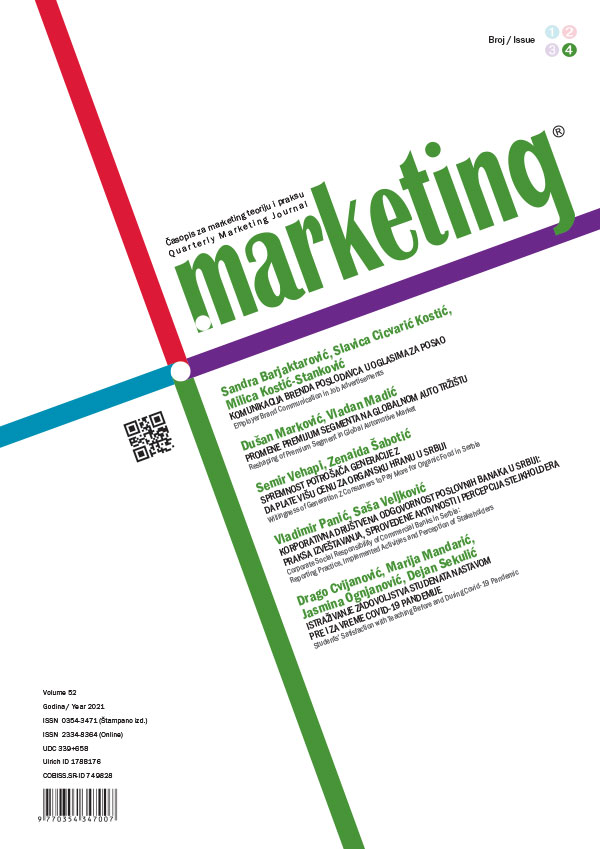
Corporate Social Responsibility of Commercial Banks in Serbia: Reporting Practice, Implemented Activities and Perception of Stakeholders
Korporativna društvena odgovornost poslovnih banaka u Srbiji: praksa izveštavanja, sprovedene aktivnosti i percepcija stejkholdera
Abstract
The contemporary phase of marketing development emphasizes the increasingly important role of economic entities as an integral part of society and a catalyst for positive changes. Researchers mainly focus their attention on large companies and sectors that significantly impact the local community and society. In that sense, this article addresses the Serbian banking sector. The authors analyzed the corporate social responsibility activities of 24 banks and their reporting practices. The analysis included a study of the content of publicly available documents and reports and news published on banks‘ websites and Facebook profiles. In addition, the authors explored stakeholders‘ perceptions of socially responsible banking activities. A survey of 30 banks stakeholder representatives showed: what are the critical issues in local communities; what are the respondents‘ attitudes about banks and the way they operate in Serbia; to what extent have stakeholders noticed the social marketing activities of commercial banks; what is the attitude of stakeholders regarding the issue of rewarding banks for socially responsible behavior. After reviewing and discussing the main findings, the authors provide key recommendations and possible directions for further research.
Apstrakt
Savremena faza razvoja marketinga naglašava sve značajniju ulogu privrednih subjekata kao sastavnog dela društva i katalizatora pozitivnih promena. Naročito se pažnja istraživača usmerava na velike kompanije, kao i na one iz sektora koji imaju veći uticaj na lokalnu zajednicu i društvo u celini. U tom smislu rad je fokusiran na bankarski sektor u Srbiji. Autori su analizirali aktivnosti 24 banke na polju društvene odgovornosti i njihovu praksu izveštavanja o tome. Analiza je uključivala proučavanje sadržaja javno dostupnih dokumenata i izveštaja, kao i vesti objavljenih na veb sajtovima i Fejsbuk profilima banaka. Osim toga, autori su istraživali percepciju stejkholdera o društveno odgovornim aktivnostima banaka. Intervjuisanje 30 predstavnika stejkholdera banaka, pokazalo je: koji su ključni problemi u lokalnim zajednicama; kakvi su stavovi ispitanika o bankama i načinu na koji posluju u Srbiji; u kojoj meri su stejkholderi primetili aktivnosti društvenog marketinga poslovnih banaka; kakav je stav stejkholdera po pitanju nagrađivanja banaka za društveno odgovorno ponašanje. Nakon prikaza i diskusije rezultata, date su ključne preporuke i pravci daljih istraživanja.
References
- Alvarado-Herrera, A., Bigne, E., Aldas-Manzano, J., & Curras-Perez, R. (2017). A Scale for Measuring Consumer Perceptions of Corporate Social Responsibility Following the Sustainable Development Paradigm. Journal of Business Ethics, 140(2), 243–262.
- Becker-Olsen, K. L., Cudmore, B. A., & Hill, R. P. (2006). The impact of perceived corporate social responsibility on consumer behaviour. Journal of Business Research, 59(1), 46–53.
- Berg, L. (2008). Loyalty, naivety and powerlessness among Norwegian retail bank customers. International Journal of Consumer Studies, 32(3), 222–232. https://bit.ly/3oKD4pK
- Campbell, J. L. (2007). Why would corporations behave in socially responsible ways? An institutional theory of corporate social responsibility. Academy of Management Review, 32(3), 946–967.
- Carroll, A. B. (2009). A History of Corporate Social Responsibility (A. Crane, D. Matten, A. McWilliams,
- Moon, & D. S. Siegel, Eds.; Vol. 1). Oxford University Press.
- Donaldson, T. (1982). Corporations and morality. Prentice-Hall.
- El-Garaihy, W. H., Mobarak, A.-K. M., & Albahussain, S. A. (2014). Measuring the Impact of Corporate Social Responsibility Practices on Competitive Advantage: A Mediation Role of Reputation and Customer Satisfaction. International Journal of Business and Management, 9(5), p109.
- Fatma, M., Rahman, Z., & Khan, I. (2014). Multi-Item Stakeholder Based Scale to Measure CSR in the Banking Industry. International Strategic Management Review, 2(1), 9–20.
- Friedman, M. (2007). The Social Responsibility of Business Is to Increase Its Profits. In W. C. Zimmerli, M. Holzinger, & K. Richter (Eds.), Corporate Ethics and Corporate Governance (pp. 173–178). Springer Berlin Heidelberg.
- Gadeikienė, A., & Banytė, J. (2015). Discourse on Corporate Social Responsibility in the Context of Marketing Scientific Research. Procedia – Social and Behavioral Sciences, 213, 702–708.
- ISO.org, ISO 26000 Social Responsibility, retrieved 25.10.2021, from: https://www.iso.org/iso-26000-social-responsibility.html
- Republic Statistical Office – RZS, Use of Information and Communication Technologies in the Republic of Serbia, 2021, retrieved 23.10.2021 from: https://www.stat.gov.rs/sr-latn/vesti/20211022-godisnje-istrazivanje-o-ikt/?a=27&s=
- Kotler, P., & Levy, S. J. (1969). Broadening the Concept of Marketing. Journal of Marketing, 33(1), 10–15.
- Kotler, P., & Zaltman, G. (1971). Social Marketing: An Approach to Planned Social Change. Journal of Marketing, 35(3), 3-12.
- Maignan, I., & Ferrell, O. C. (2004). Corporate Social Responsibility and Marketing: An Integrative Framework. Journal of the Academy of Marketing Science, 32(1), 3–19.
- McDonald, L. M., & Hung Lai, C. (2011). Impact of corporate social responsibility initiatives on Taiwanese banking customers. International Journal of Bank Marketing, 29(1), 50–63.
- Moufty, S., Clark, E., & Al-Najjar, B. (2021). The different dimensions of sustainability and bank performance: Evidence from the EU and the USA. Journal of International Accounting, Auditing and Taxation, 43, 100381.
- National Bank of Serbia, official website, retrieved 1 September 2021, from https://www.nbs.rs/sr/finansijske-institucije/banke/spisak-banaka/
- Palazzo, M., Vollero, A., & Siano, A. (2020). From strategic corporate social responsibility to value creation: an analysis of corporate website communication in the banking sector. International Journal of Bank Marketing, 38(7), 1529–1552.
- Paluszak, G., & Wiśniewska-Paluszak, J. (2019). Corporate Social Responsibility of the Leading Bank Institutions in Poland. Acta Universitatis Lodziensis. Folia Oeconomica, 6(339), 17–40.
- Paschen, J., Wilson, M. and Robson, K. (2020), „# BuyNothingDay: investigating consumer restraint using hybrid content analysis of Twitter data”, European Journal of Marketing, Vol. 54 No. 2, pp. 327-350.
- Pérez, A., Martínez, P., & Rodríguez del Bosque, I. (2013). The development of a stakeholder-based scale for measuring corporate social responsibility in the banking industry. Service Business, 7(3), 459–481.
- Smith, W. A. (2006). Social marketing: An overview of approach and effects. Injury Prevention, 12(suppl_1), i38–i43.
- Social Serbia 2021 – a survey by the agency Pioniri in cooperation with the agency Smart Plus Research, retrieved on 25/10/2021 from: https://pioniri.com/sr/socialserbia2021/
- Sweetin, V. H., Knowles, L. L., Summey, J. H., & McQueen, K. S. (2013). Willingness-to-punish the corporate brand for corporate social irresponsibility. Journal of Business Research, 66(10), 1822–1830.
- United Nations, Global Compact, retrieved 25.10.2021 from the address https://www.unglobalcompact.org/what-is-gc/mission
- van Hierden, Y. T., Dietrich, T., & Rundle-Thiele, S. (2021). A citizen-centred approach to CSR in banking. International Journal of Bank Marketing, 39(4), 638–660.