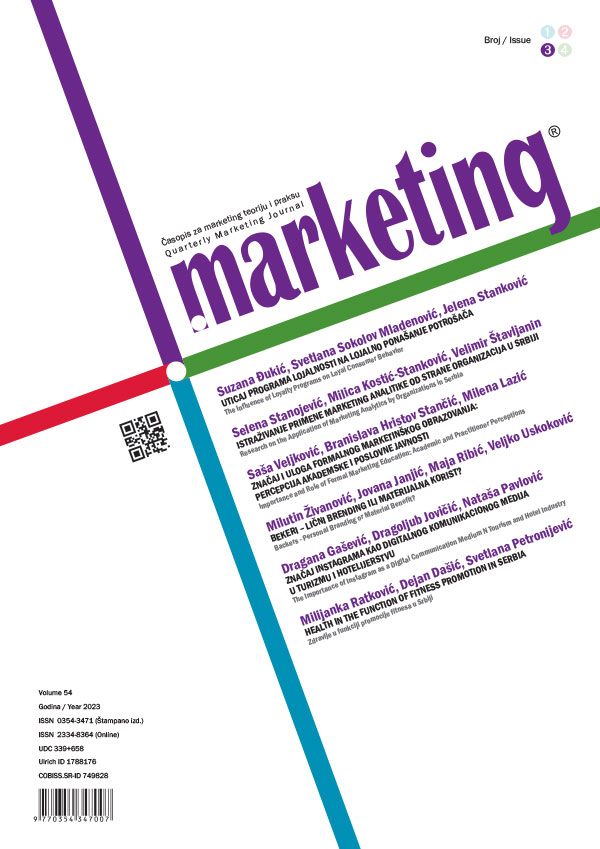
Research on the Application of Marketing Analytics by Organisations in Serbia
Istraživanje primene marketing analitike od strane organizacija u Srbiji
Abstract
The expansion of social media has led to the need for defining a theoretical framework for the application of marketing analytics and data management in the context of digitalization, which would contribute to the decision making process in marketing. Enhancing the decision making process involves the application of advanced marketing analytics methods and data-driven decisionmaking. The paper presents the concept of marketing analytics at the core of decision-making in organizations as an imperative of today‘s business environment. The aim of the research is to explore the extent to which organizations operating in the Serbian market utilize marketing analytics and how they perceive its significance. A survey was conducted using an online questionnaire with employees of organizations operating in Serbia. In addition to demographic questions, the research examined the use of digital channels in customer communication, the importance of specific data categories in decision-making, various perspectives and attitudes, as well as respondents‘ willingness to undergo education in the field of marketing analytics. The research results showcase the potential of applying marketing analytics in organizations in Serbia, identify challenges in implementing this concept, and suggest potential directions for further research.
Apstrakt
Ekspanzija društvenih medija dovela je do potrebe za definisanjem teorijskog okvira primene marekting analitike i upravljanja podacima u uslovima digitalizacije, što bi obezbedilo doprinos u procesu donošenja marketinških odluka. Unapređenje procesa odlučivanja podrazumeva primenu naprednih metoda marketing analitike i donošenje odluka baziranih na podacima. U radu je predstavljen koncept marketing analitike u osnovi donošenja odluka u organizacijama, kao imperativ današnjeg poslovanja. Cilj rada je da se istraži u kojoj meri organizacije koje posluju na tržištu Srbije koriste marketing analitiku i na koji način percipiraju njen značaj. Metodom onlajn ankete sprovedeno je istraživanje sa zaposlenima u organizacijama koje posluju u Srbiji. Pored demografskih pitanja, istraživanjem je ispitana upotreba digitalnih kanala u komunikaciji sa potrošačima, značaj određenih kategorija podatka prilikom donošenja odluka, ali i različita viđenja i stavovi, kao i spremnost ispitanika na edukaciju u oblasti marketing analitike. Rezultatima istraživanja prikazan je potencijal primene marketing analitike u organizacijama u Srbiji, utvrđeni su izazovi primene ovog koncepta i dati potencijalni pravci daljeg istraživanja.
References
- Baesens, B., Bapna R., Marsden, J.R., Vanthienen J., Zhao, J.L. (2016). Transformational issues of big data and analytics in networked business. MIS Quarterly 40 (4): 807–818
- Berry, M. J., & Linoff, G. S. (2004). Data mining techniques: for marketing, sales, and customer relationship management. Hoboken, New Jersey: John Wiley & Sons.
- Cavanillas, J.M., Curry, E., Wahlster, W (2013), New Horizons for a Data-Driven Economy A Roadmap for Usage and Exploitation of Big Data in Europe, Springer Open, 2015.
- Cicvarić-Kostić S., Štavljanin, V. (2020). Brand Management: Creating Distinctive Value. Belgrade: Faculty of Organisational Sciences.
- Erevelles, S., Fukawa, N., Swayne, L. (2016). Big Data consumer analytics and the transformation of marketing. Journal of Business Research 69 (2): 897–904.
- Germann, F., Lilen, G., Rangaswamy, A. (2013). Performance implications of deploying marketing analytics. International Journal of Research in Marketing. 30: 114–128.
- Giampaolo, V. (2014) Online Marketing Behavior and Analytics, Palgrave Macmillan, New York.
- Goh, T.T., Sun, P. (2015). Teaching social media analytics: An assessment based on natural disaster postings. Journal of Information Systems Education 26 (1): 27–38.
- Hauser, W.J. (2007). Marketing analytics: The evolution of marketing research in the twenty-first century. Direct Marketing: An International Journal 1 (1): 38–54.
- Hayes, B. (2015), Making Sense of Our Big Data World: Samples, Populations, and Sampling Error, http://www.business2community.com/big-data/making-sense-big-dataworld-samples-populationssampling-error-01437410
- Hoppner, J.J., Grifth, D.A. (2015). Looking back to move forward: A review of the evolution of research in international marketing channels. Journal of Retailing 91 (4): 610–626.
- Iacobucci, D., Petrescu, M., Krishen, A., Bendixen, M. (2019). The state of marketing analytics in research and practice. J Market Anal 7, 152–181. https://doi.org/10.1057/s41270-019-00059-2
- Iankova, Davies, I., Archer-Brown, C., Marder, B., Yau, A. (2019). A comparison of social media marketing between B2B, B2C and mixed business models. Industrial Marketing Management 81: 169–179.
- Järvinen, J., Karjaluoto, H. (2015). The use of Web analytics for digital marketing performance measurement. Industrial Marketing Management 50: 117–127.
- Keller, K., Kevin, L. (2014) Research Priorities. Cambridge, MA: Marketing Science Institute.
- Kostić – Stanković, M., Filipović, V., Štavljanin, V. (2017). Marketing. Belgrade: Faculty of Organizational Sciences.
- Li, F., Larimo, J., Leonidou, L.C. (2021). Social media marketing strategy: Definition, conceptualization, taxonomy, validation, and future agenda. Journal of the Academy of Marketing Science 49 (1): 51–70.
- Mandina, S. (2014). Contribution of CRM strategies in enhancing customer loyalty. Journal of Marketing Development and Competitiveness 8 (2): 70-87.
- Matarazzo, M., Penco, L., Profumo, G., Quaglia, R. (2021). Digital transformation and customer value creation in Made in Italy SMEs: A dynamic capabilities perspective. Journal of Business Research 123: 642–656.
- Mayer-Schönberger, V., & Cukier, K. (2013). Big data: A revolution that will transform how we live, work, and think. Boston, Massachusetts: Houghton Mifflin Harcourt.
- Moe, W.W., Schweidel, D.A. (2017). Opportunities for innovation in social media analytics. Journal of Product Innovation Management 34 (5): 697–702.
- Olson, E.M., Olson, K.M., Czaplewski, A.J., Key, T.M. (2021). Business strategy and the management of digital marketing. Business Horizons 64 (2): 285–293.
- Petrescu, M., Krishen, A.S. (2021). Focusing on the quality and performance implications of marketing analytics. Journal of Marketing Analytics 9 (3): 155–156.
- Ritter, T., Pedersen C.L. (2020). Digitization capability and the digitalization of business models in business-to-business firms: Past, present, and future. Industrial Marketing Management 86: 180–190.
- Sestino, A., Prete, M.I., Piper, L., Guido, G. (2020). Internet of Things and Big Data as enablers for business digitalization strategies. Technovation 98:102173.
- Steinhoff, L., Palmatier, R.W. (2021). Commentary: Opportunities and challenges of technology in relationship marketing. Australasian Marketing Journal 29 (2): 111–117.
- Tarka, P. (2018). The views and perceptions of managers on the role of marketing research in decision making, International Journal of Market Research, 60(1), 67-87.
- Ungerman, O., Dedkova, J., Gurinova, K. (2018). The impact of marketing innovation on the competitiveness of enterprises in the context of Industry 4.0, Journal of Competitiveness, 10(2), pp. 132-148
- Wedel, M., & Kannan, P. K. (2016). Marketing analytics for data-rich environments. Journal of Marketing, 80(6), 97-121.
- Yu, L., Zhao, Y., Tang, L., Yang, Z. (2019). Online big data-driven oil consumption forecasting with Google trends. International Journal of Forecasting 35 (1): 213–223.
- Zekavica, A. (2018). The Role and Significance of the Big Data Phenomenon from the Perspective of Marketing Research. Doctoral Dissertation, Faculty of Economics and Engineering Management, Novi Sad.
- Zekavica, A., Ćirić, M., Vukmirović, J. (2018). The Significance of the Big Data Phenomenon for Real-Time Marketing Decision-Making, Ekonomija – theory and practice, 9(2), 35-50.