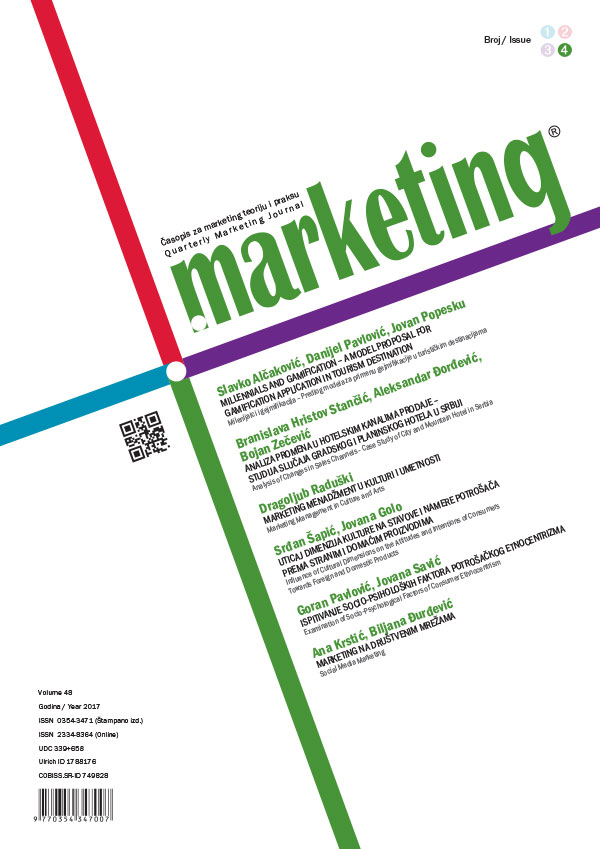
Examination of Socio-Psychological Factors of Consumer Ethnocentrism
Ispitivanje socio-psiholoških faktora potrošačkog etnocentrizma
Abstract
The main goal of this research is ascertaining impact of socio-psychological factors, i.e. patriotism, nationalism, cultural openness and animosity of citizens of Republic of Serbia toward Republic of Croatia on consumer ethnocentrism. Modern business conditions are characterized by frequent changes in consumers behavior. The impact of economic crisis, increased migratory movements, political tensions and changes in the world, as well as frequent social unrest, are not just reviving, but also increasing ethnocentric tendencies in bying products and services. Respecting the main goal of this paper, the research was conducted on the territory of the Republic of Serbia during 2017 on a sample of 458 respondents. Resutls of the research showed increase of consumer ethnocentrism level of the citizens of Serbia and statistic significant impact of patriotism, nationalism and animosity toward Republic of Croatia on consumer ethnocentrism. Importance of this paper is reflected in conceptual frame of the research model, which includes variables that, according to the knowledge of authors, haven’t been used in examining consumer ethnocentrism in Republic of Serbia before.
Apstrakt
Osnovni cilj istraživanja ovog rada jeste utvrđivanje uticaja socio-psiholoških faktora, odnosno patriotizma, nacionalizma, kulturne otvorenosti i animoziteta građana Republike Srbije prema Republici Hrvatskoj na potrošački etnocentrizam. Savremene uslove poslovanja karakterišu učestale promene u ponašanju potrošača. Dejstvo ekonomske krize, pojačana migratorna kretanja, političke tenzije i promene u svetu, kao i učestali socijalni nemiri, ne samo da oživljavaju, već i pojačavaju etnocentrične tendencije potrošača prilikom kupovine proizvoda i usluga. Uvažavajući osnovni cilj ovog rada, realizovano je istraživanje na teritoriji Republike Srbije u toku 2017. godine nad uzorkom od 458 ispitanika. Rezultati istraživanja su pokazali porast nivoa potrošačkog etnocentrizma građana Srbije i statistički značajan uticaj patriotizma, nacionalizma i animoziteta prema Republici Hrvatskoj na potrošački etnocentrizam. Značaj ovog rada ogleda se u konceptualnom okviru istraživačkog modela koji uključuje varijable koje, prema saznanjima autora, ranije nisu ispitivane na teritoriji Republike Srbije.
References
- Ahmed, Z., Anang, R., Othman, N., & Sambasivan, M. (2013). To purchase or not to purchase US products: role of religiosity, animosity, and ethnocentrism among Malaysian consumers. Journal of Services Marketing, 27(7), 551-563. doi:10.1108/JSM-01-2012-0023
- Altintaş, M.H., & Tokol, T. (2007). Cultural openness and consumer ethnocentrism: an empirical analysis of Turkish consumers. Marketing Intelligence & Planning, 25(4), 308-325. doi:10.1108/02634500710754565
- Ang, S.H., Jung, K., Kau, A.K, Leong, S.M., Pornpitakpan, C., & Tan, S.J. (2004). Animosity toward economic giants: what the little guys think. The Journal of Consumer Marketing, 21(3), 190-207. doi:10.1108/07363760410534740
- Averill, J.R. (1982). Anger and Aggression: An essay on emotion. New York: Springer.
- Balabanis, G., Diamantopoulos, A., Mueller, R.D., & Melewar, T.C. (2001). The impact of nationalism, patriotism and internationalism on consumer ethnocentric tendencies. Journal of International Business Studies, 32(1), 157-175. doi:10.1057/palgrave. jibs.8490943
- Cheah, I., Phau, I., Kea, G., & Huang, Y.A. (2016). Modelling effects of consumer animosity: Consumers’ willingness to buy foreign and hybrid products. Journal of Retailing and Consumer Services, 30, May, 184-192. doi:10.1016/j.jretconser.2016.01.018
- Cobanoglu, C., Warde, B., & Moreo, P.J. (2001). A comparison of mail, fax and web-based survey methods. International Journal of Market Research, 43(4), 441-452. doi:10.1177/0193841X09340214
- Deb, M., & Sinha, G. (2016). Impact of culture on religiosity, cosmopolitanism and ethnocentrism. Asia Pacific Journal of Marketing and Logistics, 28(1), 56-72.doi:10.1108/APJML-12-2014-0173
- Ding, Q.S. (2017). Chinese products for Chinese people? Consumer ethnocentrism in China. International Journal of Retail and Distribution Management, 45(5), 550-564. doi:10.1108/ IJRDM-11-2016-0212
- Field, A. (2000). Discovering statistics using SPSS for windows. Thousand Oaks: Sage Publications.
- Howard, D.G. (1989). Understanding how American consumers formulate their attitudes about foreign products. Journal of International Consumer Marketing, 2(2), 7-24. doi:10.1300/J046v02n02_02
- Javalgi, R.G., Khare, V.P., Gross, A.C., & Scherer, R.F. (2005). An application of the consumer ethnocentrism model to French consumers. International Business Review, 14(3). 325-344. doi:10.1016/j.ibusrev.2004.12.006
- Jin, Z., Lynch, R., Attia, S., Chansarkar, B., Gülsoy, T., Lapoule, P., Liu, X., Newburry, W., Nooraini,
- S., Parente, R., Purani, K., & Ungerer, M. (2015). The relationship between consumer ethnocentrism, cosmopolitanism and product country image among younger generation of consumers: The moderating role of country development status. International Business Review, 24(3), 380-393. doi:10.1016/j. ibusrev.2014.08.010
- Josiassen, A., Assaf, A.G., & Karpen, I.O. (2011). Consumer ethnocentrism and willingness to buy: Analyzing the role of three demographic consumer characteristics. International Marketing Review, 28(6), 627-646. doi:10.1108/02651331111181448
- Jung, K., Ang, S.H., Leong, S.M., Tan, S.J., Pornpitakpan, C., & Kau, A.K. (2002). A typology of animosity and its cross-national validation. Journal of Cross-Cultural Psychology, 33(6), 529-539. doi:10.1177/0022022102238267
- Kent, D.P., & Burninght, R.G. (1951). Group centrism in complex societies. The American Journal of Sociology, 57(3), 256-259.
- Kesić, T., Piri Rajh, S., & Vlašić, G. (2005). The influence of animosity, xenophilia and ethnocentric tendencies on consumers’ willingness to buy foreign products (The case of Croatia). 34th EMAC Conference – Rejuvenating marketing: Contamination, Innovation, Integration, 1-14, European Marketing Academy, Milan.
- Kipnis, E., Kubacki, K., Broderick, A.J., Siemieniako, D., & Pisaranko, N.L. (2012). They don't want us to become them’: Brand local integration and consumer ethnocentrism. Journal of Marketing Management, 28(7-8), 836-864. doi:10.1080/0267257X.2012.698634
- Klein, J.G., & Ettenson, R. (1999). Consumer animosity and consumer ethnocentrism: an analysis of unique antecedents. Journal of International Consumer Marketing, 11(4), 5-24. doi:10.1300/J046v11n04_02
- Klein, J.G., Ettenson, R., & Morris, M.D. (1998) The animosity model of foreign product purchase: An empirical test in the People's Republic of China. Journal of Marketing, 62(1), 89-100. doi:10.2307/1251805
- Kosterman, R., & Feshbach, S. (1989). Toward a measure of patriotic and nationalistic attitudes. Political Psychology, 10(2), 257-274. doi: 10.2307/3791647
- Lee, W., Hong, J., & Lee, S. (2003). Communicating with American consumers in the post 9/11 climate: An empirical investigation of consumer ethnocentrism in the United States. International Journal of Advertising, 22(4), 487-510. doi:10.1080/02650487.2003.11072865
- Lovrić, M. (2008). Fundamentals of Statistics. Kragujevac: Faculty of Economics.
- Ma, J., Wang, S., & Hao, W. (2012). Does cultural similarity matter? Extending the animosity model from a new perspective. Journal of Consumer Marketing, 29(5), 319-332. doi:10.1108/07363761211247442
- Marinković, V. (2017). Effects of animosity towards the European Union and patriotism on consumer ethnocentrism of citizens of Serbia. Economic Horizons, 19(1), 3-15. doi:10.5937/ekonhor1701003M
- Marinković, V., Stanišić, N., & Kostić, M. (2011). Consumer ethnocentrism of the citizens of Serbia. Sociology, 53(1), 43-58. doi:10.2298/SOC1101043M
- Matić, M. (2013). Intensity and impact of consumer animosity and ethnocentrism in Croatia. Ekonomski Vjesnik, 26(1), 39-56.
- Netemeyer, R.G., Durvasula, S., & Lichtenstein, D.R. (1991). A cross-national assessment of the reliability and validity of the CETSCALE. Journal of Marketing Research, 28(3), 320-327. doi:10.2307/3172867
- Nunnally, J.C. (1978). Introduction to psychological measurement. New York: McGraw-Hill.
- Park, J.E., & Yoon, S.J. (2017). Antecedents of consumer animosity and the role of product involvement on purchase intentions. American Journal of Business, 32(1), 42-57. doi:10.1108/AJB-08-2016-0028
- Renko, N., Karanović, C.B., & Matić, M. (2012). Influence of consumer ethnocentrism on purchase intentions: Case of Croatia. Ekonomska Misao i Praksa, 21(2), 529-544.
- Republic Statistical Office. (2016). Municipalities and regions in the Republic of Serbia. Belgrade: Republic Statistical Office.
- Riefler, P., & Diamantopoulos, A. (2007). Consumer animosity: a literature review and a reconsideration of its measurement. International Marketing Review, 24(1), 87-119. doi:10.1108/02651330710727204
- Rose, M., Rose, M.G., & Shoham, A. (2009). The impact of consumer animosity on attitudes towards foreign goods: a study of Jewish and Arab Israelis. Journal of Consumer Marketing, 26(5), 330-339. doi:10.1108/07363760910976583
- Rosenblatt, P.C. (1964). Origins and effects of group ethnocentrism and nationalism. The Journal of Conflict Resolution, 8(2), 131-146.
- Salvatore, D. (2011). Introduction to international economics. 3rd edition. New Jersey: Wiley.
- Shah, K.A.M., & Ibrahim, H.I. (2016), The impact of consumer boycott, ethnocentrism and patriotism in Malaysia. The Social Sciences, 11(19), 4622-4627. doi:10.3923/sscience.2016.4622.4627
- Shankarmahesh, M. (2006). Consumer ethnocentrism: an integrative review of its antecedents and consequences. International Marketing Review, 23(2), 146-172. doi:10.1108/02651330610660065
- Sharma, S., Shimp, T.A., & Shin, J. (1995). Consumer ethnocentrism: A test of antecedents and moderators. Journal of the Academy of Marketing Science, 23(1), 26-37. doi:10.1007/BF02894609
- Shimp, T.A., & Sharma, S. (1987). Consumer ethnocentrism: Construction and validation of CETSCALE. Journal of Marketing Research, 24(3), 280-289. doi:10.2307/3151638
- Thompson, C.J., & Tambyah, S.K. (1999). Trying to be cosmopolitan. Journal of Consumer Research, 26(3), 214-241. doi:10.1086/209560
- Todosijević, B. (2013). Social, psychological and ideological roots of nationalist attitudes in Serbia. Psihologija, 46(3), 279-297. doi:10.2298/PSI130411005T
- Tsai, W.H., Lee, W.N., & Song, Y.A. (2013). A cross-cultural study of consumer ethnocentrism between China and the U.S. Journal of International Consumer Marketing, 25(2), 80-93. doi:10.1080/08961530.2013.759043
- Veljković, S. (2009). The Influence of Ethnocentrism on Consumers in Serbia. Marketing, 40(2), 97-107.
- Vida, I., & Reardon, J. (2008). Domestic consumption: rational, affective or normative choice?. Journal of Consumer Marketing, 25(1), 34-44. doi:10.1108/07363760810845390
- Wang, C.L., & Chen, Z.X. (2004). Consumer ethnocentrism and willingness to buy domestic products in a developing country setting: testing moderating effects. Journal of Consumer Marketing, 21(6), 391-400. doi:10.1108/07363760410558663
- Zolfagharian, M., Saldivar, R., & Braun, J. (2017). Country of origin and ethnocentrism in the context of lateral, upward and downward migration. International Marketing Review, 34(2), 330-352. doi:10.1108/IMR-06-2015-0158