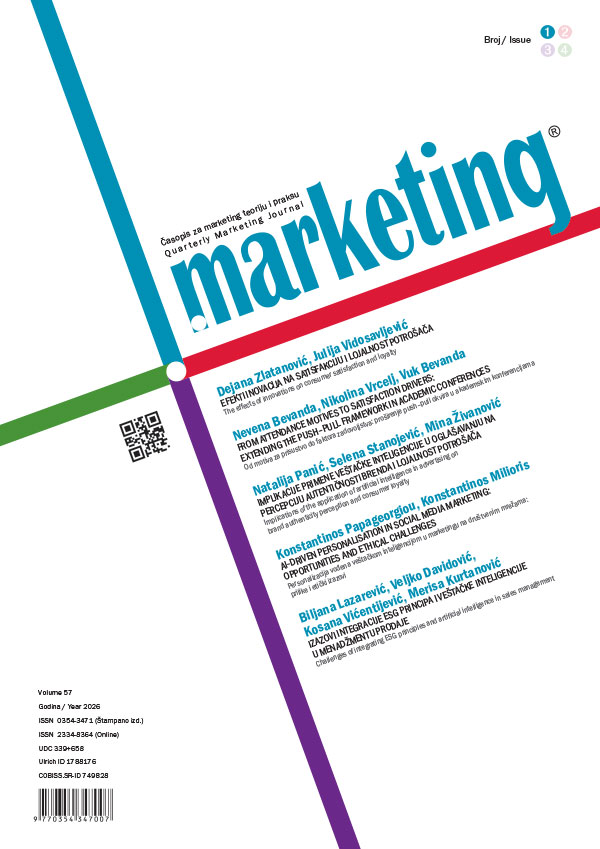
The implications of applying artificial intelligence in advertising on brand authenticity perception and consumer loyalty.
Implikacije primene veštačke inteligencije u oglašavanju na percepciju autentičnosti brenda i lojalnost potrošača
Abstract
The rapid development of artificial intelligence and its comprehensive application in the contemporary business environment have led to significant changes in the way brands communicate with consumers. However, although the use of generative artificial intelligence in creating promotional campaigns represents one of the newest trends in marketing communications, the number of empirical studies examining this topic is still insufficiently represented in academic literature. Accordingly, this paper aims to identify consumer preferences and attitudes toward advertisements generated by artificial intelligence, with a particular focus on preserving brand identity, consistency, and authenticity of communication. After reviewing the relevant literature, the paper presents the results of an indicative study on the attitudes of Generation Z and Millennial respondents regarding the use of artificial intelligence in brand communication. The research was conducted on a sample of 112 participants using a quantitative research approach, applying descriptive statistics and t-tests to examine statistically significant differences in the perception of traditional advertisements and those generated with the help of artificial intelligence. A specific part of the research consisted of an experiment in which respondents compared two holiday advertisements of the Coca-Cola brand—one created by humans and the other with the help of artificial intelligence—to determine the extent to which AI-generated content conveys brand values, maintains its consistency and recognizability, and how consumers evaluate such content in comparison with traditional formats. The results showed that consumers still tend to perceive traditional advertisements as more authentic and emotionally persuasive, while advertisements generated with the help of artificial intelligence are perceived as innovative and efficient, but with a limited impact on brand loyalty and trust.
Apstrakt
Ubrzani razvoj veštačke inteligencije i njena sveobuhvatna primena u savremenom poslovnom okruženju doveli su do značajnih promena u načinu komunikacije između brendova i potrošača. Međutim, iako je jedan od najnovijih trendova u oblasti marketinških komunikacija korišćenje generativne veštačke inteligencije u kreiranju promotivnih kampanja, broj empirijskih studija koje istražuju ovu temu još uvek je nedovoljno zastupljen u naučnoj literaturi. Shodno tome, cilj ovog rada je da se identifikuju potrošačke preferencije i stavovi u vezi sa reklamama generisanim veštačkom inteligencijom, sa posebnim osvrtom na očuvanje identiteta brenda, doslednosti i autentičnosti komunikacije. Nakon pregleda relevante literature prikazani su rezultati indikativnog istraživanja stavova pripadnika generacije Z i milenijalaca o primeni veštačke inteligencije u komunikaciji brendova. Istraživanje je sprovedeno na uzorku od 112 ispitanika i korišćen je kvantitativni istraživački pristup, uz upotrebu deskriptivne statistike i t-testa za ispitivanje statistički značajnih razlika u percepciji tradicionalnih reklama i reklama generisanih uz pomoć veštačke inteligencije. Poseban segment istraživanja činio je eksperiment u kojem su ispitanici upoređivali dve praznične reklame brenda Coca-Cola, jednu kreiranu od strane ljudi, a drugu uz pomoć veštačke inteligencije, sa ciljem utvrđivanja u kojoj meri sadržaj generisan veštačkom inteligencijom prenosi vrednosti brenda, održava njegovu doslednost i prepoznatljivost, kao i načina na koji potrošači vrednuju ovakav sadržaj u poređenju sa tradicionalnim formatima. Rezultati su pokazali da potrošači i dalje u većoj meri percipiraju tradicionalne reklame kao autentičnije i emotivno ubedljivije, dok su reklame generisane uz pomoć veštačke inteligencije percipirane kao inovativne i efikasne, ali sa ograničenim uticajem na lojalnost i poverenje prema brendu.
References
- Aaker, J. (1997). Dimensions of Brand Personality. Journal of Marketing Research, 34(3), 347-356. https://doi.org/10.2307/3151897
- Bulut, A., & Arslan, B. (2024). Creating Ad Campaigns Using Generative AI. In Z. Lyu (Ed.), Applications of Generative AI (pp. 23-36). Cham: Springer. https://doi.org/10.1007/978-3-031-46238-2_2
- Chaffey, D., & Smith, P. R. (2022). Digital marketing excellence: Planning, optimising, and integrating online marketing (6th ed.). New York: Routledge.
- Chui, M., Roberts, R., & Yee, L. (2022). Generative AI is here: How tools like ChatGPT could change your business. Taken from: https://www.mckinsey.com/capabilities/quantumblack/our-insights/generative-ai-is-here-how-tools-like-chatgpt-could-change-your-business
- Cicvarić Kostić, S., and Štavljanin, V. (2020). *Brend menadžment: kreiranje prepoznatljive vrednosti* [Brand Management: Creating Recognisable Value]. Belgrade: Faculty of Organisational Sciences.
- Davenport, T., Guha, A., Grewal, D., & Bressgott, T. (2020). How artificial intelligence will change the future of marketing. *Journal of the Academy of Marketing Science*, *48*(1), 24-42. https://doi.org/10.1007/s11747-019-00696-0
- De Bruyn, A., Viswanathan, V., Beh, Y. S., Brock, J. K.-U., & von Wangenheim, F. (2020). Artificial intelligence and marketing: Pitfalls and opportunities. Journal of Interactive Marketing, 51(1), 91–105. https://doi.org/10.1016/j.intmar.2020.04.007
- Deryl, M. D., Verma, S., & Srivastava, V. (2023). How does AI drive branding? Towards an integrated theoretical framework for AI-driven branding. *International Journal of Information Management Data Insights*, *3*(2), 100205. https://doi.org/10.1016/j.jjimei.2023.100205
- Dwivedi, R., Dave, D., Naik, H., Singhal, S., Omer, R., Patel, P., Qian, B., Wen, Z., Shah, T., Morgan, G., & Ranjan, R. (2023). Explainable AI (XAI): Core ideas, techniques, and solutions. *ACM Computing Surveys*, *55*(9), 1-33. https://doi.org/10.1145/3561048
- Fernando, K. W. T. M., & Das, G. (2025). The influence of brand value dimensions on consumer loyalty among young adults: Evidence from Sri Lanka‘s high-tech market. Marketing, 56(2), 91-112. https://doi.org/10.5937/mkng2502091W
- Fui-Hoon Nah, F., Zheng, R., Cai, J., Siau, K., & Chen, L. (2023). Generative AI and ChatGPT: Applications, challenges, and AI-human collaboration. *Journal of information technology case and application research*, *25*(3), 277-304. https://doi.org/10.1080/1522 8053.2023.2233814
- Gołąb-Andrzejak, E. (2025). The impact of generative AI and ChatGPT on creating digital advertising campaigns. Cybernetics and Systems, 56(8), 1-15. https://doi.org/10.1080/01969722.2023.2296253
- Gujar, P., & Panyam, S. (2024). Generative AI in Digital Advertising Campaigns. International Journal of Computer Trends and Technology, 72(5), 51-55. https://doi.org/10.14445/22312803/IJCTT-V72I5P106
- Hartmann, J., Exner, Y., & Domdey, S. (2025). The power of generative marketing: Can generative AI create superhuman visual marketing content? *International Journal of Research in Marketing*, *42*(1), 13–31. https://doi.org/10.1016/j.ijresmar.2024.09.002
- Huang, M.H., & Rust, R.T. (2021). A strategic framework for artificial intelligence in marketing. *Journal of the Academy of Marketing Science*, 49(1), 30–50. https://doi.org/10.1007/s11747-020-00749-9
- Islam, T., Miron, A., Nandy, M., Choudrie, J., Liu, X., & Li, Y. (2024). Transforming Digital Marketing with Generative AI. Computers, 13(7), 168. https://doi.org/10.3390/computers13070168
- Jelonek, D., Kumar, N., & Pawełoszek, I. (2024). Artificial intelligence applications in brand management. Scientific papers of Silesian University of Technology – Organisation and management series,(202), 153-170. http://dx.doi.org/10.29119/1641-3466.2024.202.10
- Kapferer, J. N. (2008). *The new strategic brand management: Creating and sustaining brand equity long term*. London: Kogan Page Publishers.
- Mariani, M. M., Perez-Vega, R., & Wirtz, J. (2022). AI in marketing, consumer research and psychology: A systematic literature review and research agenda. Psychology & Marketing, 39(4), 755-776. https://doi.org/10.1002/mar.21619
- Meire, M., Hewett, K., Ballings, M., Kumar, V., & Van den Poel, D. (2019). The role of marketer-generated content in customer engagement marketing. *Journal of Marketing*, *83*(6), 21–42. https://doi.org/10.1177/0022242919873903
- Mende, M., Scott, M. L., Van Doorn, J., Grewal, D., & Shanks, I. (2019). Service robots rising: How humanoid robots influence service experiences and elicit compensatory consumer responses. *Journal of Marketing Research*, *56*(4), 535-556. https://doi.org/10.1177/0022243718822827
- Nanavare, R. A., & Ganbote, A. (2024). Development of Artificial Intelligence Model for AI-Empowered Brand Positioning with Tracking Customer Satisfaction to Achieve Management 5.0. In 2024 IEEE 9th International Conference for Convergence in Technology (I2CT) (pp. 1-6). Piscataway, NJ: IEEE.
- Park, J., & Ahn, S. (2024). Traditional vs. AI-generated brand personalities: Impact on brand preference and purchase intention. Journal of Retailing and Consumer Services, 81, 104009. https://doi.org/10.1016/j. jretconser.2024.104009
- Rowles, D. (2025). Digital branding: how to successfully build and measure a brand online. London: Kogan Page Publishers.
- Slater, J.S. (2001). Collecting Brand Loyalty: A Comparative Analysis of How Coca-Cola and Hallmark Use Collecting Behaviour to Enhance Brand Loyalty. Advances in Consumer Research, 28(1), 362-369.
- Soni, V. (2023). Adopting Generative AI in Digital Marketing Campaigns: An Empirical Study of Drivers and Barriers. Sage Science Review of Applied Machine Learning, 6(8), 1–15.
- Stoeva, M. (2017). Emotional Branding Online: Case study: Nike (final thesis, Helsinki Metropolia University of Applied Sciences).
- Udinmwen, E. (2025). GenAI is no longer a future consideration‘ – marketing teams ecstatic about AI as a paltry 7% of CMOs in a research say they don‘t see an ROI. Retrieved from: https://www.techradar.com/pro/genai-is-no-longer-a-future-consideration-marketing-teams-ecstatic-about-ai-as-a-paltry-7-percent-of-cmos-in-a-research-say-they-dont-see-an-roi
- Verma, S., Sharma, R., Deb, S., & Maitra, D. (2021). Artificial intelligence in marketing: Systematic review and future research direction. International Journal of Information Management Data Insights, 1(1), 100002. https://doi.org/10.1016/j.jjimei.2020.100002
- Wirth, N. (2018). Hello marketing, what can artificial intelligence help you with? *International Journal of Market Research*, *60*(5), 435-438. https://doi.org/10.1177/1470785318776841
- Yoganathan, V., Roper, S., McLeay, F., & Machado, J. C. (2020). Branding in the digital age: a „2020” vision for brand management. *Internet Research*, *30*(1), 19-22. https://doi.org/10.1108/INTR-02-2020-555
- Zhang, Y., & Gosline, R. (2023). Human favoritism, not AI aversion: People’s perceptions (and bias) toward generative AI, human experts, and human–GAI collaboration in persuasive content generation. Judgment and Decision Making, 18, 1–16. https://doi.org/10.1017/jdm.2023.37