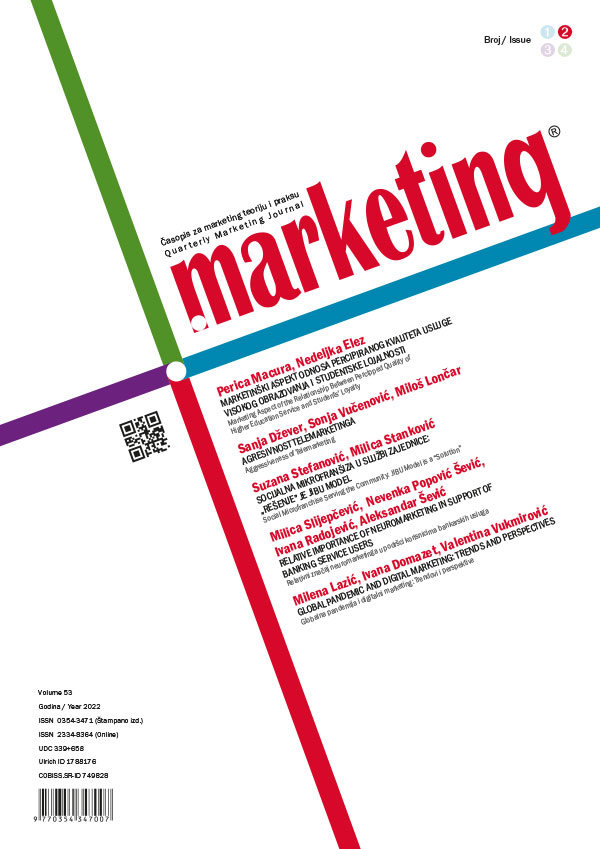
Aggressiveness of Telemarketing
Agresivnost telemarketinga
Abstract
During the past two decades the use of the telephone had been dramatically increased, while its possession and using are presented as almost as an imperative at the moment. Business entities are guided by the stated fact when creating communication strategies, so it is mostly treated as an inevitable instrument of direct marketing communication with the target audience. Therefore, the subject of the paper is direct marketing communication, with special reference to telemarketing. Although it has a wide range of strengths and advantages, a common objection to telemarketing is an overly aggressive approach which can decrease the level of customer satisfaction. Since the costumers аrе the center of marketing efforts, an aim of the research paper was to identify their attitudes about marketing campaigns via phone call and text message. The empirical research was conducted on the territory of the Republic of Serbia on a sample of 100 respondents. The analysis had been performed using Pearson‘s correlation test, after which the hypothesis H0 – „Interactive communication via telephone is perceived by consumers as aggressive“ was confirmed. The results of the research indicated that consumer interest will decrease proportionally as the aggressiveness of direct interactive marketing grows in their consciousness.
Apstrakt
Tokom poslednje dve decenije korišćenje telefona dramatično je poraslo, dok u aktuelno posmatranoj svakodnevnici njegovo posedovanje i rukovanje gotovo da predstavlja imperativ. Poslovni subjekti vode se navedenom činjenicom prilikom kreiranja marketing strategija, te ga većinski tretiraju kao neizbežan instrument komunikacije s ciljnim auditorijumom. Samim tim, predmet rada predstavlja direktna marketing komunikacija, s posebnim osvrtom na telemarketing. Iako poseduje širok spektar snaga i prednosti, problem istraživanja je česta primedba telemarketingu o suviše agresivnom pristupu koji narušava nivo satisfakcije korisnika. Kako su potrošači u centru marketinških napora, cilj istraživanja predstavlja identifikacija njihovih stavova o kampanjama putem telefonskog poziva i tekstualne poruke. Empirijsko istraživanje sprovedeno je na teritoriji Republike Srbije na uzorku od 100 ispitanika. Analiza je izvršena primenom Pirsonovog testa korelacije, nakon čega je hipoteza H0 „Interaktivnu komunikaciju preko telefona potrošači doživljavaju kao agresivnu“ potvrđena. Rezultati istraživanja ukazali su da će zainteresovanost potrošača srazmerno opadati kako agresivnost direktnog interaktivnog marketinga bude rasla u njihovoj svesti.
References
- Đokić, I. (2016). Planning integrated marketing communications as part of the strategic marketing plan. Proceedings of the Faculty of Economics in Subotica, 52 (36), 079-093.
- Eraslan, L. and Kukuoglu, A. (2019). Social relations in virtual world and social media aggression. World Journal on Educational Technology: Current Issues, 11 (2), 01-11.
- IBM Corporation. (2021). IBM SPSS Statistics. Retrieved 18 April 2022, from https://www.ibm.com/products/spss-statistics.
- ITU. (2021). Unsolicited Commercial Communications – an overview of challenges and strategies. Retrieved 16 April 2022, from https://www.itu.int/oth/D0727000001/en.
- Joshi, A., Kale, S., Chandel, S., and Pal, D. K. (2015). Likert Scale: Explored and Explained. British Journal of Applied Science & Technology, 7 (4), 396-403.
- Lazarević, J., and Marinković, V. (2021). Consumer lifestyle in Serbia before and during the virus pandemic. Journal of Marketing Theory and Practice – Marketing, 52 (1), 3-11.
- Leković, K., and Marić, D. (2015). Satisfaction and loyalty in the development of marketing relationships with consumers in the context of globalisation. Proceedings of the Faculty of Economics in Subotica, 51 (34), 059-071.
- Marić, D. (2016). Models of interpersonal communication. Proceedings of the Faculty of Economics in Subotica, 52 (35), 045-060.
- Markov, J., & Lazić, B. (2011). The problem of ensuring data privacy in direct marketing. Journal of Marketing Theory and Practice – Marketing, 42 (3), 189-196.
- Maulana, A. E. and Nurulfirdausi, K. (2015). Permissive, Aggressive or Apathetic? Indonesian Telemarketing Customer. Procedia – Social and Behavioral Sciences, 169, 69-74.
- Mehrotra, A., and Agarwal, R. (2009). Classifying customers on the basis of their attitudes towards telemarketing. Journal of Targeting Measurement and Analysis for Marketing, 17(3), 171-193.
- Ochani, A. (2020). A study on the effectiveness of telemarketing for boosting sales with special reference to the Jaipur region. International Journal of Recent Scientific Research, 11 (06), 38953-38956.
- Perčić, K. (2018). The Effectiveness of Print Media in Direct Marketing in the Republic of Serbia. Journal of Marketing Theory and Practice – Marketing, 49 (3), 206-220.
- Perčić, K., and Perić, N. (2021). The Effectiveness of Direct Marketing Media Regarding Attitudes of Different Target Groups of Consumers in Serbia, Periodica Polytechnica Social and Management Sciences, 29 (1), 21-32.
- Prayudi, D., and Nugraha, R. (2022). The influence of advertising, direct marketing and event experience on brand awareness and their impact on purchase decision. Journal of Business and Management Research, 15 (1), 50-55.
- Rajković, J., Poštin, J., Konjikušić, M., Jagodić Rusić, A., and Nikolić, M. (2020). Multicriteria ranking of available forms of promotional activities: a case study. Annals of the Faculty of Economics in Subotica, 56 (43), 153-169.
- Salai, S., and Končar, J. (2007). Direct Marketing. Subotica: University of Novi Sad, Faculty of Economics in Subotica.
- Schober, P., Boer, C., and Schwarte, L. A. (2018). Correlation Coefficients: Appropriate Use and Interpretation. Anesthesia & Analgesia Journal, 126 (5), 1763-1768.
- Srinivasan, T. (2013). Consumer attitude towards telemarketing. Tactful Management Research Journal, 1 (9), 2319-7943.
- Stanković, J., Brkljač, M., and Nikolić, S. T. (2014). Strategically integrated marketing communications: domination or equality of elements?. Annals of the Faculty of Economics in Subotica, 51 (32), 205-218.
- Statista. (2021). Average monthly number of spam phone calls per user in selected countries from 2017 to 2020. Retrieved 16 April 2022. from https://www.statista.com/statistics/1045618/spam-calls-per-month-user-leading-countries/#statisticContainer.
- Statista. (2021). Number of mobile (cellular) subscriptions worldwide from 1993 to 2021. Retrieved 16 April 2022, from https://www.statista.com/statistics/262950/global-mobile-subscriptions-since-1993/.
- TrueCaller. (2020). Truecaller insights: Top 20 countries affected by spam calls in 2020. Retrieved 16 April 2022, from https://truecaller.blog/2020/12/08/truecaller-insights-top-20-countries-affected-by-spam-calls-in-2020-2/.