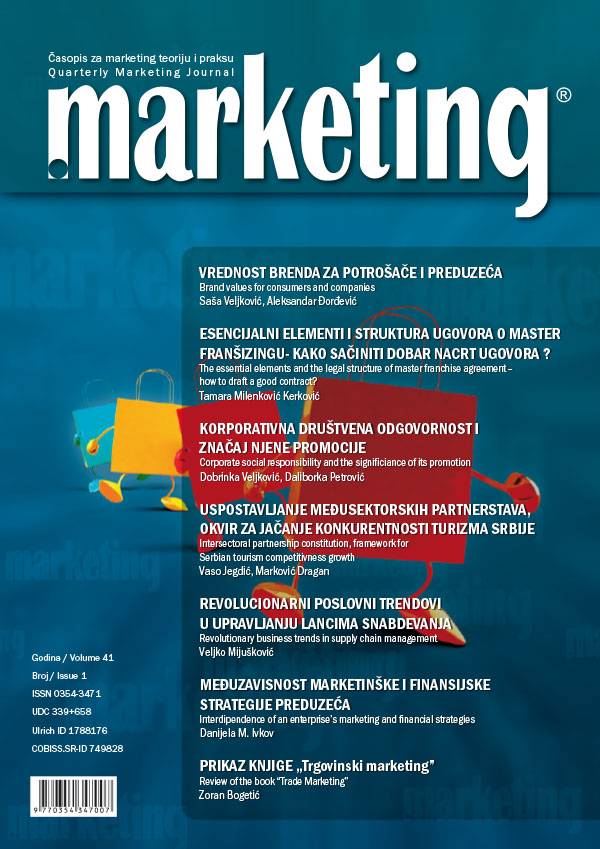
Uspostavljanje međusektorskih partnerstava, okvir za jačanje konkurentnosti turizma Srbije
Intersectoral Partnerships Constitution, Framework for Serbian Tourism Competitvness Growth
Apstrakt
Međusektorsko partnerstvo je sredstvo strateškog menadžmenta koje integriše ekonomske, društvene i ekološke ciljeve razvoja. Turističku privredu Srbije karakteriše veliki broj malih i srednjih preduzeća, sa pojedinačno ograničenim sredstvima za istraživanje, razvoj, marketing i druga ulaganja. To zahteva veliku upućenost na druge subjekte (stejkholdere). Izgradnjom partnerskih mreža i klastera, stejkholderi zajednički obezbeđuju potrebna sredstva i mogućnosti za razvoj i jačanje konkurentnosti turističkih proizvoda i destinacija.
Abstract
ntersectoral partnership is a means of strategic management that incorporates economical, social and environmental developmental aims. The Serbian tourist industry is characterized by numerous small and average-sized enterprises with limited resources for research, development, marketing and other investments. That requires addressing other subjects (stakeholders). By establishing partnership networks and clusters, stakeholders acquire necessary means and get opportunities for the development and improvement of competition of tourist products and destinations.
Reference
- Anderson, J.C. et al. (1994), Dyadic Business Relationships within a Business Network Context, -Prema: Kotler, Ph., Keller, K.L. (2006), Marketing menadžment, str. 18, Data status, 12. izdanje, Beograd.
- Bakić, O. (2010), „Prilagođavanje marketing menadžmenta u turističkim destinacijama u uslovima globalizacije i klasterizacije u turizmu“, Marketing, God. 40, Br. 4, str. 203-211.
- Crouch, G.I. (2007), Modelling Destination Competitiveness: A Survey and Analysis of the Impact of Competitiveness Attributes, CRC for Sustainable Tourism, Queensland, Australia.
- Dobre, R. (2004), Menadžment turističke destinacije, Viša škola za turistički menadžment, Šibenik.
- Dragičević, M., Obadić, A. (2006), Regionalni klasteri i novo zapošljavanje u Hrvatskoj, Ekonomski fakultet, Zagreb.
- Građanske inicijative, (2005), NVO sektor u Srbiji. (http://www.scribd.com/doc/7032469/NVO_Sektoru_Srbiji , pristupljeno: 1.07.2010.
- Jegdić, V. (2010), „Relaciona priroda marketinga u turizmu“, Marketing, God. 40, Br. 4, str. 249-257.
- Konferencija Evropskog udruženja za klastere „PRO INNO EUROPE“: European Presidency Conference on Innovation and Clusters, Stokholm, 22-23 januar 2008. http://www.proinno.net/upload/documents/european_presidency_conference_on_innovation_and_clusters.docS pristupljeno: 15.07.2010
- OECD, (1999), Boosting Innovation: The Cluster Approach, OECD Proceedings, Paris.
- Porter, M. (1998), „Clusters and the Economics of Competition“, Harvard Business Review, Vol. 76, n. 6.
- Porter, M. (1980), Competitive strategy; techniques for analyzing industries and competitors, Free Press, 397 p, New York. www.google.com/search?hl=en&q=+site:promenaideja.blog.co.yu+Gurui+menadzment+/+Michael+Porter+11/12 , pristupljeno: 11.01.2009.
- Rosenfeld, S.A. (2001), Backing into Clusters: Retrofitting Public Policies, Integration Pressures: Lessons from Around the World, John F. Kenedy School Symposium, Harvard Univesity. – Prema: Nordin, S. (2003), Tourism Clustering & Innovation – Paths to Economic Growth & Development, p. 13, ETOUR, Ostersund, Sweden.
- Smartkolektiv, (2007), Studija o mogućnostima za međusektorska partnerstva u Srbiji, Beograd.
- Ministarstvo ekonomije, turizma i usluga RS, (2005). Strategija turizma Republike Srbije 2005-2015, Beograd.
- Ministarstvo turizma i regionalnog razvoja RS, (2010). Klasteri Srbije, http://klaster.merr.gov.rs/O_klasterima/Aktivnosti_Ministarstva , pristupljeno: 31.01.2010.
- World Economic Forums Trawel & Tourism Report Highlights the Importance of Environmental Sustainability, Geneva, Switzerland. www.weforum.org/pdf/TTCR09/Rankings.pdf , pristupljeno: 15.07.2010.
- http://www.fondrnps.org.rs/, pristupljeno: 2.07.2010.