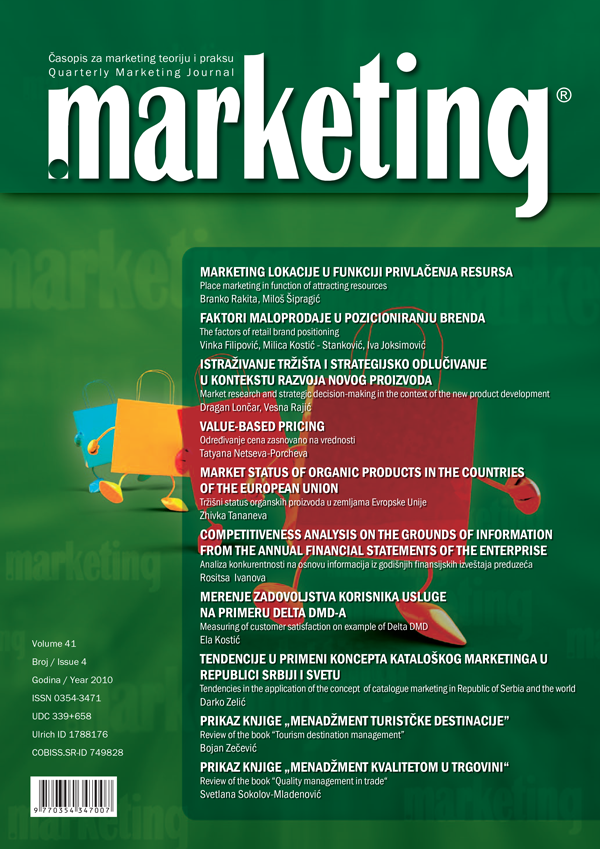
Tendencije u primeni koncepta kataloškog marketinga u Republici Srbiji i svetu
Tendencies in the Application of the Concept of Catalogue Marketing in Republic of Serbia and the World
Apstrakt
Kataloški marketing predstavlja jedan od kanala direktnog marketinga. Ovaj koncept podrazumeva donošenje velikog broja odluka strateškog i taktičkog karaktera, od kojih zavisi uspeh kataloga na tržištu. Kataloška prodaja je najrazvijenija u SAD (gde je i nastala) i u zemljama Zapadne Evrope. U Srbiji se kataloški marketing primenjuje tek nekoliko godina, od kada su veliki strani kataloški prodavci pokrenuli poslovanje u ovom regionu. Ovde je kataloški marketing na nižem stepenu razvoja nego u razvijenim zemljama, te obuhvata minoran deo ukupnog trgovinskog prometa. Pozitivno je to što su doneti zakoni koji regulišu ovu oblast, čime se podstiče njen razvoj. Sve je više kompanija u Srbiji koje svoj asortiman prezentuju i prodaju putem internet kataloga. Anketa, čiji su rezultati ukratko prikazani u ovom članku, pokazala da potrošači u Srbiji kupuju manje putem štampanih kataloga od potrošača u razvijenim zemljama, i da se povećava učešće onih koji kupuju putem e-kataloga. Sa porastom standarda stanovništva i izlaskom iz krize, postoji šansa da kataloški marketing dobije na značaju među potrošačima i kompanijama u Srbiji.
Abstract
Catalogue marketing is one of the direct marketing channels. This concept implies making a lot of strategic and tactical decisions that determine catalogue‘s market success. Catalogue sales is most developed in USA (where it originated) and in Western Europe. In Serbia, catalogue marketing is applied just in last few years, since big foreign catalog companies started their business in this region. Here, catalogue marketing is at a lower level of development than in the developed countries, and it comprises a minor part of total trade turnover. The positive thing is that now there are laws that regulates this area, which is encouraging for its development. More and more companies in Serbia are presenting and selling its product range through Internet catalogs. The survey, whose results are briefly presented in this article, showed that consumers in Serbia shop less by print catalogues than consumers in developed countries, and that the partition of those who buy through e-catalogues is increasing. With the increase in standard of living, and overcoming the crisis, there is a chance for catalogue marketing to become much more important concept among consumers and companies in Serbia.
Reference
- Bashford, S. (2010), Customer Publishing: Catalogues are the order of the day, Marketing magazine, str. 51.
- Basye Anne (2008), Opportunities in Direct Marketing Careers, The McGraw-Hill, New York.
- Catalog Retail Industry Profile: Global, Datamonitor.
- Direct Marketing Association, State of the Catalog Industry, 2009.
- Dupius, M., Dawson, J. (1999), European cases in retailing, Blackwell Publishers Ktd, Oxford, str.33-47.
- Heather, R. (2006), Naturalizer‘s brand makeover lifts sales, Multichannel Merchant, Vol. 2 Issue 11, str. 10.
- Hrvatska filijala kompanije Neckermann, zvaničan sajt, www.neckermann.hr, pristupljeno 16.06.2010.
- Istorijat kompanije Sears, zvaničan sajt, www. searsarchives.com, pristupljeno 06.08.2010.
- Jackson, M. (2008), Farewell to mail order catalogues, Precision Marketing, Vol. 20 No.16, str. 6.
- Lewis, H. G. (2008), Coping with tough times, Multichannel Merchant, Vol. 4. Issue 10, str.15-16.
- Milisavljević, M. (2006), Strategijski marketing, Centar za izdavačku delatnost Ekonomskog fakulteta u Beogradu, Beograd.
- Montgomery, A. (2009), The Next Generation of Direct Marketing, Brandweek, Vol. 50 Issue 36, str 6.
- Roberts, M. L., Berger, P. (1999) Direct marketing management, Prentice Hall, New Jersey.
- RZS Srbije: Upotreba informaciono-komunikacionih tehnologija u Republici Srbiji, april 2010.
- Zakon o elektronskoj trgovini
- Zakon o trgovini
- Zelić, D. (2010) Master teza: Primena kataloškog marketinga u Republici Srbiji, Ekonomski fakultet u Beogradu.