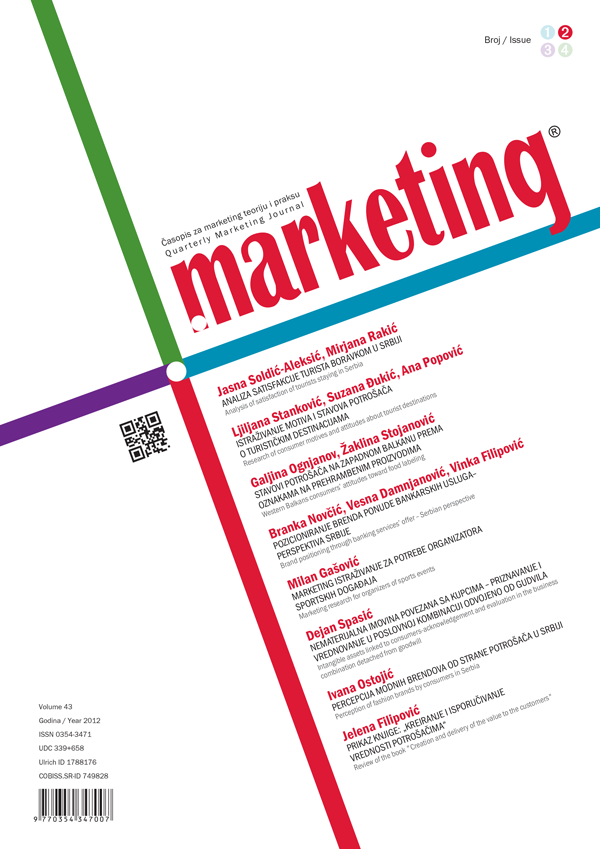
Stavovi potrošača na Zapadnom Balkanu prema oznakama na prehrambenim proizvodima
Western Balkans Consumers’ Attitudes Toward Food Labeling
Apstrakt
Cilj studije je da se analiziraju stavovi potrošača na Zapadnom Balkanu prema oznakama na prehrambenim proizvodima. U tom cilju, prezentujemo nalaze iz istraživanja sprovedenog na slučajnom reprezentativnom uzorku koji je činilo ukupno 3085 stanovnika šest zemalja Zapadnog Balkana i to: Bosne i Hercegovine, Crne Gore, Hrvatske, Makedonije, Slovenije i Srbije. Iz svake navedene zemlje najmanje 500 slučajno izabranih ispitanika je ušlo u uzorak. Statistička analiza je obuhvatila testiranje razlika u stavovima ispitanika prema oznakama na hrani, kao i u percipiranom nivou informisanosti o hrani sa zdravstvenim izjavama, uzevši u obzir sledeća socio-demografska obeležja: pol, godine starosti, obrazovanje, tip naselja, i zemlju Zapadnog Balkana u kojima ispitanik živi. Sve navedene varijable uključene su u model binarne logističke regresije (logit) kako bi se analizirali faktori koji utiču na stav potrošača prema korisnosti zdravstvenih izjava na prehrambenim proizvodima. Rezultati su ukazali na to da percipirani nivo informacija o hrani sa zdravstvenim izjavama, kao i stavovi prema oznakama na hrani uopšt, predstavljaju osnovne faktore uticaja na uverenje da su zdravstvene izjave korisne kada se donosi odluka o tome koji prehrambeni proizvod da se kupi i konzumira. Na osnovu svega, u radu su dati zaključci i implikacije za menadžere marketinga, donosioce odluka iz domena javnog zdravlja i za buduća istraživanja.
Abstract
The main purpose of this study is to shed light on consumers’ attitudes toward food labelling in the Western Balkans. Pioneering in this respect, we present the results obtained from a cross-national consumer survey on a random representative sample of 3085 respondents, i.e. at least 500 respondents per country included. The survey covered six Western Balkans countries (WBC), namely Bosnia and Herzegovina, Croatia, Macedonia, Montenegro, Serbia and Slovenia. Differences in consumers’ attitudes toward food labels as well as in self-perceived level of information about food with health claims were tested according to a number of socio-demographic criteria, including gender, age, education, type of settlement and the country of the Western Balkans where the respondent lives. The variables were also included as independents in a binary logistic model to achieve better understanding of the factors that may influence consumers’ confidence in the usefulness of health claims on product labels. The results showed that self-perceived level of information about functional food as well as consumers’ attitudes toward food labelling are influencing factors of consumers’ confidence in usefulness of health claims on product labels when making food choices. Based on the mentioned, we provide conclusions and implications for marketing managers, decision makers in public health and for further research.
Reference
- Andrews, J.C., Netemeyer, R. G.; Burton, S. (1998), Consumer Generalization of Nutrient Content Claims in Advertising, Journal of Marketing, , Vol. 62, No. 4, str. 62-75.
- Asam, E.H., Bucklin, L.P. (1973), Nutrition Labelling for Canned Goods: A Study of Consumer Response, Journal of Marketing, Vol. 37, No. 2, str. 32-37.
- Grunert K.G., Wills J.M., Fernández-Celemín L. (2010), Nutrition knowledge, and use and understanding of nutrition information on food labels among consumers in the UK, Appetite, Vol. 55, No. 2, str. 177-89.
- Kozup, J.C., Creyer, E.H., Burton, S. (2003), Making Healthful Food Choices: The Influence of Health Claims and Nutrition Information on Consumers‘ Evaluations of Packaged Food Products and Restaurant Menu Items, Journal of Marketing, Vol. 67, No. 2, str.19-34.
- Peng, C-Y. J., Lee K.L., & Ingersoll, G.M. (2002), Introduction to Logistic Regression Analysis and Reporting, The Journal of Educational Research, Vol. 96, No. 1, str. 3-14.
- Peters-Texeira, A., Badrie, N. (2005), Consumers’ perception of food packaging in Trinidad, West Indies and its related impact on food choices, International Journal of Consumer Studies, Vol. 29, No, 6, str. 508-514.
- Rimal, A. (2005), Meat labels: consumer attitude and meat consumption pattern, International Journal of Consumer Studies, Vol. 29, No. 1, str. 47-54.
- Stolz, H., Stolze, M., Janssen, M., Hamm, U. (2011), Preferences and determinants for organic, conventional and conventional-plus products – The case of occasional organic consumers, Food Quality and Preference, Vol. 22, No. 8, str. 772–779.
- Troldahl, V.C., Carter, R.E. (1964), Random Selection of Respondents within Households in Phone Surveys, Journal of Marketing Research, Vol. 1, No. 2, str. 71-76.
- Williams, P. (2006), Can Health Claims for Foods Help Consumers Choose Better Diets?, Current Medical Literature: Clinical Nutrition, Vol. 15, No. 2, str. 25-30.