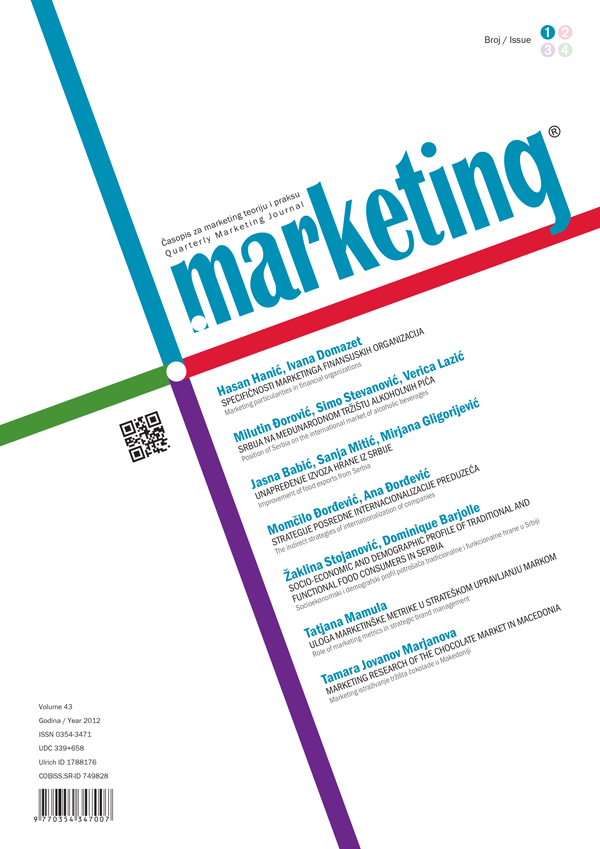
Specifičnosti marketinga finansijskih organizacija
Marketing Particularities in Financial Organizations
Apstrakt
Osnovni cilj marketing orijentisane finansijske organizacije jeste superiorno (u odnosu na konkurente) zadovoljenje sadašnjih i budućih potreba klijenata uz ostvarivanje željene dobiti koja će obezbediti njen dalji (održivi) rast i razvoj i jačanje tržišne pozicije u odnosu na konkurenciju. Ostvarivanje dobrih marketinških i ukupnih poslovnih performasi podrazumeva da finansijska organizacija kontinuirano inovira svoj portfolio proizvoda i usluga. Finansijski resursi svake organizacije su limitirani i, sledstveno tome, moraju se alocirati na pojedinačne instrumente marketing miksa na takav način koji će doneti najbolje rezultate organizaciji i istovremeno pružiti najviše koristi potrošačima i drugim stejkholderima. Koliki će iznos sredstava odvojiti za svaki pojedinačni element marketing miksa, u dobroj meri zavisi i od toga koliki stepen važnosti finansijska organizacija pridaje pojedinim elementima, od stepena njihove delotvornosti i doprinosa pojedinih instrumenata učinku ukupnog miksa. U ovom radu se prezentuju osnovni modeli marketinga finansijskih usluga i budžetiranja promocije, kao i rezultati empirijskog istraživanja strukture i dinamike ulaganja finansijskih organizacija Srbije u promociju u proteklom četvorogodišnjem periodu. U tom kontekstu prikazani su i empirijski rezultati koji otkrivaju učestalost upotrebe metoda koje finansijske organizacije Srbi-je primenjuju prilikom određivanja svojih budžeta za marketing.
Abstract
Acceptance of marketing as a business concept in financial organizations, implies that the respective organization adopts the following marketing postulations: value of action capital conclusively depends on the client (value); key goal of marketing management in financial organizations is to attract new and retain existing clients; clients are attracted by delivering superior value/offer, and retaind by generating client satisfaction; in creating and deliver-ing superior quality (value), marketing must have full colaboration with other departments (functional business areas). Due to the financial services nature, marketing management demands the classical marketing mix concept to accomodate and expand with respect to basic 4P concept, by adding new elements related to humen force (employees), physical environment and the manner in which they provide services to their clients. Therefore we believe that for the financial organizations 7P, namely 7C model is more adequate than classical model, and that it represents conceptual frame that identifies wider spectar of marketing management tools. In addition, we would like to emphasize that the advertisment, that participates with over 2/3 in total marketing budget, represents the dominant promotional form and that the budget structure for advertizing is commonly defined by the goal and task method, that stands for an important indicator of proper market orientation of financial organizations in Serbia.
Reference
- Cheverton, P., et. al. (2008), Key Account Management in Financial Services, Kogan Page, London.
- Domazet, I. (2012), Marketing komunikacije finansijskih organizacija, Institut ekonomskih nauka, Beograd.
- Domazet, I. Zubović, J. i Jeločnik M. (2010), „Development of long-term relationship with clients in financial sector companies as a source of competitive advantage”, Bulletin Vol. 62, No. 2, str. 1-11.
- Ehrlich, E.and Fanelli D. (2004), The Financial Services Marketing, Bloomberg Press, Princeton.
- Ennew, C. and Waite, N. (2007), Financial services marketing, Butterworth-Heinemann, Elsevier, Oxford.
- Ewing, M.T. (2009), „Integrated Marketing Communications Measurement and Evaluation“, Journal of Marketing Communications, Vol. 15-2/3, pp. 103-117.
- Financial Services Authority Research, www.fsa.gov.uk/pubs/conhsumer-research/crpr47.pdf, pristupljeno: 10.01.2011.
- Gronroos, C. (1998), “Marketing Services: the Case of a Missing Product”, Journal of Business & industrial marketing, No.4/5.
- Grove, S., Carlson L. and Dorsch M.J. (2002), “Addresing Services’ intangibility through integrated marketing communication”, Journal of Services Marketing, Vol. 16, No. 5.
- Hanić, H. (2008), Upravljanje marketingom, Beogradska bankarska akademija, Beograd.
- Hanić, H. i Domazet, I. (2011), „Managing Customer Relationship within Financial Organizations”, Polish journal of Management Studies, Vol. 4-2011, pp.151-166.
- Hill, P. (1997), “On Goods and Services”, The Review of Income and Wealth, Vol.23/4.
- Kancir, R. (2006), Marketing usluga, 2. izdanje Beogradska poslovna škola, Beograd.
- Kangis, P.Y. (2000), “Service Quality and customer retentionin financial services”, Journal of Financial Services Marketing, Vol. 4/4.
- Klasens, R. (2007), Marketing u finansijskim organizacijama, Udruženje banaka Srbije, Beograd.
- Lovelock, Ch. and Wirtz, J. (2004), Services Marketing, 5th Edition, Pearson Education International.
- Ljubojević, Č. (1998), Menadžment i marketing usluga, Želnid, Beograd.
- Marinković, S., Stanković, Lj. (2011), „Institucionalna osnova zaštite korisnika finansijskih usluga u Srbiji“, Marketing, No.4, Vol. 42, str. 257-266.
- Mittal, B. (2002), “Services Communications: from mindless tangibilization to meaningful messages”, Journal of Services Marketing, Vol. 16, No. 5, pp. 424 –431.
- Mortimer, K. (2002), ”Integrated advertising theories with conceptual models of services advertising”, Journal of Services Marketing, Vol. 16, No. 5.
- Pelsmacker P. et.al. (2010), Marketing Communications: A European Perspective, 4th Edition, Pearson Education.
- Pickton, D., Broderick, A. (2001), Integrated Marketing Communications, Pearson Education, England.
- Stanković, Lj., Đukić, S. (2009) Marketing, Ekonomski fakultet, Niš.
- Veljković, S. (2009), Marketing usluga, Ekonomski fakultet, Beograd.
- Zeithaml, V., Bitner, M.J. and Gremler D. (2006), Services Marketing, 4th edition, McGraw-Hill.