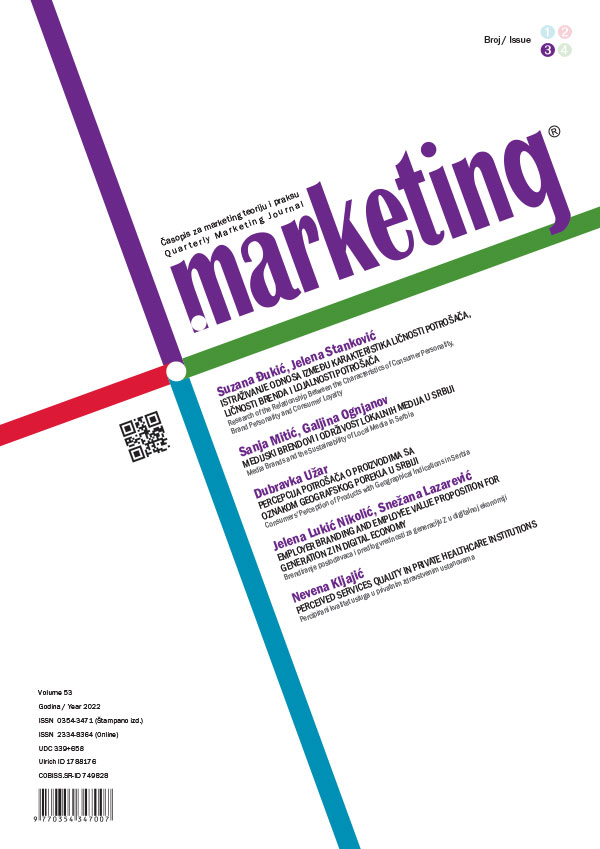
Percipirani kvalitet usluga u privatnim zdravstvenim ustanovama
Perceived Services Quality in Private Healthcare Institutions
Apstrakt
Jedna od redovnih aktivnosti u razvijenim zemljama svijeta jeste ta da se evaluacija stepena kvaliteta usluga u zdravstvenom sektoru percipiranom od strane pacijenata vrši redovno, tačnije u kontinuiranim vremenskim intervalima, te se mnogim metodama mjeri stepen rasta kvaliteta određenih usluga, ali isto tako i uočavaju određeni nedostaci koje je potrebno blagovremeno korigovati i raditi na njihovom unaprijeđenju. Nažalost, mjerenje kvaliteta usluga zdravstvenog sektora, kako i javnog i privatnog u Republici Srpskoj nije prisutno u zadovoljavajućoj mjeri. Koncepcija marketinga u poslovanju zdravstvenih ustanova nije razvijena na zavidnom nivou, prije svega kada je riječ o javnim zdravstvenim ustanovama Za razliku od javnih zdravstvenih ustanova, privatne zdravstvene ustanove postaju svjesne velike neophodnosti implementacije internog i eksternog marketinga u poslovanju, a sve u cilju boljeg korisničkog iskustva i stvaranja dugoročne lojalnosti. Rad se temelji na istraživanju stanovništva o percipiranom kvalitetu pruženih zdravstvenih usluga, te se kroz sagledavanje stanja zdravstvenog sektora u RS nastojalo doći do rezultata o razini na kojoj je kvalitet pruženih usluga privatnih u odnosu na javne zdravstvene ustanove. Pored kvaliteta usluga, cilj istraživanja je bio dobiti uvid u nivo primjene marketinške koncepcije u poslovanju privatnih zdravstvenih usluga na osnovu percepcije pacijenata o kvalitetu usluga i njegovim determinantama, ali i tržišnoj orijentisanosti zdravstvenih ustanova.
Abstract
One of the regular activities in the developed countries of the world is an evaluation of the degree of healthcare sector services qualities, as perceived by the patients. This evaluation has been carried out in regular time spans and many methods are being used to measure the degree of certain services’ quality increase, as well as to spot certain downsides that need to be improved in a timely manner. Unfortunately, measuring the healthcare sector services quality, regarding both the state and the private one, is not sufficiently present. The concept of marketing in the healthcare institutions business is not particularly developed, especially regarding public healthcare institutions. Unlike state healthcare institutions, private healthcare institutions have become aware of the great necessity of implementing both internal and external marketing modes in business, with the ultimate goal being reflected in a better customer experience and in the creation of long-term loyalty. The work is based upon research among the citizens on the perceived quality of the provided healthcare services. By means of a comprehensive perception of the healthcare sector’s state, the aim was to contrast the quality of the provided services in the private healthcare institutions to the same services provided by the state ones. Apart from the quality of services, another aim of the research was getting an insight into the level of the marketing conception utilization within the private healthcare institutions business, based upon the customer perception of the services’ quality and its determinants, and the market orientation of the healthcare institutions, as well.
Reference
- Biondić, М. (2018). Marketing neprofitne organizacije. Pula: Sveučilište Jurja Dobrile u Puli, Fakultet ekonomije i turizma „Dr Mijo Mirković“.
- Cazacu, L. O. (2015). Healthcare Marketing – A Relational Approach. Revista Economica.
- Domazet, I. (2011). Uloga internog marketinga u3. Domazet, I. (2011). Uloga internog marketinga u unaprijeđenju kvaliteta ljudskih resursa. Institut Ekonomskih nauka, Beograd.
- Došen, Đ. O. (2010). Mjerenje kvaliteta usluge sistema primarne zdravstvene zaštite SERVIQUAL instrumentom. Revija za socijalnu politiku.
- Eroglu, E. (2014). The Changing Shopping Culture: Internet Consumer Behavior. The Review of Business Information Systems, 18, p. 35.
- Herni Justiana Astuti, K. N. (2014). PATIENT LOYALTY TO HEALTH CARE ORGANIZATIONS: RELATIONSHIP MARKETING AND SATISFACTION. International Journal of Management and Marketing Research, 39-56 ; 42.
- Hillestad, S. &. (2013). Health Care Market Strategy: From Planning to Action, Fourth edition, Burlington: Jones and Bartlett Learning, Burlington.
- Ikechukwu E Obi, A. C. (2018). Patient satisfaction with services at a tertiary hospital in south-east Nigeria. Malawi Medical Journal, Vol. 30 No. 4.
- Jabnoun, N. a. (2003). „Comparing the quality of private and public hospitals“. Managing Service Quality: An International Journal, 13, No. 4, 290-299.
- Jović, M. Ž. (2017). Razvoj modela međuzavisnosti prodajnih aktivnosti i pozicioniranosti brenda privatnih zdravstvenih ustanova u Republici Srbiji, doktorska disertacija. Beograd.
- Kotler, P. &. (2008). Principles of Marketing. London: Englewood.: Prentice-Hall International editions.
- Kumaraswamy, S. (2012). „Service Quality in Health Care Centers: An Empirical Study“. International Journal of Business and Social Science, Vol. 3 (16), 141-150.
- Kurrasch, T. F. (2009). „All Together Now: Involving Key Stakeholders in Design Planning.”. Health Facilities Management, Health Forum of the American Hospital., 237-244.
- Little, Ed; Marandi, Ebi (2003). Relationship Marketing Management. Thompson Learning
- Lohr KN, S. S. (1990). A strategy for quality assurance in Medicare. SA New Engl J Med.,707–712.
- Macura, P. (2019). Osnove marketinga. Banja Luka: Ekonomski fakultet Univerziteta u Banjoj Luci.
- Mujkić, E. (2011). Sistem zdravstva u Bosni i Hercegovini: stanje i pravci moguće reforme. Sarajevo: Centar za javno pravo Stiftung Kompetenzzentrum für Öffentliches Recht.
- Mehran Alijanzadeh; Seyed Ali Moonsaniaye Zare; Roya Rajaee; Mousavi Fard; Saeed Asefzadeh; Mahnaz Alijanzadeh; Soheyla Gholami. (2016) Comparison Qaulity of Healthecare Services between Public and Private Providers: The Iranian People’s Perspective, Pubmed Central.
- Ognjanov, G. (2013). Marketinške komunikacije. Beograd: Centar za izdavačkudelatnost Ekonomskog fakulteta u Beogradu.
- Pilic, B. (2018). Uloga efikasnosti koncepcije marketinga u zdravstvu. Banja Luka: Ekonomski fakultet, Univerzitet u Banjoj Luci.
- Professor Arne Björnberg, P. &. (2018, 16.12.). Euro Health Consumer Index. Health Consumer Powerhouse. Retrieved from Health Consumer PowerHouse: https://healthpowerhouse.com/media/EHCI-2018/EHCI-2018-report.pdf
- Racz, S. M. (2018). Koncept i mjerenje kvalitete zdravstvenih usluga,. Journal of Applied Health Sciences , Vol. 4. No 1, 49-62.
- Radulescu, V. C. (2012, July). Key Factors that Influence Behavior of Healthcare Consumers, theBasis of Health Care Strategies. Contemporary Readings in Law and Social Justice, Vol. 4No 2., 992.
- Rodić Lekić, V. (2015). Kvalitet i usluge u funkciji satisfakcije i namera korisnika u ostvarivanju marketing performansi visokoobrazovnih institucija na Zapadnom Balkanu, Univerzitet u Novom Sadu.
- Veljković, S. (2009). Marketing usluga. Beograd: Centar za izdavačku delatnost Ekonomskog fakulteta u Beogradu.
- Sanja, Č. (2018). Zadovoljstvo bolesnika kvalitetom pruženih usluga zdravstvene skrbi u kliničkom zavodu za nuklearnu medicinu i zaštitu od zračenja. Osijek: Sveučilište Josipa Jurja Strossmayera u Osijeku.
- Sekulić D., Mandarić M., (2012) Kvalitet usluga kao determinanta satisfakcije potrošača u hotelijerstvu. Srpsko udruženje za marketing, Beograd.
- Stremersch, S. (2008). Health and marketing: The emergence of a new field of research. Rotterdam: Department of Marketing, Erasmus School of Economics, Erasmus University Rotterdam, Rotterdam, The Netherlands Department of Marketing, Fuqua School of Business, Duke Univer.
- Širola, D. (2017). Implementacija koncepcije marketinga u funkciji unaprijeđenja performansigradova. Split: Faculty of economics Split.
- Thomas, K. (2011). Marketing Health Services, Second Edition. AUPHA, Health Administration Press, 22.
- Turkalj, I. R. (2016). Kvaliteta zdravstvenih usluga, završni specijalistički rad. Rijeka: Sveučilište u Rijeci, Fakultet za menadžment u turizmu i ugostiteljstvu/University of Rijeka, Faculty of Tourism and Hospitality Management.