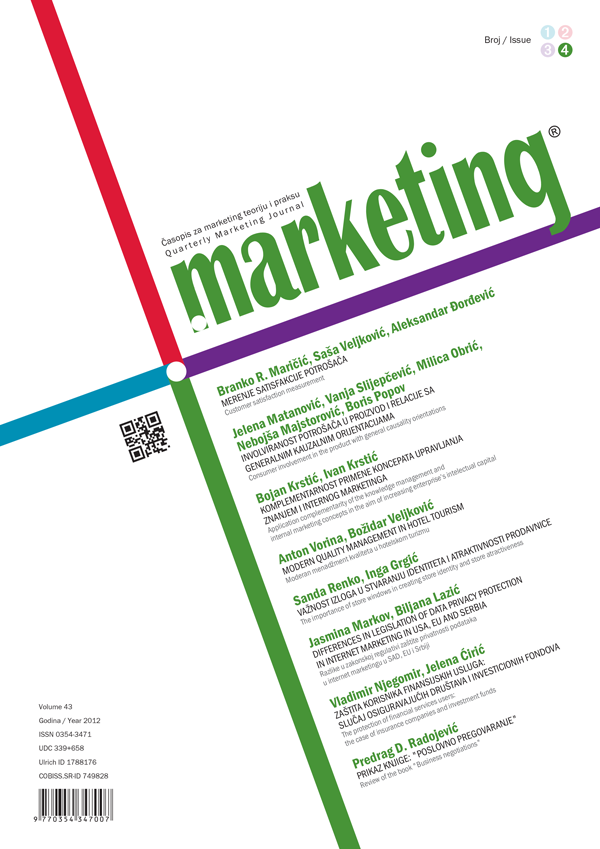
Moderan menadžment kvaliteta u hotelskom turizmu
Modern Quality Management in Hotel Tourism
Apstrakt
Turizam je brzo rastuća grana, što zahteva eksplozivne reakcije menadžmenta. Da bi dostigli ili čak premašili očekivanja gostiju, moramo utvrditi kakva su njihova očekivanja kada se radi o kvalitetu usluga. Zaposleni su srce svakog preduzeća. Na koji način treba povezati sve snage u preduzeću, kako bi postali kvalitetni u očima gostiju? To je u stvari zadatak modernog menadžmenta u turizmu. U radu analiziramo kvalitet turističke ponude na slučajnom uzorku od 333 gostiju u 42 različita hotela u Sloveniji i Hrvatskoj. Na osnovu multivarijantne linearne analize smo utvrdili da su gosti u hotelima sa četiri zvezdice zadovoljniji kvalitetom ponude u odnosu na goste u hotelima sa tri zvezdice. Statistički važne razlike između hotela sa četiri i tri zvezdice se izražavaju u zadovoljstvu kvalitetnom hranom i pićem, brzom uslugom, cenom usluga, ljubaznošću osoblja prema gostima te uređenosti restorana, recepcije i soba.
Abstract
Tourism is a rapidly growing industry that requires explosive reaction of management. In order to achieve or even exceed guests‘ expectations, we must determine what their expectations for quality of service are. The employees are the heart of business. How do we integrate all the power of quality that we will become in the eyes of customers? This is the task of modern management in tourism. In this paper we present an analysis of quality in a casual sample of 333 guests in 42 different hotels in Slovenia and Croatia. Based on multiple linear regression analysis, we found that guests in the four-star hotels are more satisfied with the quality of offers as guests in three-star hotels. Statistically significant differences between the three-stars hotels and four-star hotel is reflected in the satisfaction with the quality of food and drink and its quick service, the price of the service, friendliness of staff to guests, and the arrangement of the restaurant, reception and rooms.
Reference
- Cevc, M., (2009), Quality and work organization in the catering services, Turistica, Portorož.
- Čočkalo, D., et al., (2011), “Customer Satisfaction and Acceptance of Relationship Marketing Concept: an Exploraty Study in QM Certificated Serbian Companies”, Organization, Vol. 44, No.2, str. 32–34.
- Grönroos, C., (2007), Service Management and Marketing, Chichester, John Wiley, New York.
- Guzzo, R. (2010), “Customer Satisfaction in the Hotel Industry: A Case Study from Sicily”. International Journal of Marketing Studies, Vol. 2, No.2, str. 3-12.
- Haller, S., (2012), Dienstleistungsmanagement: Grundlagen- Konzepte- Instrumente, Gabler Verlag, Berlin.
- Lekič, Z., (2011), “Are the „accreditation“ is really the best way to a higher quality of health care institutions in Slovenia?” Quality, No. 2, str. 25–27.
- Marolt, J., Gomišček, B. (2005), Total quality management, Moderna organizacija, Kranj.
- Tominc, P., (2008), Izbrana poglavja iz poslovne statistike. Učno gradivo pri predmetih Statistične poslovne raziskave in Poslovna statistika II za študijsko leto 2008/2009, EPF Maribor, Maribor.
- Trebar, A., (2010), Creative design of new products and services: an introduction to the theory of inventive problem solving-Trizen, Slovenian association for quality and excellenc, Ljubljana.
- Vorina, A. (2012), Total quality management in tourism, Fakulteta za komercialne in poslovne vede, Celje.
- Vorina, A., (2008), Am I a quality lecturer? Slovenian association for quality and excellence, Ljubljana.
- Vorina, A., (2011), An example of implementation of internal audit, Višja ekonomska šola, Murska Sobota.
- Zeithaml, V., Berry, L. in Parasuraman, A. (1996), “The Behavioral Consequences of service Quality”, Journal of Marketing, Vol. 60, str. 31-46.