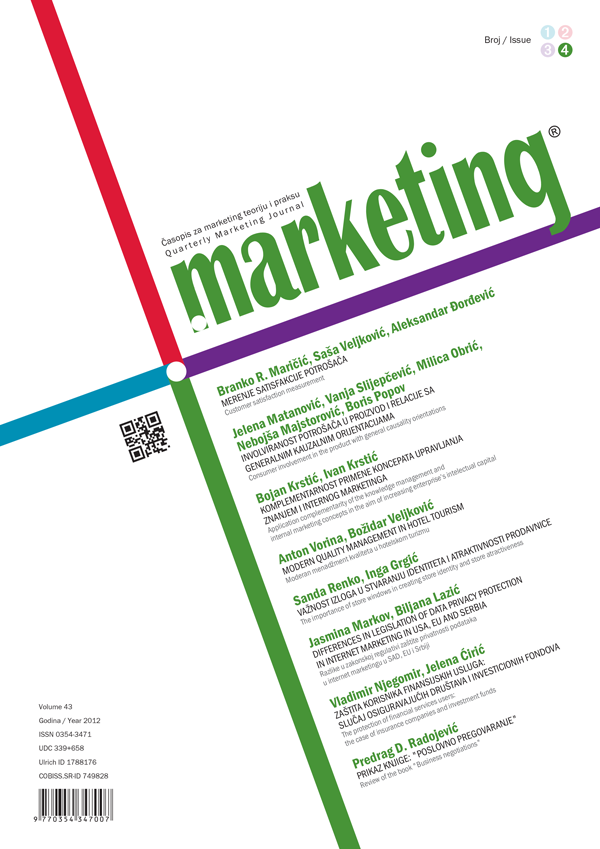
Komplementarnost primene koncepata upravljanja znanjem i internog marketinga
Application Complementarity of the Knowledge Management and Internal Marketing Concepts n the Aim of Increasing Enterprise’s Intelectual Capital
Apstrakt
Konkurentnost preduzeća u eri ekonomije znanja najneposrednije se vezuje za ljudske i ostale intelektualne resurse. Menadžeri i ostali zaposleni postaju vitalni resurs u 21. veku, a njihovo znanje ključ kreiranja i isporuke superiorne vrednosti potrošačima. Oni su danas jedan od najvažnijih segmenata imovine preduzeća, bez koje nema ni njegove egzistencije. Ključno pitanje menadžmenta jeste kako da se na osnovu znanja ljudskih resursa uvećaju ostali resursi znanja, odnosno intelektualni kapital. Polazna hipoteza ovog rada je da interni marketing, koji u fokusu ima zaposlene u preduzeću, može stvoriti adekvatnu osnovu za usavršavanje i uvećanje resursa znanja – intelektualnih resursa ili intelektualnog kapitala, kao ključnog faktora konkurentnosti u eri ekonomije znanja. Upravljanje znanjem, posmatra se kao segment procesa upravljanja intelektualnim kapitalom u preduzeću, koji za svrhu ima usmeravanje efikasne upotrebe svih vrsta znanja (individualnog, grupnog-timskog, organizacionog) radi stvaranja novih poslovnih mogućnosti i uspešne komercijalizacije proizvoda/usluga. Cilj ovog rada je da ukaže na to da komplementarna primena koncepta internog marketinga i koncepta menadžmenta znanja može da rezultira sinergetskim efektom uvećanja i usavršavanja resursa znanja – intelektualnog kapitala. U radu se koriste metodi naučnog posmatranja, ispitivanja i povezivanja, kao i analize i sinteze. Svrha primene dobijenih rezultata i zaključaka ovog istraživanja je da menadžmentu preduzeća ukaže na važnost istovremene efektivne primene koncepta internog marketinga i transfera znanja kroz procese i prakse upravljanja znanjem.
Abstract
Enterprise competitiveness in the era of knowledge economy is most directly connected to human and other intellectual resources. Managers and other employees become vital resource in the 21st century, and their knowledge is the key of creating and delivering superior value to the customers. Nowadays, they are one of the most important segments of assets without which enterprise cannot exist. Crucial question for management is how to enlarge other knowledge resources based on human resources knowledge, that is, their economically- relevant form – intellectual capital. Initial hypothesis of this paper is that, internal marketing, which has enterprise’s employees in the focus, can create adequate basis for specializing and enlarging knowledge resources – intellectual resources or intellectual capital as a key factor of competitiveness in the era of knowledge economy. Knowledge management is observed as a segment of intellectual capital management process within an enterprise, with aim to direct the efficient usage of all kinds of knowledge (individual, group-team, organizational) in order to create new business opportunities and successful commercialisations of products/services. The aim of this paper is to indicate that complementary application of the concept of internal marketing and the concept of knowledge management may result in synergetic effect of enlargement and specialisation of the knowledge resources – intellectual capital. In the paper we use methods of scientific observation, testing and connecting, as well as methods of analysis and synthesis. The purpose of obtained results application and conclusions from this research is to show to the enterprise management the importance of simultaneous effective application of internal marketing concept and knowledge transfer through processes and practices of knowledge management.
Reference
- Al-Ali, N., (2003), Comprehensive Intellectual Capital Management – step by step, Wiley, New Jersey
- Babić-Hodović, V. (2005), „Internal marketing and internal marketing orientation“, Collection of Papers of School of Economics in Sarajevo, Vol. 25, str. 115-141.
- Ballantyne, D., (2000) „Internal relationship marketing: a strategy for knowledge renewal“, International Journal of Bank Marketing, Vol. 18, No. 6, str. 274-286.
- Ballantyne, D., (2003), „A relationship – mediated theory of internal marketing“, European Journal of Marketing, Vol. 37, No. 9, str. 1242-1260.
- Berry, L. L., (1981), „The employee as customer“, Journal of Retail Banking, Vol. 3, No. 1, str. 33-39.
- Bhatt, D. G., (2001), „ Knowledge management in organizations: examining the interaction between technologies, techniques, and people“, Journal of Knowledge Management, Vol. 5, No. 1, str. 68-75.
- Chen, M., (2009) The Effect of Knowledge Economy and Internal Marketing on Job Satisfaction in Taiwan’s IT Industry, The Journal of International Management Studies, Vol. 4, No. 2, August, pp. 116-125.
- Collins, B., Payne, A., (1991), „Internal marketing: a new perspective for HRM“, European Management Journal, Vol. 9, No. 3, str. 261-270.
- David, B., (2003), „ A Relationship-Mediated Theory of Internal Marketing“, European Journal of Marketing, Vol. 37, No. 9, str. 1242-1260.
- Fang, S., Fang, S., Chuang, M., The impact of internal marketing mechanism on knowledge sharing motivation and knowledge sharing behaviour, www.decisionsciences.org/Proceedings/DSI 2008/docs/122-7090.pdf, pristupljeno 25.11.2012.
- George, W. R., (1990), „Internal marketing and organiyational behaviour: a partneship in developing customer-conscious employees at every level“, Journal of Business Research, Vol. 20, str. 63-70.
- George, W. R., Grőnross, C. (1989), Developing customer conscious employees at every level – internal marketing, in Congram, C.A., Friedman, M. L. (Eds), Handbook of Services Marketing, AMACOM.
- Gounaris, P., S., (2006), „Internal market orientation and its measurement“, Journal of Business research, Vol. 59, str. 432-448.
- Grinberg, Dž., Baron, A. R., (1998), Ponašanje u organizacijama: razumevanje i upravljanje ljudskom stranom rada, Želnid, Beograd
- Grőnross, C., (1994), „From marketing mix to relationship marketing: towards a paradigm shift in marketing“, Management Decision, Vol. 32, No. 2, str. 4-20.
- Janićijević, N., (2008) Organizaciono ponašanje, Data status, Beograd
- Kerste, R., Muizer, A., (2002), Effective knowledge transfer to SMEs-Lessons from marketing and knowledge management, Strategic Study B200202, EIM Business&Policy Research, Zoetermeer
- Kotler, P., Keller, K. L., (2006), Marketing menadžment, 12 izdanje, Data status, Beograd
- Krstić B., Vukadinović, D., (2008), „Upravljanje znanjem kao izvor održive konkurentnosti preduzeća“, Ekonomske teme, Vol. 46, No. 3, str. 85-98.
- Krstić, B., (2007), „Upravljanje performansama ljudskih resursa kao determinanta kreiranja vrednosti i konkurentske prednosti preduzeća“, Teme, Vol. 37, No. 2, str. 315-328.
- Krstić, B., (2009), Intelektualni kapital i konkurentnost preduzeća, Ekonomski fakultet Niš
- Krstić, B., (2012), Uloga strategijske kontrole u unapređenju poslovnih performansi, Ekonomski fakultet, Niš
- Krstić, B., Petrović, B., (2011), „The role of knowledge mamagement in developing capabilities for increasing enterprise’s absorptive capacity“, Facta universitatis, Series: Economics and Organization, Vol. 8, No. 3, str. 275-286.
- Krstić, B., Sekulić, V., (2007), Upravljanje performansama preduzeća, Ekonomski fakultet, Niš
- Lee, C., Chen W., (2005), „The effect of internal marketing and organizational culture on knowledge management in the information technology industry“, International Journal of Management, Vol. 22, No. 4, str. 661-662.
- Lings, N. I., Greenley, E. G., (2009), „The impact of internal and external market orientations on firm performance“, Journal of Strategic Marketing, Vol. 17, No. 1, str. 41-53.
- Milisavljević, M., (2006), Strategijski marketing, Centar za izdavačku delatnost Ekonomskog fakulteta, Beograd
- Nonaka, I., Takeuchi, H., (1995), The Knowledge Creating Company, Oxford University, New York
- Nonaka, I., Toyama, R., Konno, N., (2000), „SECI, Ba and Leadership: a Unified Model of Dynamic Knowledge Creation“, Long Range Planing, Vol. 33, No. 1, str. 5-34.
- Paschal, A., Pervaiz, A., (2006), Internal marketing: perceptions from theory and practice, Working Paper Series, University of Wolverhampton Business School, No. WP0005/06, ISSN number 1363-6839
- Pierce N. F., Morgan N. A. (1991), „Internal marketing – the missing half of the marketing programme“, Long Range Planning, Vol. 24, No. 1, str. 4-6
- Piercy, P. N., (2002), „Market-Lead Strategic Change: New Marketing for New Realities“, The Marketing Review, Vol. 2, No. 4, str. 385-404.
- Rafiq, M., Ahmed, K. P., (1993), „The scope of internal marketing: defining the boundary between marketing and human resource management“, Journal of Marketing Management, Vol. 9, No. 3, July, str. 219-232.
- Rafiq, M., Ahmed, K. P., (2000), „ Advances in the internal marketing concept: definition, synthesis and extension“, Journal of Services Marketing, Vol. 14, No. 6, str. 449-462.
- Ratković, M., (2009), „ Interni marketing u funkciji povećanja zadovoljstva kupaca“, Marketing, Vol. 40, Issue 1, str. 269-275.
- Stanković, Lj., (2002), Međuzavisni marketing, Ekonomski fakultet, Niš
- Stanković, Lj., Đukić, S., (2009), Marketing, Ekonomski fakultet, Niš
- Stanković, Lj., Radenković – Jocić, D. , Đukić, S., (2007), Unapređenje poslovne konkurentnosti, Ekonomski fakultet, Niš
- Steward, T., (2001), The Wealth of Knowledge –Intellectual Capital and the Twenty-first Century Organization, Currency, New York
- Schultz, D. E. (2004), „Building an internal marketing management calculus“, Interactive Marketing, Vol. 6, No. 2, str. 111-129.
- Tansuhaj, P., Randell, D., Cullough, M. J., (1988), „Aservices marketing management model: integrating internal and external marketing functions“, The Journal of Services Marketing,Vol. 2, No. 1, str. 31-38.
- Varey, R. J. (1995), „Internal marketing: a review and som interdisciplinari research chalenges“, International Journal of Service Industry Management, Vol. 6, No. 1, str. 40-63.
- Wieseke, J., Ahearne, M., Lam, K. S., Dick, V. R., (2009), „The role of leaders in internal marketing“, Journal of Marketing, Vol. 73, No. 2, str. 123-145.
- Wheatley, E.W. (1987), „Rainmakers, Mushrooms and Immaculate Conception: Internal Marketing for Professional Service Firm Associates, Journal of Professional Services Marketing, 2 4, str.73-82