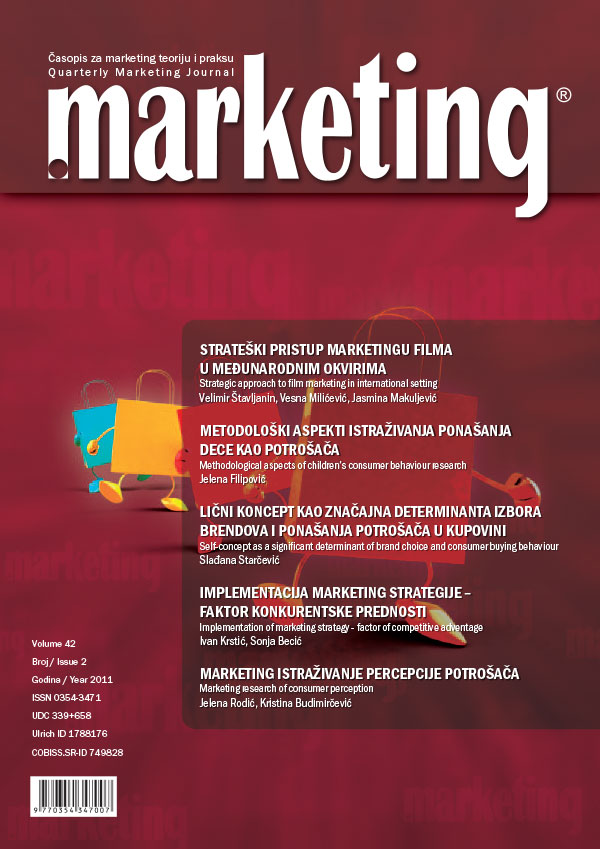
Metodološki aspekti istraživanja ponašanja dece kao potrošača
Methodological Aspects of Children’s Consumer Behaviour Research
Apstrakt
Dečije tržište svakodnevno raste po svojoj kupovnoj moći, pa su kompanije sve spremnije da ulože u istraživanje stavova i ponašanja pripadnika ovog tržišnog segmenta. Iako u većini slučajeva istraživači primenjuju iste tehnike i metode koje koriste i za istraživanje ostalih starosnih segmenata, ovde se u obzir moraju uzeti brojna ograničenja, koja su vezana za etiku, dostupnost ispitanika, zakonsku regulativu i stepen emotivnog i kognitivnog razvoja dece. U radu su razmotrene osnovne kvalitativne i kvantitativne metode koje se koriste pri istraživanju dece.
Abstract
The children market gains in its economic potential constantly. Therefore, companies are more ready to invest their resources in research of children’s consumer behaviour and attitudes. Even though the resarchers mostly use methods and techniques that have been developed for research of consumer behaviour of adults, when researching it applied on children, some specifics and limitations of researching this age cohort must be taken into consideration. Those limitations are mostly related to ethics, accessibility of respondents, legal regulation and the stage of the children’s emotional and cognitive development. Some qualitative and quantitive methods are also taken into account in this paper.
Reference
- Acuff, D.S., Reiher, R.H. (1997), What Kids Buy and Why – The Psychology of Marketing to Kids, The Free Press, New York
- Carroll, J. (2002), “Play therapy: the children’s views”, Child and Family Social Work, Vol. 7, str. 177-187
- Christensen, P.H. (2002), Prout, A., “Working with ethical symmetry in social research with children”, Childhood, Vol. 9, No. 4, str. 477-497.
- Convention on the Rights of the Child, http://www2.ohchr.org/english/law/crc.htm#art12 , pristupljeno: 30.5.2011.
- Cowell, P. (2001), “Marketing to Children: A Guide for Students and Practitioners – Part 2”, The Marketing Review, Vol. 2, No. 1, str. 71-87
- Davis, T. (2000), “What children understand about consumption constellations: differences across three age groups”, Advances in Consumer Research, (ed. Hoch, S.J., Meyer, R.J.), Association for Consumer Research, str. 72-78.
- Davis, T. (2010), “Methodological and design issues in research with children”, Understanding children as consumers, (ed. Marshall, D.), SAGE – Advanced Marketing Series, London, str. 61-78
- Elliott, R., Gender and the Psychological Meaning of Fashion Brands, http://www.acrwebsite.org/volumes/gender/v02/second%20conference.Gender%20and%20the%20Psychological%20Meaning%28p.99%29.pdf, pristupljeno: 1.6.2011.
- Farrell, A. (2005), Ethical Research with Children, Open University Press, Columbus
- Faux, S., Walsh, M., Deatrick, J. (1988), „Intensive interviewing with children and adolescents“, Western Journal of Nursing Research, Vol. 10, No. 2, str. 180-194
- Filipović, J. (2010), Mali kupci, veliko tržište, Zavod za udžbenike, Beograd
- Forty Key Trends for the Next Decade: 20 Key Global Trends and 20 Key Consumer Trends 2005-2015, http://www.euromonitor.com , pristupljeno: 10.5.2010.
- King, M. (2007), „The Sociology of Childhood as Scientific Communication: Observations from a social systems perspective”, Childhood May, Vol.14, str. 193-213.
- Mangleburg, T.F. (1990), „Children‘s influence in purchase decisions: a review and critique“, Advances in Consumer Research, (ed. Goldberg, M.E., Gorn, G. i Pollay, R.W.), Association for Consumer Research, str. 813-825.
- Maričić, B. (2011), Ponašanje potrošača, 9. izdanje, CID Ekonomskog fakulteta, Beograd
- Mauthner, M. (1997), „Methodological aspects of collecting data from children: lessons from three research projects”, Children & Society, Vol. 11, No. 1, str. 16-28.
- McNeal, J.U. (1998), “Taping the Three Kids‘ Markets”, American Demographics, Vol. 20, No. 4, str. 36-41
- McNeal, J.U. (1999), The kids market: myths and realities, Paramount Market Publishing, NY.
- Mikloš, B., Novović, Z., Tovilović, S. (2006), “Kognitivno funkcionisanje edukativno zapuštene dece predškolskog uzrasta”, Psihologija, Vol. 39, No. 2, str. 183-206.
- Miller, C. (Sept 3 1990), „Researching children isn’t kids’ stuff anymore“, Marketing News, str. 32-34.
- Miller, S. (2000), “Researching children: issues arising from a phenomenological study with children who have diabetes mellitus”, Journal of Advanced Nursing, Vol. 31, No. 5, str. 1228-1234.
- Moore, T., McArthur, M., Noble-Carr, D. (2008), „Little voices and big ideas: lessons learned from children about research“, International Journal of Qualitative Research, Vol. 7, No. 2, str. 77-91.
- Murray, C. (2006), „Peer led focus groups and young people“, Children & Society, Vol. 20, str. 273-286.
- Nickerson, N.P., Jurowski, C. (2001), „The influence of children on vacation travel patterns”, Journal of Vacation Marketing, Vol. 7, No. 1, str. 19-30.
- Potrošač (10.3.2011.), “Niko ne brine o malim potrošačima”, str. 9.
- Pridmore, P., Lansdown, R. (1997), „Exploring childrenćs perceptions of health: does drawing really break down barriers?”, Health Education Journal, Vol. 56, str. 219-230
- Roedder John, D. (1999), “Consumer Socialization of Children: A Retrospective Look at Twenty-Five Years of Research”, Journal of Consumer Research, Vol. 26, str. 183-213.
- Rosenberg J. (2000), „Agencies pile on the resources“, Advertising Age, Vol. 71, No. 7, str. 45.
- Sellers, P. (May 8 1989), „The ABCs of marketing to kids“, Fortune, str. 114-120.
- Zakon o zaštiti podataka o ličnosti, http://www.poverenik.org.rs/images/stories/dokumentacija-nova/zakon-o-zastiti-podataka-o-licnosti-latinica.pdf, pristupljeno: 30.5.2011.