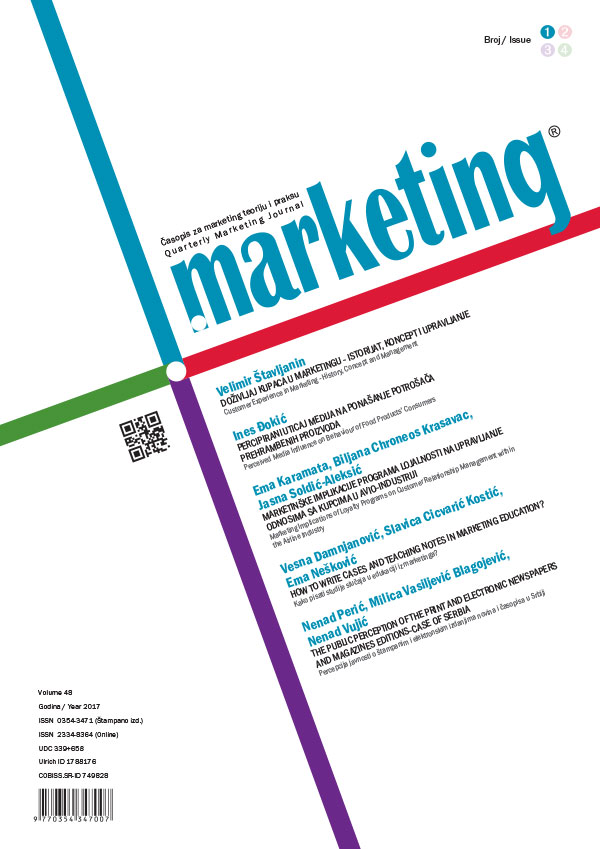
Marketinške implikacije programa lojalnosti na upravljanje odnosima sa kupcima u avio-industriji
Marketing Implications of Loyalty Programs on Customer Relationship Management within the Airline Industry
Apstrakt
Jedna od bitnih tendencija koja se uočava na tržištu avio-industrije jeste da danas skoro svaka avio-kompanija nastoji da izgradi dugoročne odnose sa kupcima odnosno korisnicima avio-usluga putem programa lojalnosti. Predmet ovog rada je da ispita značaj programa lojalnosti na upravljanje odnosima sa kupcima u avio-industriji i da utvrdi da li pripadnost programu lojalnosti utiče na kupce da kupuju avio-karte kod iste avio-kompanije. U te svrhe urađena je empirijska analiza, zasnovana na podacima dobijenim putem ankete sprovedene na beogradskom aerodromu „Nikola Tesla“ u toku septembra 2015. godine. Za testiranje hipoteze, formirane u skladu sa navedenim ciljem rada, pored deskriptivnih i grafičkih prikaza, primenjen je hi-kvadrat statistički test. Rezultati su pokazali da programi lojalnosti imaju uticaja na izbor avio-kompanije tj. članovi programa lojalnosti određene avio-kompanije nastoje da u situaciji kada koriste avionski prevoz, ako im cena i vreme putovanja odgovaraju, biraju avio-kompaniju čijeg su programa lojalnosti član. Takođe, šansa da izaberu avio-kompaniju u čijem programu lojalnosti imaju članstvo, proporcionalno se povećava sa dužinom članstva i, još bitnije, sa brojem letova koje putnici ostvaruju. Na osnovu testirane hipoteze i uočenih preferencija putnika, ukazano je na moguće marketinške implikacije dobijenih rezultata, uz analizu statusa i rejtinga naše nacionalne avio-kompanije kod anketiranih putnika.
Abstract
One of the most remarkable tendencies on the market of airline services is that nowadays almost every airline company strive to build long-term relationships with customers/users of airline services through loyalty programs. The subject of the paper is to explore the role of Frequent Flyer Programs (FFPs) in the scope of customer relationship management in airline industry and to determine whether affiliation to FFPs affects customers to buy tickets from the same airline carrier. For this purpose, an empirical analysis was conducted based on the data obtained from the survey conducted at the Belgrade airport Nikola Tesla, in September 2015. Hypothesis is formed in accordance with the stated aim of the work and was tested by using descriptive and graphical presentation as well as Chi-square statistical test. The results have shown that loyalty programs influence customers when choosing airlines, meaning that Frequent Flyer members tend to use air transportation services of airline carriers which are part of Frequent Flyer Program they belong to, whenever price and timing suit them. Furthermore, the chance of choosing the airline whose Frequent Flyer Program one is member of, increases proportionally to the length of membership and, more importantly, the number of flights that one has realized so far. Based on the tested hypothesis and observed preferences of the travelers, possible marketing implications of the results are pointed out in this article, as well as the analysis of the status and rating of our national airline according to surveyed passengers.
Reference
- Agrawal M. (2013). The ultimate guide to airline customer relationship management and loyalty. Preuzeto 06.12.2015. sa: https://www.tnooz.com/article/the-ultimate-guide-to-airline-customer-relationship-management-and-loyalty/
- Beiske B. (2007). Loyalty Management in the Airline Industry. Munich: GRIN Verlag GmbH
- Belobaba, P., Odoni, A., Barnhart, C. (2009). The Global Airline Industry. United Kingdom: Wiley
- Chroneos Krasavac B. (2005), Modeliranje sistema direktnog marketinga (doktorska disertacija). Ekonomski fakultet. Beograd
- Cosmas A., Belobaba P. and Swelbar W. (2011). Framing the Discussion on Regulatory Liberalisation: A Stakeholder Analysis of Open Skies, Ownership and Control. International Journal of Aviation Management, Vol.1, No. 1/2, pp. 17-39
- de Boer E.R. and Gudmundsson S.V. (2012). 30 years of frequent flyer programs. Journal of Air Transport Management, Vol. 24, pp. 18-24
- Dolnicar S., Grabler K., Grün B. and Kulnig A. (2011) Key drivers of airline loyalty. Tourism Management, Vol. 32, No.5, pp. 1020-1026
- Karamata E. (2016). Upravljanje odnosima s korisnicima avio-usluga (master teza). Ekonomski fakultet. Beograd
- Lovreta S., Berman B., Petković G., Veljković S., Crnković J., and Bogetić Z. (2010). Menadžment odnosa sa kupcima. Beograd: Data Status i Centar za izdavačku delatnost Ekonomskog fakulteta Univerziteta u Beogradu
- Martin M. (2015). Better Targeting your Customers with CRM Value Chain Model. Preuzeto 03.11.2016.sa https://www.cleverism.com/crm-value-chain-model-better-targeting-customers/
- Mason G. and Barker N. (1996). Buy now fly later: an investigation of airline frequent flyer programmes. Tourism Management, Vol. 17, No. 3, pp. 219-232
- Milisavljević M., Maričić B., i Gligorijević M. (2012). Osnovi marketinga (5. izdanje). Beograd: Centar za izdavačku delatnost Ekonomskog fakulteta Univerziteta u Beogradu
- Sandada M. and Matibiri B. (2016). An investigation into the impact of service quality, frequent flier programs and safety perception on satisfaction and customer loyalty in the airline industry in Southern Africa. South East European Journal of Economics and Business, Vol. 11, pp. 41-53
- Shoemaker S., Lewis R.C. (1999). Customer loyalty: the future of hospitality marketing. International journal of hospitality management, Vol. 18, No.4, pp. 345-370
- Soldić-Aleksić, J. (2015). Primenjena analiza podataka. Beograd: Centar za izdavačku delatnost Ekonomskog fakulteta Univerziteta u Beogradu
- Tyler T. (2014). State of the Industry. Preuzeto 18.11.2016. sa: http://www.iata.org/pressroom/speeches/Pages/2014-06-02-1.aspx
- Veljković S. i Chroneos Krasavac B. (2015). Direktni marketing, Beograd: Centar za izdavačku delatnost Ekonomskog fakulteta Univerziteta u Beogradu