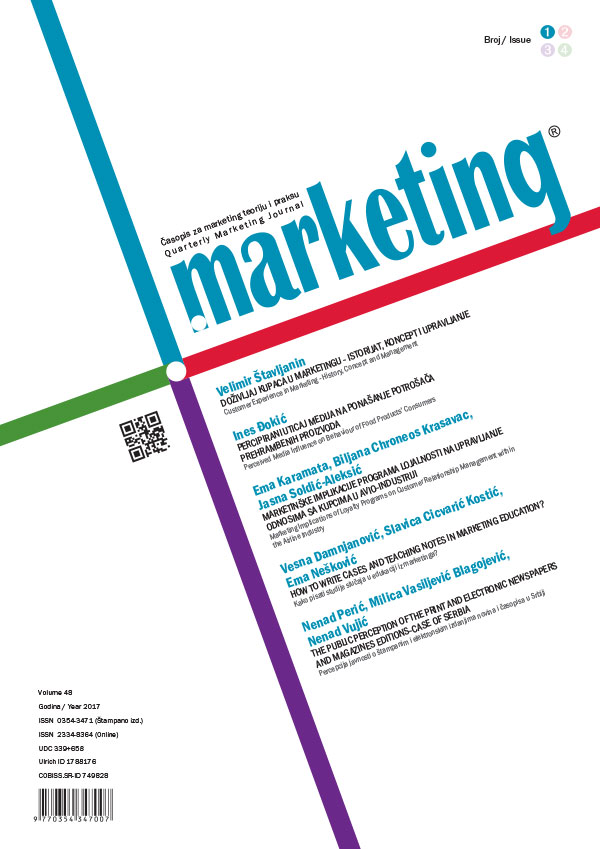
Doživljaj kupaca u marketingu – istorijat, koncept i upravljanje
Customer Experience in Marketing - History, Concept and Management
Apstrakt
Kompanije se danas susreću sa izazovima koji se odnose na interakciju s kupcima u različitim tačkama kontakta u multikanalnom okruženju. Ključni prioritet u takvoj situaciji je upravljanje svim tačkama kontakta kako bi se optimizovao doživljaj kupaca. U ovakvom kontekstu upravljanje doživljajem kupaca postaje prioritet velikog broja kompanija. Cilj ovog rada je da razjasni koncept doživljaja potrošača, približi ga akademskoj i stručnoj zajednici i kreira interes za ovaj relativno nov koncept. Rad predstavlja istorijski pregled literature u domenu doživljaja kupaca, detaljnu analizu koncepta doživljaja kupaca i modele upravljanja doživljajem kupaca.
Abstract
Companies are nowadays faced with challenges regarding interaction with customers through various touchpoints in multichannel environment. Key priority in that situation is to manage all those touchpoints in such a way to optimize customer experience. In a context like this customer experience management is becoming a priority for a large number of companies. The aim of this paper is to clarify the concept of customer experience, bring it closer to the academic and practitioner community, and create interest for this relatively novel concept. Paper provides historical review of the literature in the domain of consumer experience, detailed analysis of customer experience concept, and present models of customer experience management.
Reference
- Arnould, E., Price, L. and Zinkhan, G. (2002). Consumers. New York: McGraw-Hill.
- Berry, L., Carbone L. and Haeckel S. (2002). Managing the Total Customer Experience. MIT Sloan Management Review, 43(8), 85-89.
- Berry, L., Wall, E. and Carbone, L. (2006). Service Clues and Customer Assessment of the Service Experience: Lessons from Marketing. Academy Of Management Perspectives, 20(2), 43-57.
- Bettman, J. R. (1970). Information Processing Models of Consumer Behavior. Journal Of Marketing Research (JMR), 7(3), 370-376.
- Brakus, J., Schmitt, B. and Zarantonello, L. (2009). Brand Experience: What Is It? How Is It Measured?Does It Affect Loyalty?. Journal of Marketing, 73(3), 52-68.
- Carbone, L.P. (2004), Clued in, Englewood Cliffs: FT Prentice-Hall.
- Cagan, J. and Vogel, C. (2002). Creating Breakthrough Products: Innovation From Product Planning to Program Approval, Upper Saddle River, NJ, USA: Prentice Hall.
- Carbone, L. and Haeckel, S. (1994). Engineering Customer Experience. Marketing Management, 3(3), 9-19.
- Carù, A. and Cova, B. (2003). Revisiting Consumption Experience: A More Humble but Complete View of the Concept. Marketing Theory, 3(2), 267-286.
- Carù, A. and Cova, B. (2007). Consuming experience. London:Routledge.
- Chakravorti, S. (2011). Managing organizational culture change and knowledge to enhance customer experiences: analysis and framework. Journal Of Strategic Marketing, 19(2), 123-151.
- Chauhan, V. and Manhas, D. (2014). Dimensional Analysis Of Customer Experience In Civil Aviation Sector. Journal Of Services Research, 14(1), 75-98.
- Forlizzi, J. and Ford, S. (2000). „The building blocks of experience: an early framework for interaction designers”, Proceedings of the conference on Design interactive systems: processes, practices, methods, and techniques, 419-423, New York City, NY, USA
- Frow, P. and Payne, A. (2007). Towards the `perfect‘ customer experience. Journal of Brand Management, 15(2), 89-101.
- Gentile, C., Spiller, N. and Noci, G. (2007). How to Sustain the Customer Experience: An Overview of Experience Components that Co-create Value with the Customer. European Management Journal, 25(5), 395–410.
- Harvard Business Review Analytical Services (2015), Designing a Marketing Organization for the Digital Age. Preuzeto 20.04.2017. sa adrese https://hbr.org/resources/pdfs/comm/marketo/19492_HBR_Report_ Marketo_Oct2015.pdf
- Holbrook, M. and Hirschman, E. (1982). The Experiential Aspects of Consumption: Consumer Fantasies, Feelings, and Fun. Journal of Consumer Research, 9(2), 132-140.
- Homburg, C., Jozić, D. and Kuehnl, C. (2017). Customer experience management: toward implementing an evolving marketing concept. Journal Of The Academy Of Marketing Science, 45(3), 377-401.
- LaSalle, D. and Britton, T. (2003). Priceless: Turning Ordinary Products Into Extraordinary Experiences, Boston, Massachusetts: Harvard Business School Press.
- Lemon, K. and Verhoef, P. (2016). Understanding Customer Experience Throughout the Customer Journey. Journal Of Marketing, 80(6), 69-96.
- Maričić, B., Đorđević, A. i Filipović, J. (2011), Kreiranje iskustva u hotelima u cilju povećanja konkurentske prednosti, Naučni skup Novi metodi menadžmenta i marketinga u podizanju konkurentnosti srpske privrede, Palic, Subotica: Ekonomski fakultet
- Maričić, B. i Đorđević, A. (2012). Kreiranje i isporučivanje vrednosti potrošačima, Beograd: Centar za izdavačku delatnost Ekonomskog fakulteta
- Mascarenhas, O., Kesavan, R. And Bernacchi, M. (2006). Lasting customer loyalty: a total customer experience approach. Journal of Consumer Marketing, 23(7), 397-405.
- Meyer, C. and Schwager, A. (2007). Understanding customer experience. Harvard Business Review, 85(2), 116-126.
- Novak, T., Hoffman, D. and Yung Y. (2000). Measuring the Customer Experience in Online Environments: A Structural Modeling Approach. Marketing Science, 19(1), 22-42.
- Oracle (2013), Global Insights on Succeeding in the Customer Experience Era. Preuzeto 11.04.2017. sa adrese http://www.oracle.com/us/global-cx-study-2240276.pdf
- Palmer, A. (2010). Customer experience management: a critical review of an emerging idea. Journal of Services Marketing, 24(3), 196-208.
- Pine II, J. and Gilmore, J. (1998). Welcome to the Experience Economy. Harvard Business Review, 76(4), 97-105.
- Pine II, J. and Gilmore, J. (1999). The Experience Economy, Boston, Massachusetts, USA: Harvard Business Press
- Popesku, J. (2016). Menadžment turističke destinacije, Univerzitet Singidunum, Beograd
- Rahman, Z. (2006). Customer experience management — A case study of an Indian bank. Journal Of Database Marketing & Customer Strategy Management, 13(3), 203-221.
- Rawson, A., Duncan, E., and Jones, C. (2013). The Truth About Customer Experience. Harvard Business Review, 91(9), 90-98.
- Ristić, Svetomir (2004), Enciklopedijski Nemačko-Srpski rečnik, Beograd, Srbija: Prosveta
- Schmitt, B. (1999). Experiential Marketing – How to get customers to sense, feel, think, act, and relate to your company and brands, New York, NY, USA: The Free Press.
- Schmitt, B. (1999b). Experiential Marketing. Journal of Marketing Management, 15(1-3), 53-67.
- Schmitt, B. (2003), Customer Experience Management: A Revolutionary Approach to Connecting With Your Customers, Hoboken, New York, USA: John Wiley & Sons.
- Schmitt, B. (2011). Experience Marketing: Concepts, Frameworks and Consumer Insights. Foundations and Trends in Marketing, 5(2), 55-112.
- Shaw, C. and Ivens, J. (2005). Building Great Customer Experiences. New York:MacMillan.
- Smith, S. and Wheeler, J. (2002). Managing the customer experience. Harlow, Essex, Great Britain: Pearson Education Limited
- Tullis, T., and Albert, W. (2013). Measuring the user experience : collecting, analyzing, and presenting usability metrics, MA; USA: Morgan Kaufmann -Elsevier
- Tynan, C., and McKechnie, S. (2009). Experience marketing: a review and reassessment. Journal Of Marketing Management, 25(5-6), 501-517.
- Yakhlef, A. (2015). Customer experience within retail environments. Marketing Theory, 15(4), 545-564. doi:10.1177/1470593115569016