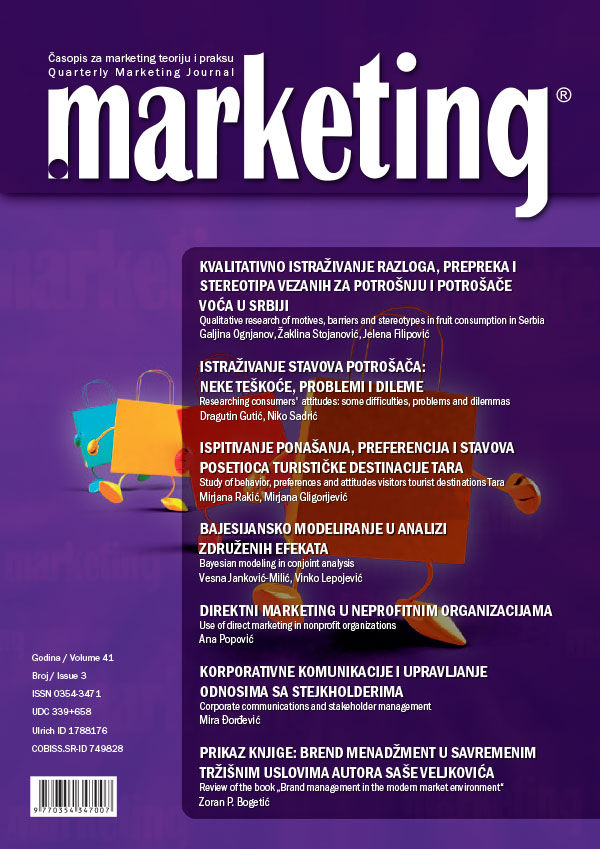
Istraživanje stavova potrošača: neke teškoće, problemi i dileme
Researching Consumers‘ Attitudes: Some Difficulties, Problems and Dilemmas
Apstrakt
Postoje područja u marketingu o kojima se pisalo, piše se i pisat će se, ali izgleda da nikada neće biti potpuno ni razjašnjena, ni poznata. O stavovima potrošača piše se već više od pola veka. Nastale su brojne teorije, radovi, istraživanja… Ta svojevrsna „kula Vavilonska“ još je i dandanas vidljiva i aktuelna. Zvuči neverovatno, ali još uvek izgleda da ni po temeljnim pitanjima stavova potrošača ne postoje usklađena stanovišta brojnih teoretičara, praktičara i istraživača u oblasti marketinga. Ovaj rad je tek samo jedan mali, simboličan osvrt i pokušaj da rasvetli brojne dileme i razmimoilaženja kako u shvatanju, tako i u istraživanjima stavova potrošača.
Abstract
Consumers‘ attitudes have always had a central place in marketing theory and practice. There is a great number of different problems, difficulties and dilemmas, which come from different sources and have different content, and which very often arise as a stumbling block in researching consumers‘ attitudes. Part of them is already contained in different views on term attitudes itself. The second part lies in an unsolved puzzle of consumers‘ attitudes and behaviour relation. The third part is of methodological nature in research. The fourth is in usage of different, numerous techniques that researchers have at their disposal when researching attitudes. It might sound unbelievable, but since the 1960s till today, very few researchers have understood, and knew real nature of the term, essence and meaning of attitudes in marketing. There is even less of them who know how to examine attitudes and generally use adequately and productively. Attitudes belong to the most complex psychical processes. Thei complexity of attitudes is manifesting during the research. It is not a rarity to become convinced that important contents, such as: determining dimensions, components, sources of emerging and stability of researched attitudes are not present in attitudes‘ examination and research. In most cases, research results of consumers‘ attitudes are actually nothing more than statements about the existence of positive and negative attitudes. There is still no complex method that can be used in research. Different, essentially partial methods are being used instead, usually to investigate particular components and dimensions of consumers‘ attitudes. There are more groups of problems that appear in consumers‘ attitudes examination. For this occasion, we point out three: problems that result from lack of knowledge and not adequate understanding of attitudes; problems related to level of examinee‘s (consumer‘s) consciousness of his attitude; problems emerging from neglectful use of methodology of researching consumers‘ attitudes. In this work, we took into consideration three methods most often used in researching consumers‘ attitudes: semantic differential, Likert scale and psychodrama. Construction demands and the technique of constructing semantic scales is a difficult, complex, long-term and demanding work. Besides, interdisciplinary approach is needed, but almost always expensive and unacceptable in terms of costs. Psychodrama, as a contemporary and modern technique in researching consumers‘ attitudes, will certainly become more and more popular, in spite of its evident weaknesses, defects and limits. In all probability it will be more and more represented in practice of maketing research.
Reference
- Allport G., (1972), Introduction to Social Psychology, Psychological Bulletin, New York
- Aronson E., Wilson T.D., Akert R.M., (2005), Socijalna psihologija, Mate, Zagreb
- Bujas Z., (1974), Uvod u metode eksperimentalne psihologije, Školska knjiga, Zagreb
- Dibb S., Lyndon S., Pride W.M., Ferrell O.C., (1995), Marketing, Mate, Zagreb
- Fishbein M.., (1980), »Attitude and the Prediction of Behaviour» u «Attitude and the Theory and Measurement», Journal of Marketing, Oct., pp. 38-52
- Grbac B., Meler M., (2010), Metrika marketinga, Ekonomski fakultet, Rijeka
- Green P.E., Tull D.S., Albaum R.D., (1990), Research of Marketing Decisions, Prentice-Hall, International, Englewood Clifs, New Yersey
- Grupa autora, (2007) , Tourism and Hospitality management, Istraživački projekt u organizaciji Fakulteta za turizam i hotelijerski menadžment, Opatija, Opatija, Wien, Thessaloniki, Vol.13, Number 1, pp. 1-435
- Hanić H., (2005), Istraživanje tržišta i marketing informacioni sistemi, Ekonomski fakultet, Beograd
- Hanić H., (2008), Proces istraživanja tržišta, Beogradska bankarska akademija, Beograd
- Hewstone M., Stroebe W., (2002), Uvod u socijalnu psihologiju, Naklada Slap, Jastrebarsko
- Kesić T., (1999), Ponašanje potrošača, Adecco, Zagreb
- Kotler Ph., (1988), Upravljanje marketingom, Informator, Zagreb
- Kotler Ph., Lane K., (2008), Upravljanje marketingom, Mate, Zagreb
- Kovačić D., Markovina J., Prebježić S., (2007), :»Ponašanje i stavovi potrošača na zagrebačkom tržištu slavonskog kulena», Agronomski glasnik br. 1/2007, Agronomski fakultet, Zagreb, str. 122-145
- Loga S., (1999), Klinička psihijatrija, Medicinski fakultet, Sarajevo
- Marušić M., Vranešević T., (2001), Istraživanje tržišta, Adeco, Zagreb
- Meler M., (2005), Istraživanje tržišta, Ekonomski fakultet, Osijek
- Milisavljević M., (1995), Marketing, Savremena administracija, Beograd
- Mindoljević Drakulić A., (2007), Mali rječnik psihodrame, Hrvatsko psihodramsko društvo, Zagreb
- Rocco F., (1988), Istraživanje tržišta – marketinški pristup, TRO Zagreb, Samobor
- Rot N., (1975), Osnovi socijalne psihologije, Rad, Beograd
- Senečić J., (1997), Istraživanje turističkih tržišta, Mikroorad i Ekonomski fakultet, Zagreb
- Salai S., Božidarević D., (2009), Marketing istraživanje, Ekonomski fakultet, Subotica
- Tihi B., (2003), Istraživanje marketinga, Dom štampa, Zenica (BiH), 2003
- Turudin – Šimunec J., (1990), Klinička neuropsihologija,, Naklada Slap, Jastrebarsko
- Vranešević T., Vignali C., Vrontis D., (2004), Upravljanje strateškim marketingom, Accent, Zagreb
- Zvonarević M., (1989), Socijalna psihologija, Školska knjiga, Zagreb, 1989