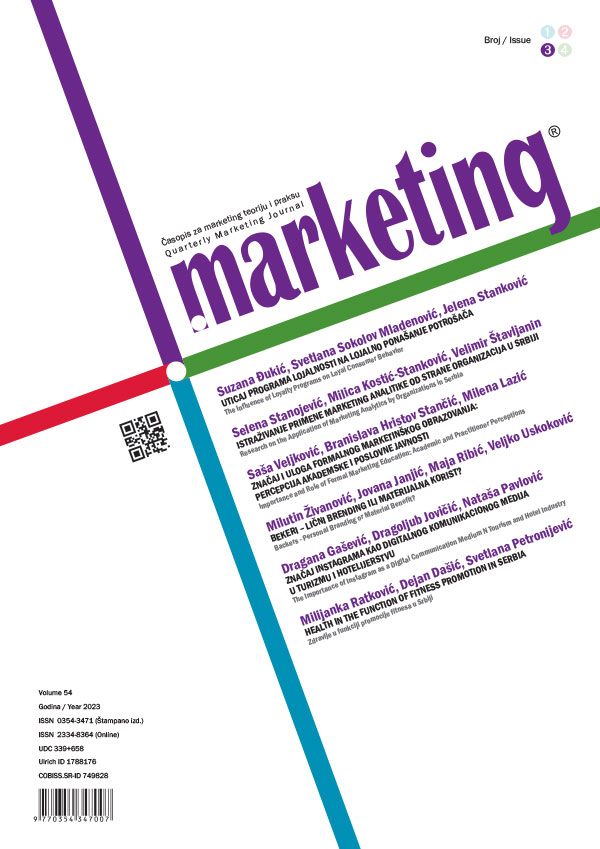
Značaj i uloga formalnog marketinškog obrazovanja: percepcija akademske i poslovne javnosti
Importance and Role of Formal Marketing Education: Academic and Practitioner Perceptions
Apstrakt
Značaj edukacije za razvoj znanja i veština iz oblasti marketinga je nesporan, ali je malo naučnih radova koji se bave ispitivanjem usklađenosti formalnog obrazovanja sa potrebama savremene marketinške prakse. Ovaj rad nastoji da popuni identifikovani jaz. U tu svrhu, sprovedena su dva istraživanja. U prvom je analizirana ponuda marketinških smerova i predmeta 165 akreditovanih visokoškolskih ustanova na teritoriji Republike Srbije. Nalazi ukazuju da su teme marketinga, strategijskog marketinga, ponašanja potrošača i istraživanja tržišta, zadržale liderske pozicije u nas tavnim planovima i programima, te da je primetan i trend brzog razvoja drugih oblasti (npr. digitalni, internet i marketing putem društvenih mreža). U drugom istraživanju anketnim putem ispitivani su stavovi i percepcije 117 pripadnika akademske i poslovne zajednice, iz oblasti marketinga. Rezultati pokazuju da postoji saglasnost o značaju specifičnih znanja, veština i stavova za rad u marketinškoj praksi, kao i o neophodnosti specijalizovanog formalnog obrazovanja za pozicije izvršnog direktora marketinga, brend menadžera i marketinškog konsultanta. Nasuprot tome utvrđene su značajne razlike u percepciji akademske i poslovne zajednice o osposobljenosti diplomiranih studenata da praktično primene marketinška znanja i veštine. Rezultati istraživanja pružaju uvid u stanje i perspektive marketinga i uspešnost formalnog obrazovanja u kreiranju znanja i veština diplomaca usklađenih sa zahtevima savremene marketinške prakse.
Abstract
The significance of education for the development of knowledge and skills in the field of marketing is undeniable, but there is a limited number of scientific studies addressing the alignment of formal education with the needs of contemporary marketing practices. This research aims to bridge the identified gap. To achieve this, two studies were conducted. The first study analyzed the offerings of marketing programs and courses in 165 accredited higher education institutions within the territory of the Republic of Serbia. The findings indicate that subjects such as marketing, strategic marketing, consumer behavior, and market research have maintained their leading positions in the curricula, with a noticeable trend of rapid development in other areas (e.g., digital, internet, and social media marketing). In the second study, the attitudes and perceptions of 117 members of the academic and business communities in the field of marketing were examined through surveys. The results reveal a consensus regarding the importance of specific knowledge, skills, and attitudes for working in marketing practice, as well as the necessity of specialized formal education for positions such as executive marketing director, brand manager, and marketing consultant. Conversely, significant differences were observed in the perception of the academic and business communities regarding the preparedness of graduates to apply marketing knowledge and skills practically. The research results provide insight into the state and prospects of marketing, as well as the effectiveness of formal education in equipping graduates with knowledge and skills aligned with the demands of contemporary marketing practice.
Reference
- Amjad, T., Abdul Rani, S. H. B., & Sa’atar, S. B. (2020). Entrepreneurship development and pedagogical gaps in entrepreneurial marketing education. The International Journal of Management Education, 18(2).
- Božič, K., Černe, M., & Bachkirov, A. A. (2022). Towards better understanding and narrowing of the science–practice gap: A practitioner-centered approach to management knowledge creation. European Management Journal, 40(4), 632-644–644.
- Bruneel, J., D, E. P., & Salter, A. (2010). Investigating the factors that diminish the barriers to university–industry collaboration. Research Policy, 39(7), 858–868.
- Erdoğan, B. Z., Doğan, S., & İşlek, M. S. (2020). A Longitudinal Study of the Turkish Marketing Academia: What Has Changed and What Has Not in a Decade? Journal of Higher Education / Yüksekögretim Dergisi, 10(3), 301–311.
- Finch, D., Nadeau, J., & O’Reilly, N. (2018). A survey of undergraduate marketing programs: An empirical analysis of knowledge areas and metaskills. Journal of Education for Business, 93(2), 23–32.
- Gross, N., & Laamanen, M. (2018). ‘The knowledgeable marketing practitioner’: practice and professional knowing in marketing work. Journal of Marketing Management, 34(13-14), 1172-1195.
- Harrigan, P., & Hulbert, B. (2011). How can marketing academics serve marketing practice? The new marketing DNA as a model for marketing education. Journal of marketing education, 33(3), 253-272.
- Hoekstra, J. C., & Leeflang, P. S. (2022). Thriving through turbulence: Lessons from marketing academia and marketing practice. European Management Journal.
- Komisija za akreditaciju i kontrolu kvaliteta, https://www.kapk.org , pristupljeno dana 15.11.2022. godine
- Kriz, A., Nailer, C., Jansen, K., & Potocnjak-Oxman, C. (2021). Teaching-practice as a critical bridge for narrowing the research-practice gap. Industrial Marketing Management, 92, 254-266.
- Kumar, V. (2015). Evolution of marketing as a discipline: What has happened and what to look out for. Journal of Marketing, 79(1), 1-9.
- Kumar, V. (2017). Integrating theory and practice in marketing. Journal of Marketing, 81(2), 1-7.
- Kurtzke, S., & Setkute, J. (2021). Analytics capability in marketing education: A practice-informed model. Journal of Marketing Education, 43(3), 298-316.
- Leeflang, P. S., & Wittink, D. R. (2000). Building models for marketing decisions: Past, present and future. International journal of research in marketing, 17(2-3), 105-126.
- Pefanis Schlee, R., & Harich, K. R. (2010). Knowledge and Skill Requirements for Marketing Jobs in the 21st Century. Journal of Marketing Education, 32(3), 341–352.
- Petrescu, M., & Krishen, A. S. (2017). Marketing analytics: from practice to academia. Journal of Marketing Analytics, 5, 45-46.
- Reis, J., & Lowe, C. (2012). Capacity development of European coastal and marine management – gaps and bridges. Ocean and Coastal Management, 55, 13–19.
- Rust, R. T. (2020). The future of marketing. International Journal of Research in Marketing, 37(1), 15-26.
- Thomas, J., & K. Gupta, R. (2005). Marketing theory and practice: evolving through turbulent times. Global Business Review, 6(1), 95-112.
- Winer, R. S. (2001). A framework for customer relationship management. California management review, 43(4), 89-105.
- Zeithaml, V. A., Lemon, K. N., & Rust, R. T. (2001). Driving customer equity: How customer lifetime value is reshaping corporate strategy. Simon and Schuster.