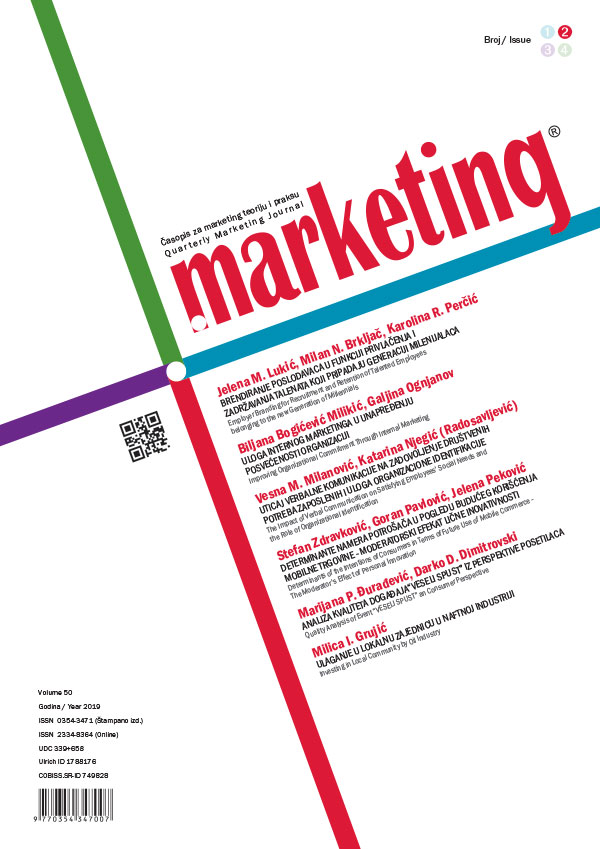
Uticaj verbalne komunikacije na zadovoljenje društvenih potreba zaposlenih i uloga organizacione identifikacije
The Impact of Verbal Communication on Satisfying Employees’ Social Needs and the Role of Organizational Identification
Apstrakt
Zaposleni čije potrebe su zadovoljene su više motivisani da, u interesu organizacije kao društvene grupe, ostvaruju bolje performanse pa je zbog toga važno poznavati način na koji se mogu podržati u zadovoljenju ovih potreba. U dosadašnjim studijama u oblasti organizacionog ponašanja, interne komunikacije i internog marketinga nije ispitivana veza između verbalne komunikacije i zadovoljenja društvenih potreba zaposlenih kao i uloga organizacione identifikacije u tome. U ovom radu se težilo odgovoriti na pitanje kako verbalna komunikacija utiče na zadovoljenje društvenih potreba zaposlenih. Pretpostavlja se da je uticaj verbalne komunikacije na nivo zadovoljenja društvenih potreba zaposlenih i organizacionu identifikaciju direktan i pozitivan, ali i indirektan kada ovom odnosu posreduje organizaciona identifikacija. Sledi da verbalna komunikacija ostvaruje uticaj na nivo zadovoljenja društvenih potreba zaposlenih preko organizacione identifikacije. Za testiranje pretpostavki je korišćena metoda strukturnog modelovanja; primenjena je tehnika najmanjih parcijalnih kvadrata. U svrhu prikupljanja podataka spovedena je anketa (onlajn upitnikom) u poslednjem kvartalu 2018. godine među zaposlenim u Beogradu (Republika Srbija). Rezultati do kojih se došlo u ovom istraživanju potvrdili su hipoteze. Verbalna komunikacija utiče neposredno na nivo zadovoljenja društvenih potreba zaposlenih, ali i posredno, putem povećanja organizacione identifikacije zaposlenih.
Abstract
Employees which social needs are satisfied are more motivated to achieve better performance. This is in the best interest of an organization, as a social group, so it is important to know how to support employees in meeting the needs. In the previous studies in the field of organizational behaviour, internal communication and internal marketing, the relationship between verbal communication and the level of satisfying social needs of employees, as well as the role of organizational identification in this relationship has not been examined. The aim of this paper is to answer the question of how verbal communication affects satisfying employees’social needs. It is assumed that there is a direct and positive effect of verbal communication on both the level of satisfying social needs of employees and the level of organizational identification. It is also assumed that there is an indirect effect of verbal communication on the level of satisfying social needs of employees which occurs through organizational identification. It follows that verbal communication affects satisfying employees’social needs through organizational identification. To test the assumptions structural equation modeling was used and the partial least squares technique was applied. In order to collect the data, the survey (online questionnaire) was conducted in the last quarter of 2018 among employees in the territory of Belgrade, in Republic of Serbia. The obtained results confirmed the hypotheses. Verbal communication directly and positively affects the level of satisfying social needs of employees, but it also affects it indirectly through the increase of the organizational identification.
Reference
- Argenti, P. (1998). Strategic employee communications. Human Resource Management, 37 (3-4); 199-206.
- Ashforth, E.B., & Mael, F.F. (1989). Social identity theory and the organization. Academy of Management Review, 14 (1); 20-39.
- Barrett, R. (2014). The Values-Driven Organization. USA, NY: Routledge.,
- Bartels, J., Pruyn, A., de Jong, M., & Joustra, I. (2007). Multiple organizational levels and the impact of perceived external prestige and communication climate. Journal of Organizational Behavior, 28 (2); 173-190.
- Bartels, J., Peters, O., de Jong, M., Pruyn, A., & van der Molen, M. (2010). Horizontal and vertical communication as determinants of professional and organisational identification. Personnel Review, 39 (2); 210-226.
- Bergami, M., & Bagozzi, R.P. (2000). Self‐categorization, affective commitment and group self‐esteem as distinct aspects of social identity in the organization. British Journal of Social Psychology, 39 (4); 555-577.
- Berry, L.L. (1981). The employee as customer. Journal of Retail Banking, 3 (1); 33-40.
- Bjerregaard, K., Haslam, S.A., Morton, T., & Ryan, M. K. (2015). Social and relational identification as determinants of care workers‘ motivation and well-being. Frontiers in Psychology, 6, 1460.
- Bjerregaard, K., Haslam, S.A., Mewse, A., & Morton, T. (2017). The shared experience of caring: A study of care-workers‘ motivations and identifications at work. Ageing and Society, 37(1); 113-138.
- Blaskova, M., Blasko, R., Borkowski, S., & Rosak-Szyrocka, J. (2016). Searching correlations between communication and motivation. Communications-Scientific letters of the University of Zilina, 18 (1A), 28-35.
- Braun, S., Bark, H.A., Kirchner, A., Stegmann, S., & Van Dick, R. (2019). Emails from the boss-Curse or blessing?, Relations between communication channels, leader evaluation, and employees‘ attitudes. International Journal of Business Communication, 56 (1); 50-81.
- Chan, S.H.J., & Lai, H.Y.I. (2017). Understanding the link between communication satisfaction, perceived justice and organizational citizenship behavior. Journal of Business Research, 70 (2017); 214-223.
- Cheney, G. (1983). The rhetoric of identification and the study of organizational communication. Quarterly Journal of Speech, 69 (2); 143-158.
- Cheney, G., & Tompkins, P. (1987). Coming to terms with organizational identification and commitment. Central States Speech Journal, 38 (1); 1-15.
- Cornelissen, J.P., Haslam, S.A., & Balmer, J.M. (2007). Social identity, organizational identity and corporate identity. Towards an integrated understanding of processes, patternings and products, British Journal of Management, 18 (1); 1-16.
- Cortina, J.M. (1993). What is Coefficient Alpha?, An Examination of Theory and Applications. Journal of Applied Psychology, 78 (1); 98-104.
- Dolphin, R.R. (2005). Internal communications: Today‘s strategic imperative. Journal of Marketing Communications, 11 (3); 171-190.
- Dutton, J.E., Dukerich, J.M., & Harquail, C.V. (1994). Organizational images and member identification. Administrative Science Quarterly, 39 (2); 239-263.
- Ellemers, N., de Gilder, D., & Haslam, S.A. (2004). Motivating individuals and groups at work: A social identity perspective on leadership and group performance. Academy of Management Review, 29 (3); 459-478.
- Falk, R.F., & Miller, N.B. (1992). A Primer for Soft Modeling. Akron, OH: University of Akron Press.
- Fornell, C., & Larcker, F.D. (1981). Structural Equation Models with Unobservable Variables and Measurement Error: Algebra and Statistics. Journal of Marketing Research, 18 (3); 382-388.
- Graham, G.H., Unruh, J., & Jennings, P. (1991). The impact of nonverbal communication in organizations: A survey of perceptions. The Journal of Business Communication, 28 (1); 45-62.
- Hair, F.J.J., Black, C.W., Babin, J.B., & Anderson, E.R.(2010). Multivariate data analysis. USA, NJ: Prentice-Hall, Inc. Upper Saddle River. 7th ed.
- Hair, J.F., Sarstedt, M., Ringle, C.M., & Mena, J.A. (2012). An assessment of the use of partial least squares structural equation modeling in marketing research. Journal of the Academy of Marketing Science, 40 (3); 414-433.
- Hair, J.F., Risher, J.J., Sarstedt, M., & Ringle, C.M. (2019). When to use and how to report the results of PLS-SEM. European Business Review, 31 (1); 2-24.
- Haslam, S.A., Powell, C., & Turner, J. (2000). Social identity, self‐categorization, and work motivation: Rethinking the contribution of the group to positive and sustainable organisational outcomes. Applied Psychology, 49 (3); 319-339.
- Haslam, S.A. (2001). Psychology in organizations: The social identity approach. London – Thousand Oaks, CA: Sage.
- Haslam, S.A., & Ellemers, N. (2005). Social identity in industrial and organizational psychology: Concepts, controversies and contributions. International Review of Industrial and Organizational Psichology, 20 (1); 39-118.
- Hogg, M.A., & Terry, I.D. (2000). Social identity and self-categorization processes in organizational contexts. The Academy of Management Review, 25 (1); 121-140.
- Hogg, M.A. (2016). Social Identity Theory. U S. Mckeown, R. Haji, & N. Ferguson (Ur.), Understanding Peace and Conflict Through Social Identity Theory. Switzerland, Cham: Springer. 3-10.
- Kanyurhi, E.B., & Mungu, A.B.D. (2016). Internal marketing, employee job satisfaction, and perceived organizational performance in microfinance institutions. International Journal of Bank Marketing, 34 (5); 773-796.
- Kassing, J.W. (2000). Exploring the relationship between workplace freedom of speech, organizational identification, and employee dissent. Communication Research Reports, 17 (4); 387-396.
- Kay, B., & Christophel, M.D. (1995). The relationships among manager communication openness, nonverbal immediacy, and subordinate motivation. Communication Research Reports, 12 (2); 200-205.
- Mael, F.F., & Ashforth, B.E. (1992). Alumni and their alma mater: A partial test of the reformulated model of organizational identification. Journal of Organizational Behavior, 13 (2); 103-123.
- Mael, F.F., & Ashforth, B.E. (1995). Loyal from day one: Biodata, organizational identification, and turnover among newcomers. Personnel Psychology, 48 (2); 309-333.
- Miao, Q., Eva, N., Newman, A., & Schwarz, G. (2019). Public service motivation and performance: The role of organizational identification. Public Money and Management, 39 (2); 77-85.
- Mishra, K., Boynton, L., & Mishra, A. (2014). Driving employee engagement: The expanded role of internal communications. International Journal of Business Communication, 51 (2); 183-202.
- Men, L.R. (2015). The internal communication role of the chief executive officer: Communication channels, style, and effectiveness. Public Relations Review, 41 (4); 461-471.
- Motoi, G. (2017). Could Employees‘ Motivation Be Increased By A Better Organizational Communication?, A Sociological Perspective. Social Sciences and Education Research Review, 4 (1); 174-190.
- Nakra, R. (2006). Relationship between Communication Satisfaction and Organizational Identification: An Empirical Study. Vision. The Journal of Business Perspective, 10 (2); 41-51.
- Neto, M.T.R., da Silva, L.C.F., & Ferreira, C.A.A. (2018). Influence of Internal Communication on the Organizations‘ Performance: Proposition of Model. Future Studies Research Journal: Trends and Strategies, 10 (2); 214-237.
- Nwagbara, G.U., & Uduma, E.N. (2016). Communication Climate and Employee Identification with Organizational Goals. International Journal of African and Asian Studies, 13-20; 18.
- Omilion-Hodges, L.M., & Baker, C.R. (2014). Everyday talk and convincing conversations: Utilizing strategic internal communication. Business Horizons, 57 (3); 435-445.
- Postmes, T. (2014). A social identity approach to communication in organizations. U A.S. Haslam,
- van Knippenberg, J.M. Platow, & N. Ellemers (Ur.), Social identity at work: Developing theory for organizational practice. USA, New York: Psychology Press. 81-88.
- Pratt, M.G. (1998). To Be or Not to Be?: Central Questions in Organizational Identification. U
- A. Whetten & P.C. Godfrey (Ur.), Identity in Organizations: Building Theory Through Conversations. Thousand Oaks, CA: Sage. 171-207.
- Rajhans, K. (2012). Effective organizational communication: A key to employee motivation and performance. Interscience Management Review, 2 (2); 81-85.
- Ramadanty, S., & Martinus, H. (2016). Organizational Communication: Communication and Motivation in the Workplace. Humaniora, 7 (1); 79-88.
- Rousseau, D.M. (1998). Why workers still identify with organizations. Journal of Organizational Behavior: The International Journal of Industrial, Occupational and Organizational Psychology and Behavior, 19 (3); 217-233.
- Rukmana, H.D., MM., S.M.P., & SE., E.N. (2018). The Impact of Organization Communication on Employee Performance Through Employee‘s Work Motivation at Pt. Putri Panda Unit Ii Tulungagung, East Jawa. Indonesia. KnE Social Sciences, 3 (3); 211-227.
- Sarstedt, M., Hair, J.F., Ringle, C.M., Thiele, K.O., & Gudergan, S.P. (2016). Estimation issues with PLS and CBSEM: Where the bias lies! Journal of Business Research, 69 (10); 3998-4010.
- Smidts, A., Pruyn, A.T.H., & Van Riel, C.B. (2001). The Impact of Employee Communication and Perceived External Prestige on Organizational Identification. The Academy of Management Journal, 44 (5); 1051-1062.
- Tajfel, H. (1974). Social Identity and Intergroup behaviour. Social Science Information, 1 (2); 65-93.
- Tajfel, H. (1978). Social categorization, social identity, and social comparison. U H. Tajfel (Ur.), Differentiation between social groups. New York: Academic Press. 61-76.
- Tajfel, H. (1982). Social psychology of intergroup relations. Annual Review of Psychology, 33 (1); 1-39.
- Tajfel, H., & Turner, J.C. (1979). An integrative theory of intergroup conflict. U W.G. Austin & S. Worchel (Ur.), The Social Psychology of Intergroup Relations. Monterey, CA: Brooks/Cole. 33-47.
- Tajfel, H., & Turner, J.C. (1985). The social identity theory of intergroup behavior. U S. Worchel & W.G. Austin (Ur.), Psychology of Intergroup Relations. Chicago: Nelson-Hall. 7-24.
- Turner, J.C. (1985). Social categorization and the self-concept: A social cognitive theory of group behavior. U E.J. Lawler (Ur.), Advances in Group Processes – Theory and Research. Greenwich, CT: JAI Press. 77-122.
- Turner, J.C., Hogg, M.A., Oakes, P.J., Reicher, S.D., & Wetherell, M.S. (1987). Rediscovering the social group: A self-categorization theory. Oxford: Blackwell.
- Van Dick, R. (2001). Identification in organizational contexts: Linking theory and research from social and organizational psychology. International Journal of Management Reviews, 3 (4); 265-283.
- Van Dick, R. (2004). My job is my castle: Identification in organizational contexts. U C.L. Cooper & I.T. Robertson (Ur.), International Review of Industrial and Organizational Psychology. Chichester: John Wiley and Sons. vol. 19, 171-203.
- Van Dick, R., & Wagner, U. (2002). Social identification among school teachers: Dimensions, foci, and correlates. European Journal of Work and Organizational Psychology, 11 (2); 129-149.
- Van Knippenberg, D. (2000). Work motivation and performance: A social identity perspective. Applied Psychology, 49 (3); 357-371.
- Van Knippenberg, D., & Van Schie, E.C. (2000). Foci and correlates of organizational identification. Journal of Occupational and Organizational Psychology, 73 (2); 137-147.
- Wegge, J., Van Dick, R., Fisher, G.K., Wecking, C., & Moltzen, K. (2006). Work motivation, organisational identification, and well-being in call centre work. Work and Stress, 20 (1); 60-83.
- Zeithaml, V., Berry, L.L., & Parasuraman, A. (1988). Communication and control processes in the delivery of service quality. Journal of Marketing, 52 (2); 35-48.