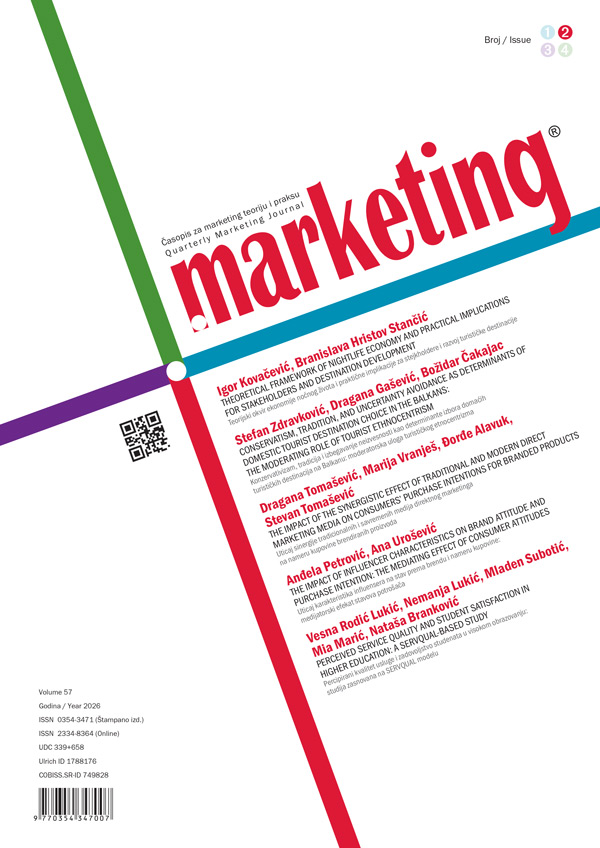
Uticaj sinergije tradicionalnih i savremenih medija direktnog marketinga na nameru kupovine brendiranih proizvoda
The impact of the synergistic effect of traditional and modern direct marketing media on consumers’ purchase intentions for branded products
Apstrakt
U savremenom marketinškom okruženju kompanije sve češće kombinuju tradicionalne i digitalne komunikacione kanale kako bi ostvarile veći uticaj na ponašanje potrošača. U tom kontekstu poseban značaj ima koncept medijske sinergije, koji podrazumeva da zajednička primena više medija može proizvesti snažniji efekat u odnosu na pojedinačnu upotrebu svakog od njih. Polazeći od ovog koncepta, predmet istraživanja u radu jeste ispitivanje sinergetskog efekta tradicionalnih i savremenih medija direktnog marketinga na namere kupovine brendiranih proizvoda. Cilj rada je da se utvrdi da li kombinacija tradicionalnih medija (televizija, radio i štampani mediji) i savremenih digitalnih kanala direktnog marketinga (veb-sajt, imejl marketing, mobilni marketing i društvene mreže) dovodi do statistički značajnog uticaja na nameru kupovine potrošača. Za potrebe analize primenjena je metoda višestruke regresione analize, pri čemu je sinergetski efekat ispitivan kroz interakciju između pojedinačnih medija. Rezultati istraživanja ukazuju na postojanje statistički značajnog sinergetskog efekta u više kombinacija tradicionalnih i savremenih medija. Dobijeni rezultati pokazuju da integracija tradicionalnih i digitalnih komunikacionih kanala može doprineti jačanju namere kupovine kod potrošača. Naučni doprinos rada ogleda se u empirijskoj verifikaciji sinergetskog efekta medija direktnog marketinga i u ukazivanju na značaj integrisanog pristupa u planiranju marketinških komunikacija. Praktični značaj rezultata ogleda se u pružanju smernica marketing menadžerima za efikasnije kombinovanje tradicionalnih i digitalnih kanala komunikacije u cilju postizanja boljih marketinških rezultata.
Abstract
In the contemporary marketing environment, companies increasingly combine traditional and digital communication channels in order to achieve a greater impact on consumer behavior. In this context, the concept of media synergy is of particular importance, implying that the combined use of multiple media can produce a stronger effect than the individual use of each medium. Based on this concept, this paper examines the synergistic effect of traditional and modern direct marketing media on consumers’ purchase intentions for branded products. The aim of this paper is to determine whether the combination of traditional media (television, radio and print media) and modern digital direct marketing channels (websites, email marketing, mobile marketing and social media) has a statistically significant impact on consumers’ purchase intentions. Multiple regression analysis was used to examine the synergistic effect through the interaction between individual media. The research results indicate the existence of a statistically significant synergistic effect in several combinations of traditional and modern media. The results show that the integration of traditional and digital communication channels can strengthen consumers’ purchase intentions. The scientific contribution of this paper lies in the empirical verification of the synergistic effect of direct marketing media and in highlighting the importance of an integrated approach to marketing communication planning. The practical significance of the results lies in providing guidelines for marketing managers on how to combine traditional and digital communication channels more effectively in order to achieve better marketing results.
Reference
- Ahmed, M. A., & Zahid, Z. (2014). Role of social media marketing to enhance CRM and brand equity in terms of purchase intention. Asian Journal of management research, 4(3), 533-549.
- Bigne, E., Andreu, L., Hernandez, B., & Ruiz, C. (2018). The impact of social media and offline influences on consumer behaviour. An analysis of the low-cost airline industry. Current Issues in Tourism, 21(9), 1014-1032. https://doi.org/10.1080/13683500.2015.1126236
- Butkouskaya, V., Oyner, O., & Kazakov, S. (2023). The impact of omnichannel integrated marketing communications (IMC) on product and retail service satisfaction. Journal of Economics, Finance and Administrative Science, 28(56), 319-334. https://doi.org/10.1108/JEFAS-09-2022-0237
- Chang, Y., & Thorson, E. (2004). Television and Web Advertising Synergies. Journal of Advertising, 33(2),75-84.
- Hanaysha, J. (2016). The importance of social media advertisements in enhancing brand equity: A study on fast food restaurant industry in Malaysia. International Journal of Innovation, Management and Technology, 7(2), 46-51. https://doi.org/10.18178/ijimt.2016.7.2.643
- Harizi, A., & Trebicka, B. (2023). The integration of social media in integrated marketing communication: A systematic review and theorical framework. Academic Journal of Interdisciplinary Studies, 12(6), 159-175. https://doi.org/10.36941/ajis-2023-0161
- Haque, A., Sarwar, A. A. M., & Yasmin, F. (2012). The Effect of Different Media Ads on Consumer’s Purchase Intension: A Pragmatic Exploration on the Bangladeshi Fast Food Industry. International Journal of Management & Business Affairs, 2(3), 1-14.
- Kumar, V., Choi, J. W. B., & Greene, M. (2017). Synergistic effects of social media and traditional marketing on brand sales: Capturing the time-varying effects. Journal of the Academy of Marketing Science, 45(2), 268-288. https://doi.org/10.1007/s11747-016-0484-7
- Jadhav, G. G., Gaikwad, S. V., & Bapat, D. (2023). A systematic literature review: digital marketing and its impact on SMEs. Journal of Indian Business Research, 15(1), 76–91. https://doi.org/10.1108/JIBR-05-2022-0129
- Mahmoud, A. B. (2015). E-mail advertising in Syria: Assessing beliefs, attitudes, and behaviors. Journal of Promotion Management, 21(6), 649-665. https://doi.org/10.1080/10496491.2015.1055044
- Majeed, M., Owusu-Ansah, M., & Ashmond, A. A. (2021). The influence of social media on purchase intention: The mediating role of brand equity. Cogent Business & Management, 8(1), 1944008. https://doi.org/10.1080/23311975.2021.1944008
- Martins, J., Costa, C., Oliveira, T., Gonçalves, R., & Branco, F. (2019). How smartphone advertising influences consumers‘ purchase intention. Journal of Business Research, 94, 378-387. https://doi.org/10.1016/j.jbusres.2017.12.047
- Momen, M. A., Sultana, S., & Haque, A. A. (2020). Web-based marketing communication to develop brand image and brand equity of higher educational institutions: A structural equation modelling approach. Global Knowledge, Memory and Communication, 69(3), 151-169. https://doi.org/10.1108/GKMC-10-2018-0088
- Naik, P.A., & Peters, K. (2009). A hierarchical marketing communications model of online and offline media synergies. Journal of Interactive Marketing, 23(4), 288-299. https://doi.org/10.1016/j.intmar.2009.07.005
- Naik, P.A., & Raman K. (2003). Understanding the Impact of Synergy in Multimedia Communications. Journal of Marketing Research, 40(4), 375-388. https://doi.org/10.1509/jmkr.40.4.375.19385
- Onana, K. I. (2021). Effect of digital marketing on consumer based brand equity of micro enterprises in Nigeria. Internatipnal Journal of Management and Social Sciences, 2(2), 1-37. https://doi.org/10.51739/122113816.v2i2.1459780014
- Perčić, K. (2018). Efektivnost štampanih medija direktnog marketinga u Republici Srbiji. Marketing, 49(3), 206-220. https://doi.org/10.5937/markt1803206P
- Rehman, S. U., Gulzar, R., & Aslam, W. (2022). Developing the integrated marketing communication (IMC) through social media (SM): The modern marketing communication approach. Sage Open, 12(2). https://doi.org/10.1177/21582440221099936
- Salelaw, G. T., & Singh, A. (2015). The effects of advertising spending and event sponsorship on brand equity in the Ethiopian brewery industry. British Journal of Marketing Studies, 3(9), 47-68.
- Schivinski, B., & Dabrowski, D. (2013). The impact of brand communication on brand equity dimensions and brand purchase intention through Facebook. GUT FME Working Paper Series A, 4(4), 1-24.
- Schivinski, B., & Dabrowski, D. (2016). The effect of social media communication on consumer perceptions of brands. Journal of Marketing Communications, 22(2), 189-214. https://doi.org/10.1080/13527266.2013.871323
- Shah, A. M., Zahoor, S. Z., & Qureshi, I. H. (2019). Social media and purchasing behavior: A study of the mediating effect of customer relationships. Journal of Global Marketing, 32(2), 93-115. https://doi.org/10.1080/08911762.2018.1497243
- Tarabieh, S. M. (2017). The synergistic impact of social media and traditional media on purchase decisions: The mediating role of brand loyalty. International Review of Management and Marketing, 7(5), 51-62.
- Tong, X., & Hawley, J. M. (2009). Creating brand equity in the Chinese clothing market: The effect of selected marketing activities on brand equity dimensions. Journal of Fashion Marketing and Management: An International Journal, 13(4), 566-581. https://doi.org/10.1108/13612020910991411
- Voorveld, H. A. (2011). Media multitasking and the effectiveness of combining online and radio advertising. Computers in Human Behavior, 27(6), 2200-2206. https://doi.org/10.1016/j.chb.2011.06.016
- Zhu, F., & Zhang, X. (2010). Impact of online consumer reviews on sales: The moderating role of product and consumer characteristics. Journal of Marketing, 74(2), 133-148. https://doi.org/10.1509/jm.74.2.133