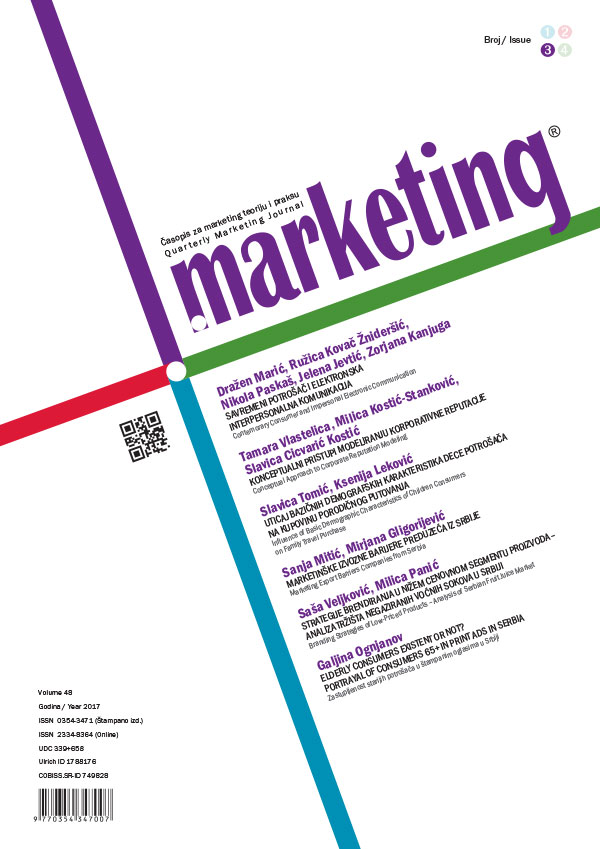
Savremeni potrošač i elektronska interpersonalna komunikacija
Contemorary Consumer and Impersonal Electronic Communication
Apstrakt
Primena savremenih koncepata i metoda marketinga nameće se kao imperativ pred preduzeća u smislu njihovog opstanka, rasta i razvoja. Aktuelni tržišni ambijent, karakteriše izraziti dinamizam promena koje se primarno mogu posmatrati kroz tehnlološki progres i izmenjeno potrošačko ponašanje. Potrošači su danas veoma skeptični prema svim oblicima marketing poruka preduzeća, pa se stoga sve više okreću ka drugim tzv. nekomercijalnim izvorima informacija, pre svih, prijateljima i porodici sa kojima imaju veoma intenzivnu interpersonalnu komunikaciju koja opredeljujuće utiče na njihove stavove prema preduzećima, brendovima, proizvodima i uslugama. Sa druge strane, razvoj novih tehnologija, pre svega, informatičke i komunikacione, olakšao je potrošačima međusobne kontakte i razmene potrošačkih iskustava o svim aspektima njihovog života, najviše o proizvodima i uslugama koje su kupili - koristili. Iz ovih razloga, preduzeća se suočavaju sa ozbiljnim problemima efektivnosti i efikasnosti svojih realizovanih marketing, pre svega promotivnih, aktivnosti. Centralna tačka na koju je usmeren marketing napor preduzeća, a to je donošenje odluke o kupovini koja određuje poslovni uspeh i opstanak na tržištu, sve manje biva pod kontrolom preduzeća, a sve više pod uticajem drugih potrošača i njihovih utisaka, komentara, preporuka, kroz interpersonalnu komunikaciju ‚od usta do usta‘. Cilj rada je da prikaže fenomen potrošačke elektronske interpersonalne komunikacije, uzroke i efekte iste na potrošako ponašanje na tržištu Republike Srbije, i na taj način ukaže na dalje pravce njenog istraživanja i na moguća praktična rešenja problema efikasnosti i efektivnosti marketing aktivnosti preduzeća.
Abstract
Application of contemporary marketing concepts and methods imposes itself on companies in terms of their survival, growth and development. The current market environment is characterized by pronounced dynamism of changes, which can be primarily observed through technological progress and altered consumer behaviour. Consumers are nowadays highly sceptic towards all forms of companies’ marketing messages, and therefore increasingly turn to other, so-called non-commercial information sources, above all friends and family, with whom they have highly intensive interpersonal commu-nication, which decisively impacts their attitudes towards companies, brands, products and services. On the other hand, the development of new technologies, primarily information and communication technologies, has facilitated consumers’ mutual contacts and exchange of consumer experiences about all aspects of their lives, most of all, products and services that they have purchased and used. For these reasons, companies are faced with serious problems of effectives and efficiency of their marketing activities, primarily promotional ones. The central point to which companies’ marketing efforts are directed, making purchase decision that determines business success and survival on the market, is decreasingly under the control of companies, and increasingly under the influence of other consumers and their impressions, comments, and recommendations through interpersonal word-of-mouth communication. The aim of this paper is to present the phenomenon of electronic interpersonal consumer communication, its causes and effects on consumer behaviour on the market of the Republic of Serbia, and thus point to further avenues of its research, as well as possible practical solutions of the problem of efficiency and effectiveness of companies’ marketing activities.
Reference
- Bejou D., Palmer A., (2005), The Future of Relationship Marketing, Best Business Book NY.
- Bodroža B., Jovanović S., Popov B., (2008), Latentna struktura ponašanja u virtuelnim društvenim zajednicama i njegove relacije sa socijalnom anksioznošću, Primenjena Psihologija, Vol.1( 1-2), 19-35.
- Brown J., Broderick A.J., Lee N., (2007),Word of Mouth Communications within on line Communities, Journal of Interactive Marketing, Vol. 21 (3), 2-20.
- Bulović V., Čavić B., Matović V., (2013), Primena društvenih mreža u direktnoj komunikaciji sa korisnicima bankarskih usluga, Infoteh-Jahorina, Vol. 12, 703-707
- Cakim M. I., (2010), Implementing Word of Mouth Marketing, John Wiley & Sons Inc.
- Cao J., Knotts T., Xu J., Chau M., (2009), Word of Mouth Marketing through Online Social Networks, Proceedings of the 15th Americas Conference on Information Systems, san Francisco, California, 1-6.
- Charlesworth A., (2009), Internet Marketing, Elsevier Butterworth-Heinemann.
- Cheung C.M.K., Thadani D.R., (2010), The Effectivenes of Electonic Word of Mouth Communication‘, 23rd Bled eConference: Implications for the Individual, Entrepreneurs, and Society, Slovenia, 329-345
- De Bruyin A., lilien L., (2008), A Multi Stage Model of Word of Mouth Influence Through Viral Marketing‘, International Journal of Research in Marketing , No 25, 151-163.
- Deighton, J., Kornfeld, L., (2009), Interactivitys Unanticipated Consequences for Marketers and Marketing, Journal of Interactive Marketing, Vol. 23 (1), 4-10.
- Dobele A., Lindgreen A., Beverland M., Vanhamme J., Wijk van R., (2007), Why Pass on Viral Messages‘, Business Horizont Vol. 50, 291-304.
- Evans D., McKee J., (2010), Social Medias Marketing-The Next Generation of Business Engagement, Wiley Publishing Inc.
- Gabriel Y., Lang T., (2006), The Unmanageable Consumer, SAGE Publication.
- Gauzente C., (2004), Web Merchants Privacy and Security Statements: How Reassuring are They for Consumers? A Two-Ssided Approach, Journal Of Electronic Commerce Research, Vol. 5 (3), 181-198.
- Gregurec I., Tomaš B., Ćorić A., (2011), Word of Mounth Marketing Within Social Networking Sites, Proceedings of the 22nd Centarl European Conference on Information and Intelligent Systems, Varaždin, Croatia, 227-233.
- Gronroos Ch., (2007), Service Management and Marketing, John Wiley & Sons Ltd.
- Hanna N., Wozniak R., (2009), Consumer Behavior-an Applied Approach‘, Kendall Hunt Publishing.
- Lesikar V. R., (2008), New Business Communication’, Irwin.
- Maričić B., (2011), Ponašanje potrošača, Centar za Izdavačku delatnost Ekonomskog Fakulteta u Beogradu.
- Marić D., (2014), Uticaj interpersonalne komunikacije između potrošača na odluku o kupovini, doktorska disertacija, Ekonomski fakultet u Subotici
- Meiners N. H., Schwarting U., Seeberger B., (2010), The Renaissance of Word of Mouth Marketing: A New Standard in IN 21st Century Marketing Management, International Journal of Economics Science and Applied Research, Vol. 3 (2), 79-97
- Murthy D., (2012), Towards A Sociological Understanding of Social Media: Theorizing Twitter, Sociology, Vol.46 (6), 1059-1073.
- Schiffman G. L., Kanuk L. L., (2004), Consumer Behavior, Pretince-Hall.
- Solomon R. M., (2011), Consumer Behavior, Pretince-Hall.
- Trusov M., Bucklin R.E., Pauwels K., (2009), Effects of Word of Mouth vs Traditional Marketing: Findings from an Internet Social Networking Site, Journal of Marketing, Vol.73, 90-102.
- Žnideršić Kovač R., Marić D., (2007), Društvene determinante ponašanja potrošača, Ekonomski fakultet u Subotici